
Most people never look at the lock on their front door. It turns, the door locks, job done. But the barrel sitting in the middle of your uPVC door is the single part a burglar is most likely to attack, and there’s a real difference between a good one and the cheap one that came fitted as standard fifteen years ago.
This isn’t scaremongering, and it isn’t a sales pitch for a new door. It’s a five-minute look at your own door that might tell you something useful.
The thing to know about lock snapping
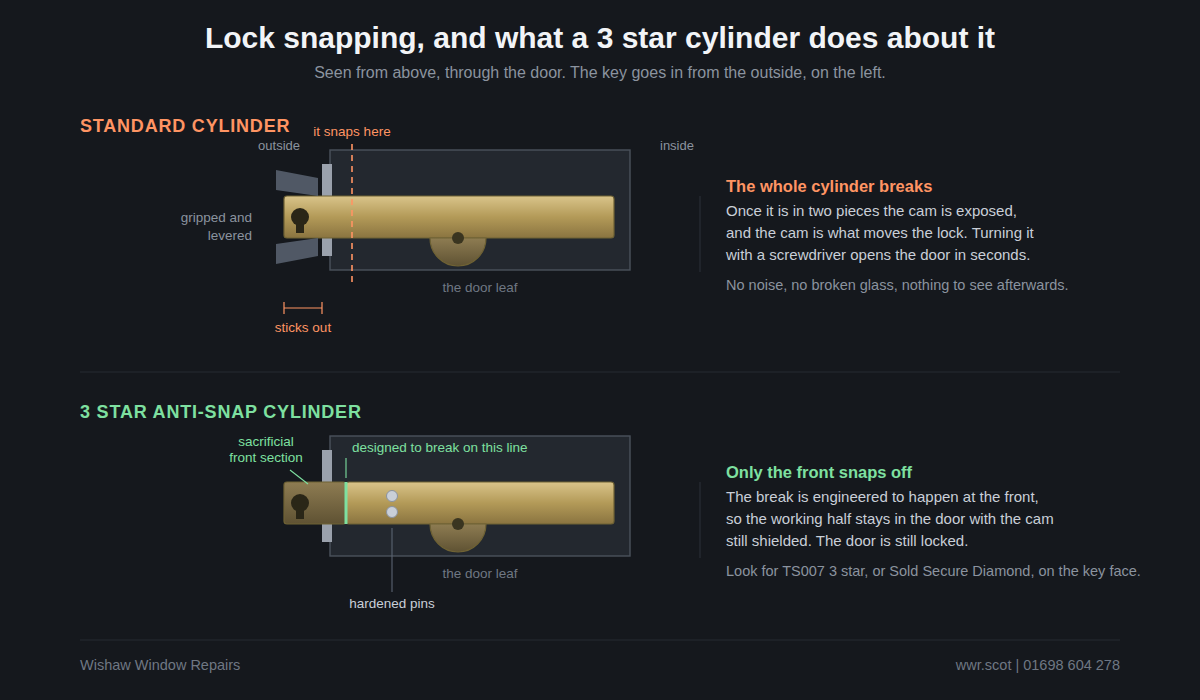
The cylinder, the barrel your key goes into, sticks out slightly through the handle plate on both sides of the door. On a lot of older uPVC doors, that barrel is a plain euro cylinder with no reinforcement in it at all.
Grip the protruding end with the right tool and it will break off at its weakest point, which lets the internal mechanism be turned directly. It is quick, it is quiet, and instructions for it are freely available, which is precisely why it became so common. There is nothing clever about it and nothing you can do to a plain cylinder to make it resistant.
The counter to it is a cylinder engineered to defeat exactly that attack. Anti-snap cylinders have deliberate sacrificial sections and hardened internals, so when force is applied the outer part breaks away and leaves the working part of the lock intact and still locked. The good ones also resist drilling, picking and bumping.
How to tell what you’ve got
You don’t need to take anything apart.
Look at your key first. If it has a small card or a code number that came with it, or the key head carries a recognisable brand name, that’s a promising sign, because branded cylinders tend to be the better ones. A plain unbranded key with no markings usually means a basic cylinder.
Then look at the barrel where it comes through the handle plate. If it protrudes noticeably, more than a couple of millimetres, that’s giving an attacker something to grip. A well-specified cylinder is sized so it sits almost flush.
Then look for a kitemark on the cylinder face or the door furniture, a British Standard mark or a diamond symbol. High-security cylinders are tested and marked. If yours carries nothing at all and the door is more than about ten years old, it’s very likely the standard barrel it left the factory with.
The other three things worth checking while you’re there
The handle plate. A flimsy handle backplate can be levered or snapped to expose the cylinder even if the cylinder itself is decent. Security handles are reinforced for that reason. If yours is thin, light and rattly, it isn’t helping.
The keeps. Open the door and look at the frame where the hooks and bolts engage. Those metal plates take all the force if someone tries to lever the door. If they look loose, worn, or as if the door has been catching on them, they need adjusting or replacing. A brilliant lock in a frame with loose keeps is a brilliant lock doing half a job.
How the door locks. Lift the handle and turn the key. If you have to lean on the door, lift hard, or fight it to get the key round, the door is out of alignment and the locking points are not engaging fully. That’s both a security issue and the reason handles and gearboxes wear out early. It’s also usually a small adjustment.
What you don’t need to do
You almost certainly don’t need a new door. Cylinders, handles, keeps and multipoint mechanisms are all replaceable parts on the door you already have, and upgrading the lot costs a small fraction of a replacement door. Anyone quoting you for a new front door because the lock is old is not answering the question you asked.
You also don’t need the most expensive product on the market. There’s a sensible middle ground: a properly rated anti-snap cylinder, a decent handle, and a door that’s aligned so everything engages the way it was designed to.
When to just get it changed regardless
A few situations where it’s worth doing without overthinking it. If you’ve just moved into a house and don’t know who else has a key. If you’ve lost a key, or lent one out and not got it back. If a key has started to feel gritty, stiff or reluctant, because that’s a lock wearing out and it will eventually strand you outside. If there’s been an attempted break-in, even an unsuccessful one, because the mechanism may be damaged in ways you can’t see. And if you’d simply rather not lie awake wondering.
Getting it looked at
Lock upgrades are one of the quickest jobs we do. A cylinder swap takes minutes, we can key alike so one key runs your front and back doors, and we’ll sort the alignment at the same time so the whole thing operates as it should.
If you’re not sure what you’ve got, take a photo of the door handle and the barrel from both sides and send it over on WhatsApp. We’ll tell you honestly whether it’s worth upgrading or whether what you have is already fine, and there’s no call-out charge for a look.
We’re a family firm and we’ve been doing this around Wishaw and Lanarkshire for over thirty years. Call us on 01698 604 278.
Cylinder upgrades are a small job and we do a lot of them, including right across Airdrie and Coatbridge.
Changing a cylinder is one of the quickest jobs we do, and it sits alongside everything else on our uPVC door repair service.
- A door that will not lock in the heat
- A snapped door handle
- A key that will not turn
- A draughty front door
- Patio and French door repairs
- Measuring a euro cylinder
- Why you have to lift the handle
- Adjusting a dropped door
- A key snapped in the lock
- A handle spinning freely
- French doors that will not close
- Composite door repairs
- Replacing a letterplate
- Being locked out
- The yearly maintenance check
See our door repair service page for what we do and where. Not sure? Ask us, there is no charge for looking.
There are around fifty more plain English guides in our advice section.
Written by the team at Wishaw Window Repairs. Over thirty years repairing uPVC windows and doors across Lanarkshire.