
A letterplate is a hole cut through your front door.
Put like that it sounds obvious, but it explains nearly everything about why they cause trouble. Somebody took a solid, insulated, weatherproof door and cut a rectangular slot clean through it, because the post has to get in somehow. Everything else about a modern door is designed to stop air moving through it. This one part is designed to let objects through. It is a deliberate weak point, and all that stands between that hole and your hallway is a set of small seals.
So when people ring about a cold hall, a letterbox rattling in the wind, or a flap that has stopped closing, this is what we are looking at.
What is inside the plate
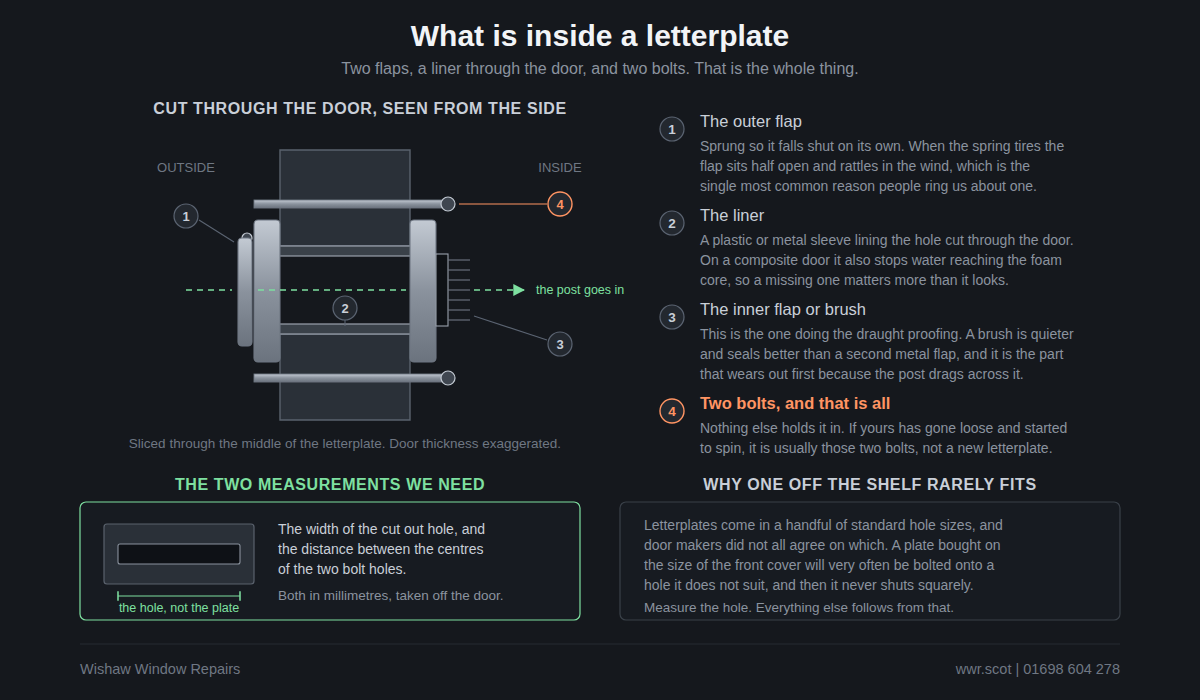
Pull the inside cover off a uPVC letterplate and there is more going on than you would think.
There is the frame itself, a rectangular sleeve that lines the cut out and clamps the two faces of the plate together through the door. There are two flaps, one on the outside face and one on the inside, usually sprung so they fall shut. And there are the seals.
The outer flap closes against a rubber or foam gasket running round the aperture. The inner side of the assembly usually carries a brush seal, a strip of dense nylon bristle, sometimes two strips facing each other so the post pushes between them. The brush does most of the real work, because a flap on its own never seals well. Flaps rattle, flaps get held ajar by a bit of grit, and a flap hinged along one edge can only ever be as tight as its hinge allows. The brush closes the gap continuously.
Those seals are what perish. Nylon brush goes limp, gets crushed flat by years of post, and eventually the bristles no longer meet in the middle. Rubber gaskets harden and take a permanent set in the shape of the flap that has been pressing on them.
On most uPVC letterplates they are separate parts, which matters. Brush strips slide into a channel in the plastic carrier and can be pulled out and a new length pushed back in. Some are held by two small screws instead. Gaskets are usually self adhesive.
So if the plate itself is sound, the flaps swing and shut, the fixings are tight, and your only problem is a draught, a set of new seals is very often the whole job. If you are reasonably practical there is no reason you cannot do it yourself in ten minutes. Take the inside cover off, look at how the existing brush is retained, measure the length, buy the same.
It stops being a ten minute job if the plate is cracked, if the fixing bolts have pulled through, or if the flap spring has gone and the flap hangs open. Then you are replacing the plate.
One related thing we see a lot: because the cut out passes through the door skin, a plate that has worked loose lets damp into the cut edges of the panel. If yours rattles when you close the door, or wobbles under your hand, tighten it rather than leaving it. Small fault, slowly becomes a bigger one.
Sizes, and why the cut out dimensions matter
This is the part that catches people out.
uPVC letterplates are made to fit a standard aperture. The common one in this country has a cut out of roughly 250mm by 40mm, and the great majority of doors we see round Wishaw and Lanarkshire use it. That is why a new plate usually drops straight onto an existing hole: the hole was cut to a standard, and the new plate was made to the same standard.
Two other dimensions matter. The fixing centres, which is the distance between the two bolts that pass through the door and clamp the plate together, and the door thickness, because the bolts and the sleeve have to be long enough to span it. A composite door and a hollow uPVC panel door are not the same thickness, and a plate meant for one may not clamp properly on the other.
So the practical rule is this. A like for like plate over an existing standard cut out is straightforward. Almost anyone can do it with a screwdriver.
A plate of a different size is another proposition entirely. If the new aperture is larger, somebody has to enlarge the hole in your door, and doing that neatly through a uPVC or composite skin without chipping the face or wandering off square takes the right tools and a steady hand. If the new aperture is smaller, you cannot make the hole smaller to suit. You are left with a plate that does not cover the old cut out, which looks poor and leaves a gap into the door structure that water finds eventually.
So if you are choosing a new letterplate for the look of it, measure your existing cut out before you buy anything, not the plate that is currently covering it.
The security side
A letterplate sits in the door, and on a lot of doors it sits fairly close to the lock. That geography matters.
The point we make to customers is a simple one and it is about habit rather than hardware: do not keep keys anywhere near the front door. Not on a hook in the hall, not on the shelf beside the door, not in the bowl on the radiator cover. Keep them somewhere out of reach and out of sight of the letterplate entirely.
If your plate is close to the lock, or you would rather not think about it at all, there are two straightforward additions. A letterbox cowl, sometimes sold as a letterbox guard, is a hood that fits on the inside face and directs post down into a closed chamber. A restrictor plate does a similar job by narrowing what can pass. Both are inexpensive and neither affects the postie’s ability to deliver.
While anyone is at the door for this, it is a sensible moment to ask about the cylinder too. An older euro cylinder with no anti-snap section is a weaker part of the door than the letterplate is.
If you want us to look at it
Photograph the inside face of the letterplate, then take a tape measure to the slot itself and note the length and height of the actual opening. Those two things tell us whether it is a straight swap or a cut out job. Send them on WhatsApp and we will tell you which it is before anybody commits to anything.
There is no call out charge, we work across Wishaw, Motherwell, Coatbridge and the wider area, and the phone is 01698 604 278 between 08:00 and 17:00 on weekdays.
A letterplate swap is one of the smaller jobs on our uPVC door repair list, and it is usually done in a single visit.
Related advice
See our replacement door panels page for what we do and where. There are before and after photographs of jobs like this in the gallery. Ring 01698 604 278 or contact us here.
You will find around fifty more guides like this one in our advice section.
Written by the team at Wishaw Window Repairs. Over thirty years repairing uPVC windows and doors across Lanarkshire.