
There’s a particular kind of cold that comes off a draughty front door. You feel it round your ankles in the hall, the doormat lifts a little in a gale, and the radiator in that hall never seems to make any difference.
Before you spend money on it, spend ten minutes finding out exactly where the air is coming in. Door draughts have several quite different causes, and the fix for one does nothing for another. Plenty of people buy a draught excluder for a problem that was actually a dropped hinge.
Finding it
Pick a windy day, which makes everything easier, and shut the door properly with the handle lifted and locked so it’s pulled fully in.
Now go round the edge slowly with the back of your hand. Skin on the back of your hand picks up moving air far better than your palm. Take the top edge, both sides, and the bottom, and take your time.
If your hand isn’t sensitive enough, a lit candle or a stick of incense held a couple of inches from the edge will show you the airflow clearly. Watch which way the flame leans and you’ve found your gap. On a still day, get someone to hold a hairdryer on cold along the outside of the door edge while you feel along the inside.
Note where it is, because that tells you what you’re dealing with.
Draught along the sides or the top
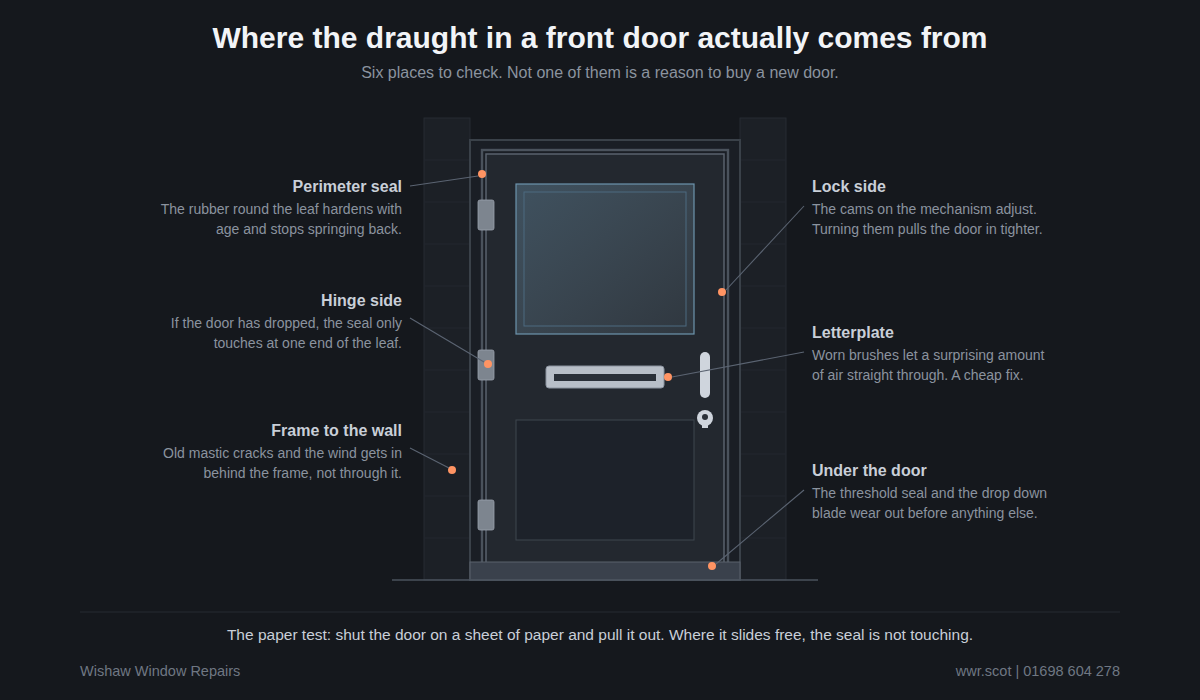
That’s the weather seal. Every uPVC door has a rubber gasket running round the frame, or round the door itself, that compresses when the door shuts and blocks the air.
Rubber doesn’t stay springy forever. It hardens, shrinks back from the corners, flattens where it’s been squashed for a decade, and eventually stops recovering when the door opens. Look closely at it. If it’s rigid rather than soft, cracked, gone shiny and flat, or has visibly pulled away leaving a gap at a corner, it’s done.
New seals are an inexpensive part and a quick job, and the difference in the hall is immediate. Often the hinges get adjusted at the same time so the door pulls up harder against the fresh rubber.
Draught along the bottom
This is the most common one and it has two possible causes.
The first is the threshold seal or the brush strip on the bottom of the door. Both wear out fast, because they’re the parts being dragged over and stood on. A brush strip goes thin and bent, a rubber threshold seal goes hard and flat. Both are replaceable.
The second is that the door has dropped. If a door sags on worn hinges, the gap at the bottom opens up on one side, and no amount of new brush strip will close a gap that’s twice the size it should be. You can usually see this: look along the bottom gap and see whether it’s even from one side to the other. If one end is noticeably wider, the door needs bringing back square before anything else.
Draught from the letterbox or the keyhole
Easy to overlook, and on a really windy day a letterplate with a tired flap can move a surprising amount of air. Sprung internal flaps and letterplate draught excluders fix that for very little money.
If air is coming through the keyhole itself, that’s normal on some cylinders and not usually worth chasing. A properly fitting escutcheon plate helps if it bothers you.
Draught you can feel but can’t locate
If cold air seems to be arriving from the general area of the door but not from any particular edge, look at the frame rather than the door. The seal between the door frame and the brickwork can shrink, crack and open up over the years, especially at the bottom corners. Rake out the old silicone, reseal it properly, and that’s often the culprit dealt with.
And if the door has a glazed panel, run your hand round the glass too. A perished seal around a panel lets air in just as effectively as one round the door.
The one to take seriously
Here’s the important bit that gets missed. On a door with a multipoint lock, a draught and a lock problem are often the same fault.
When you lift the handle, the hooks and bolts pull the door tightly into the frame and compress the seal all the way round. That’s what makes a locked uPVC door airtight. If the door has dropped, or the keeps have drifted, those bolts don’t engage properly, the door isn’t pulled in, and it’s draughty for the same reason it’s becoming stiff to lock.
So if your door is draughty and the handle has also got harder to lift, don’t buy a draught excluder. Get the alignment sorted, because you’ve got one problem showing two symptoms, and the second symptom is the one that eventually leaves you unable to lock your front door.
What it costs, roughly
All of this sits at the cheap end. Seals, brush strips, threshold seals, letterplate excluders and hinge adjustments are inexpensive parts and short visits. It’s genuinely one of the best-value things you can do to a house before winter, because a draughty front door is a hole in the middle of your heating.
What you almost certainly don’t need is a new door. If the door slab and the frame are sound, a draught is a seal or an alignment issue, and anyone telling you otherwise is quoting on the wrong thing.
Get it looked at
We sort draughty doors all over Wishaw and Lanarkshire, and it’s usually one short visit. There’s no call-out charge.
Tell us where you feel the draught, bottom, sides, top or everywhere, and whether the handle has got stiffer to lift lately. That second answer tells us a lot. Send a photo of the door and the seal on WhatsApp, or just call us on 01698 604 278 and we’ll talk it through.
If the draught is down to the door having dropped or the seals having perished rather than the panel itself, that is a door repair rather than a replacement.
Related advice
- How secure your door lock really is
- Composite door repairs
- Replacing a letterplate
- Getting ready for winter
See our replacement door panels page for what we do and where. If you would rather just ask, get in touch.
Stuck on something else? Our window and door advice section covers around fifty of the faults we see most.
Written by the team at Wishaw Window Repairs. Over thirty years repairing uPVC windows and doors across Lanarkshire.