
The busiest week of our year is usually the first properly cold one. The phone starts at eight and it’s the same call over and over. The back door won’t lock. The handle’s gone stiff and now it won’t move at all. There’s a draught off the living room window that wasn’t there in August.
None of those faults appear overnight. They were all there and mild in October, and nobody tested them, because in October everything still works well enough not to bother you.
Here’s a walk round that takes half an hour on a dry mild day. It moves problems from January, when they strand you, to now, when they’re a nuisance at worst.
Start with the paper test
Take a sheet of ordinary paper. Open the window or door, lay the paper across the frame so it hangs out, then close and lock it onto the paper. Now pull. Firm resistance means a good seal. If it slides out with nothing holding it, the gasket isn’t being compressed at that point, and that’s where your draught is.
Do it at several points on the same opener, each corner and the middle of each edge. What you usually find is a window gripping fine along the hinge side and holding nothing at the bottom corner furthest from it. That pattern tells you more than the draught does, because it’s the signature of a dropped sash, and it points straight at the fix.
Every opener in the house and both external doors. Ten minutes.
Look hard at the corners of the seals
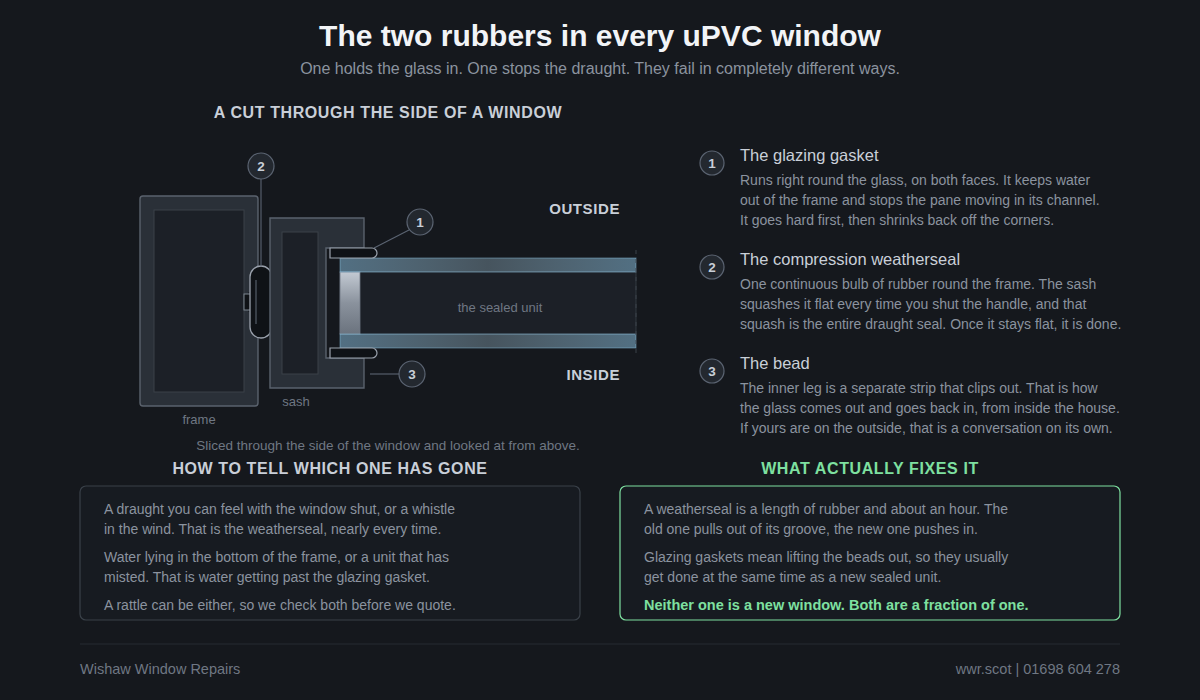
Run a finger round the rubber gasket. A healthy one is soft and springy and comes back when you press it. An old one goes hard and shiny, cracks along its length, and stays flattened where the sash has been sitting on it.
The corners are where it matters. Gaskets shrink over the years, and because they run as a continuous length round the opening, that shrinkage shows as a gap where the two ends meet or where the rubber has pulled off a corner. A small triangular hole, a few millimetres. It doesn’t look like much, and it’s a hole straight through to the outside. With the wind coming across Lanarkshire in January you’ll feel every bit of it.
Gasket comes on a roll and pushes into a groove. Cheap part, and replacing a run round a window is a small job.
Clear the drainage before the leaves come down
Along the bottom of the outer frame outside are small drainage slots, often with a little plastic hood over each, and rain that gets past the outer gasket leaves through those. Autumn is when they block. Leaves break down to a fine mush, moss grows, the slot fills. Water that should be draining sits in the frame instead, works along the bottom edge of the sealed unit, pools under the hinges, and eventually comes over the inside edge onto your sill. A fair share of the leaking window calls we get in winter are blocked drainage and nothing else.
Clear them with a cable tie, a thin plant stick or a squirt from a garden sprayer. Nothing metal, nothing you could snap off inside. Do it now, and again once the trees are bare.
Work every lock while it’s still mild
The one worth doing even if you skip the rest. On every window and door, lift the handle fully and throw the lock, then release it. Not quickly. Pay attention to what your hand is doing, because you’re feeling for effort.
A healthy multipoint mechanism lifts smoothly and the key turns easily. What you’re hunting is the one that needs a shoulder against the door, a hard shove at the top of the lift, or a lean on the sash before the handle moves. That resistance is the mechanism telling you the locking points are no longer meeting their keeps squarely, and every time you force it you wear the gearbox inside the door.
October rather than December matters because uPVC expands in heat and contracts in cold, so a door that’s marginal in mild weather goes out of tolerance on a frosty morning. The door that wants a firm shove now is the one that won’t lock at all in January, and it tends to pick seven in the morning with everyone trying to get out, or worse, when you’re on the wrong side of it.
If a handle is stiff, stop. Forcing is how an adjustment becomes a mechanism replacement.
Winding the hinges up for winter
Most modern uPVC windows and doors have adjustment built into the hinges and a lot of people never know it’s there. Window hinges often have a small adjustment at the sash end altering how tightly the sash pulls in against the frame. Door hinges carry grub screws for lateral position, height and compression, usually under a cap. Compression brings the door harder onto its gasket, and taking it up slightly for winter is a normal seasonal adjustment. It firms the seal and takes load off the locking points, so the handle lifts more easily rather than less.
There’s a limit. Over-compressing keeps constant strain on hinges and gasket and wears both faster, and on a door that has genuinely dropped it’s treating a symptom. If you can’t find the adjustment, or aren’t sure which problem you’ve got, it’s a short job for somebody who does it daily.
The front door, bottom and middle
Shut the door and look along the bottom from inside, with daylight outside and the room darker. Light along the bottom means a gap, and the foot of a door is where the coldest air comes in.
Composite and uPVC doors carry a seal on the underside of the leaf, a rubber blade or bubble meeting the threshold. That’s the one part of a door that gets dragged over, stood on and packed with grit, so it flattens, splits at the ends, or works loose and trails. They’re replaceable. Check the threshold while you’re down there, because trapped grit stops the door closing squarely and grinds the seal away.
Then the letterplate, a rectangular hole cut clean through your front door. Check the outer flap shuts fully and isn’t propped by a bent hinge or tired spring, then look at the inside. A decent one has brushes or an internal flap behind the aperture, and on older doors those are worn to stubs or snapped off years ago. An open letterplate on an exposed door moves a surprising amount of air, and brush sets are inexpensive.
A draught is not a reason for new windows
Worth being clear about, since October is also when the doorstep sales pick up. A draught round a window is nearly always one of two things: a perished or shrunken seal, or a sash sitting out of position so the seal isn’t compressed evenly. Both are repairs, and both involve parts that cost very little next to a window. The frame, the glass and the welds are usually sound. Windows don’t develop draughts because they’ve worn out. They develop draughts because a strip of rubber has hardened or a hinge has let something drop by two millimetres.
If somebody stands in your hall in November telling you a draughty window needs replacing, they should be able to point at what’s wrong with it. Ask which seal, or which hinge. After over thirty years of this we replace very few windows purely because they let air in.
So: paper test everything, feel round the seal corners, clear the drainage, work every lock and pay attention to the stiff one. Find the sticking lock in October and it’s a booked appointment. Find it in January and it’s an emergency, in the dark, in the rain.
If your walk round turns something up, send a photo on WhatsApp or ring us on 01698 604 278. We’re out around Wishaw, Motherwell and the wider Lanarkshire area Monday to Friday, there’s no call out charge, and autumn is far and away the easiest time of year to get us booked in.
If the draught is coming from the window itself rather than from round the outside of the frame, that is usually a seal or a hinge that has gone, and it is a straightforward uPVC window repair rather than anything bigger.
Related advice
Ring 01698 604 278 or contact us here.
More like this: browse all fifty guides in our window and door advice section.
Written by the team at Wishaw Window Repairs. Over thirty years repairing uPVC windows and doors across Lanarkshire.