
Most people think of it as one thing. The black rubber round the window. In fact there are two separate rubbers on a typical uPVC window, they do completely different jobs, and when one fails you get a completely different symptom from the other.
Worth knowing which is which before anybody quotes you for anything.
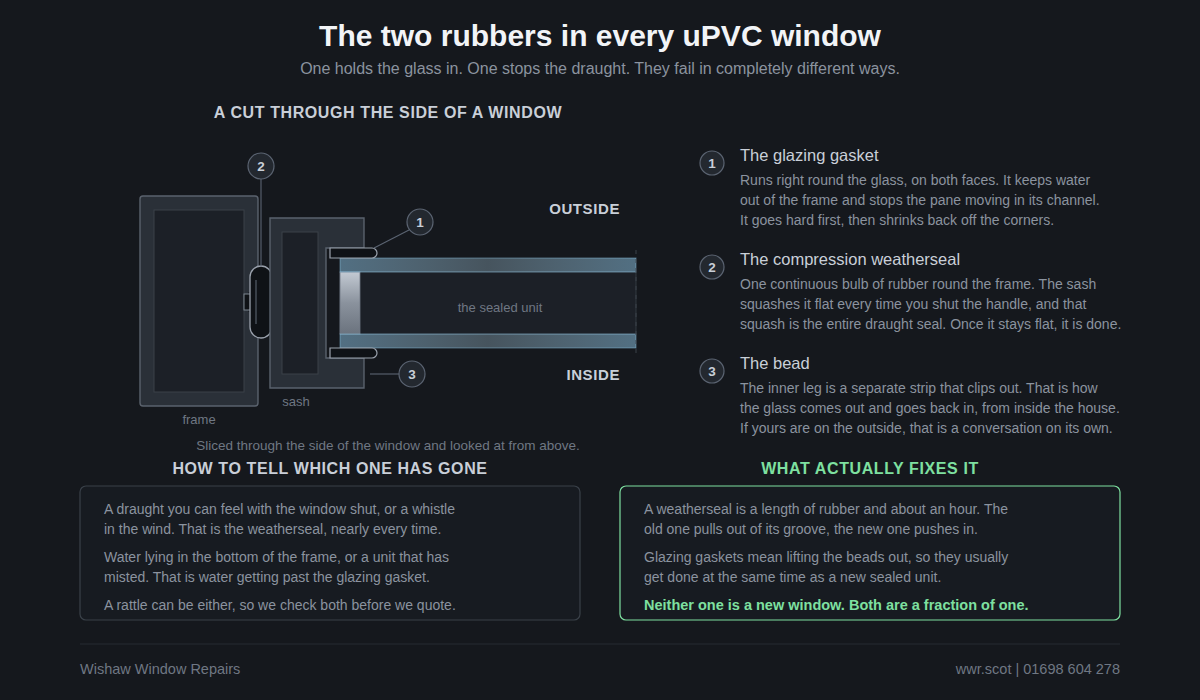
Two seals, two jobs
The glazing gasket is the one round the edge of the glass itself, inside and out. It sits in a groove in the sash or the bead and its lip presses against the pane. Its job is to hold the sealed unit firmly in place and to keep water from sitting against the edge of that unit. It is not really a draught seal. Think of it as a glass retention and water management part.
The compression seal is the one you only see when the window is open. It runs round the outer frame, or round the edge of the opening sash depending on the system, and it gets squashed flat when you close the window and turn the handle. That is your draught seal.
A fixed pane has no compression seal at all, because nothing moves. So if you’ve got a draught at a window that doesn’t open, the rubber isn’t your problem and somebody should be looking at the joint between frame and brickwork instead.
Telling them apart by symptom is easy. A felt draught, a whistle or a sash that chatters in the wind is the compression seal. Water on the inside sill, or a unit that has started to mist, points at the glazing gasket.
The five ways rubber gives up
It goes hard. Rubber is flexible because of the plasticisers mixed into it, and those slowly migrate out over years of sun and frost. The seal ends up shiny, flat and stiff, and once it has stopped springing back it has stopped sealing, even though it looks perfectly present.
It shrinks back. The sneaky one. Gasket is cut to length and fitted, then contracts along its own length and pulls away from the mitred corners, leaving a neat triangular gap at the bottom corners. Which is exactly where water collects. People see black rubber all the way round and never think to check the corners.
It gets painted. Someone decorates and glazes the rubber over with the frame. Paint stiffens a gasket and cracks it, and paint on a compression seal effectively glues the sash shut and tears the rubber the first time it’s forced.
It gets pulled out. Very common after a window clean. A cloth or a squeegee catches the lip and lifts it out of its groove, and once a length has been out it never goes back quite the same.
It cooks. Heat and ultraviolet do the damage, so a south facing elevation ages faster than the north side of the same house. Fitted the same day, we regularly find the front windows perished and the back ones still soft. Dark and foiled frames run hotter again.
Why a cheap bit of rubber is protecting an expensive pane of glass
This is the part that surprises people.
A sealed unit is two panes held apart by a spacer bar and bonded round the perimeter with a sealant. That bond keeps damp air out and keeps the drying agent inside the spacer working. It is very good at resisting water vapour. It is not good at all at standing in water.
Now picture a gasket that has hardened and shrunk back at the bottom corner. Rain gets past the gap and sits in the rebate where the edge of the unit is. If the drainage slots underneath are blocked too, and they usually are on a window nobody has looked at in a decade, the bottom inch of that unit sits in a puddle for weeks at a time.
That is what breaks a unit seal. The drying agent saturates, and the first cold morning after that you get condensation between the panes and it never clears again. Replacement units start from £75 and go up with size and glass type. A length of gasket costs a fraction of that.
Rubber is not one size fits all
There is no universal seal. Every window system has its own gasket profile, and the shape that matters is the cross section: the leg that pushes into the groove, the barb that stops it pulling back out, the height and angle of the lip that meets the glass. Get any of that wrong and it either won’t stay in or won’t touch the glass.
So the useful thing to have when you ring anybody is a short offcut of the old rubber, or a photograph of the cut end with a coin beside it for scale. From the end profile a repairer can usually match it. From a photograph taken six feet away, nobody can. Cut your sample from a length that’s already ruined rather than pulling a good one out.
Worth saying plainly, because people assume the worst: replacing a gasket does not mean taking your glass out and does not mean touching the frame. Most gaskets pull out of their groove and the new length pushes back in. The window comes apart no further than it has to.
Keeping them alive
One thing, once a year, ideally in spring.
Wipe the seals with warm soapy water, dry them, then go round with a silicone based rubber conditioner on a cloth. That puts back some of what the weather takes out and keeps the rubber supple for years longer than it would manage on its own.
What you must not use is a solvent. White spirit, meths, degreasers, brake cleaner, anything from the shed with a warning triangle on it. They strip the plasticiser straight out and you’ll feel the rubber go hard within a season. Wet oils are nearly as bad.
If you’re not sure what you’re looking at
Take a photo of the corner where the glass meets the frame, and another with the window open showing the seal round the edge, and send them over on WhatsApp. We’ll tell you which rubber it is and whether it genuinely needs doing. Quite often the answer is that it has a few years left and blocked drainage slots are the real culprit.
We’re a family firm working across Wishaw, Motherwell and the wider Lanarkshire area, and there’s no call out charge for a look. The number is 01698 604 278, Monday to Friday, 8 till 5.
Reseating or replacing gaskets is one of the most common window repairs we do, and it costs a fraction of what a new frame does.
Related advice
- The yearly maintenance check
- Draughty and stiff windows
- Windows rattling in the wind
- Getting ready for winter
See our window repair service page for what we do and where. Ring 01698 604 278 or contact us here.
Browse the rest of our window and door advice for around fifty guides on common window and door problems.
Written by the team at Wishaw Window Repairs. Over thirty years repairing uPVC windows and doors across Lanarkshire.