
It’s half two in the morning, the wind is up, and one window in the house is going like a snare drum. Not a constant noise, which you could sleep through, but a thump and a chatter every time a gust hits, then silence, then it starts again. You get up, you push the window, you check the handle. It’s shut. It’s locked. It still rattles.
We get a run of these calls every winter in Lanarkshire, usually the week after the first proper gale.
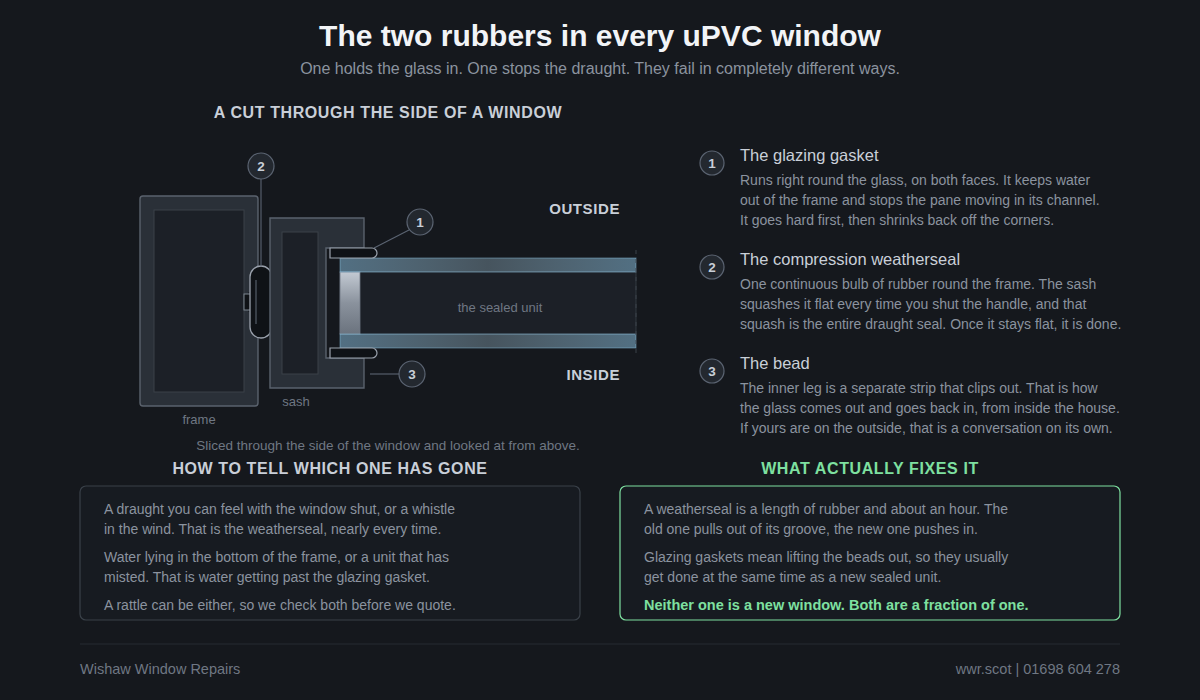
What the noise is telling you
A closed window is supposed to be clamped. Turn the handle and the locking mechanism pulls the sash hard against a rubber compression seal running round the frame, squashing that rubber to something like half its free height. Once it’s squashed there’s no space left for the sash to move in, so there’s nothing to rattle.
A rattle means the sash isn’t being pulled tight against that seal any more. Somewhere there’s a millimetre or two of free play, and wind pressure is enough to push the sash into that gap and let it spring back out, over and over.
So the question is never really why it’s rattling. It’s why the clamp went slack.
The three usual answers
The seal has given up. Compression seals harden and flatten with age. A new one stands proud and springs back after every close. An old one is shiny, stiff and has taken a permanent set, so it no longer fills the gap it was designed to fill. Nothing has broken. The rubber has got thinner and harder, and the sash sits a fraction loose.
The lock isn’t pulling the sash in. Most uPVC windows run an espagnolette, a long steel strip down the opening edge of the sash carrying mushroom shaped cams. Turn the handle, the strip slides, and those cams rotate into keeps fixed to the frame. Cam and keep are shaped so the last part of that movement drags the sash inwards, and that’s what compresses the seal. If the keeps have worn, or the sash has shifted so the cams engage at the wrong depth, the sash gets held but never gets pulled.
The hinges have let the sash drop. Friction hinges carry the whole weight of the sash on a couple of thin steel stays. As they wear the sash settles, usually on the handle side, and stops sitting square in its opening. You get too much compression at one corner and none at the diagonally opposite one. That opposite corner is where the noise comes from, and it’s why a rattle so often seems to come from one spot rather than the whole window.
Finding the loose corner with a piece of paper
Two minutes, and it tells a repairer more than any description over the phone.
- Open the window and lay a sheet of ordinary paper over the compression seal, half in and half out of the opening.
- Close the window and lock it properly, handle fully turned.
- Pull the paper out.
Where the seal is doing its job the paper grips and you have to tug, or it tears. Where it slides out with no resistance, the seal isn’t touching. Work round the window every foot or so and note where it comes out freely.
Tight everywhere except one corner means a dropped sash or a worn keep at that corner. Loose all the way round means the rubber itself has had it.
The adjustment nobody mentions
Here’s the bit that saves a lot of people a lot of money.
On a great many window systems those mushroom cams are adjustable. They sit slightly off centre on their stems, so rotating a cam, with a spanner or a screwdriver depending on the make, moves its high point and changes how far the sash is drawn in when the handle turns. It’s a designed-in adjustment, not a bodge, and it exists because seals compress over time and windows settle in their openings.
A repairer will do the paper test, work out which points are slack, turn those cams and try it again. Where the rubber is still sound and the hinges are fine, that alone can take a window from rattling to silent in a few minutes per sash. Keeps can be shimmed or repositioned in the same visit if the cams don’t quite get there.
It isn’t always the answer. If the rubber has gone hard there’s nothing left to compress, and winding the cams up just makes the handle stiff and wears the mechanism out. If the hinges are worn, tightening the cams pulls a crooked sash harder into a square hole and you end up needing a shoulder to close it.
It’s easy to file a rattle under annoying and live with it. The gap the wind is exploiting is the same gap warm air leaves through whether it’s blowing or not, so a window you can hear in a gale is quietly making that room colder than the rest of the house all winter. People often tell us one room never gets warm and never connect it with the window keeping them awake in February.
Two rattles that aren’t a loose sash
A buzz from inside the glass. If the window has Georgian bars fitted within the sealed unit, those bars are held between the two sheets of glass by small clips with a fraction of movement in them by design. In certain conditions they hum. It sounds alarming and it’s completely normal. Not a sign the unit has failed.
Glass moving in the beads. Not normal. If you press the pane gently with your palm and feel it shift, or you get a knock rather than a buzz, the packers holding the unit square in the sash have slipped or the glazing gasket has shrunk back and let go. Worth attending to promptly, because a unit that isn’t properly supported can crack from the edge. Don’t start prising beads off to investigate, particularly upstairs. Leave it and get someone to look.
Two things we get asked
Can I not just wedge something in it?
You can, and people do, and it works right up until you need to open the window. Packing a gap also loads the sash somewhere it wasn’t designed to be loaded. Reasonable at midnight in a storm, poor as a permanent arrangement.
Does the whole window need replacing?
Almost never. Seals, keeps, cams and hinges are all replaceable parts on the window you already own.
Getting it looked at
If you’ve done the paper test, tell us which corner let go. That, plus a photo of the edge of the open sash showing the metal strip and the cams, is usually enough for us to know what it needs before we set off.
Send it on WhatsApp or ring 01698 604 278, weekdays 8 till 5. We cover Wishaw, Motherwell, Coatbridge and the surrounding area, there’s no call out charge, and a rattle is the sort of thing we’d far rather sort in October than in January.
A rattle almost always traces back to a worn gasket or a loose keep, and both are quick uPVC window repairs rather than a reason to replace the window.
Related advice
See our window repair service page for what we do and where. Photographs on WhatsApp are the quickest route to an answer. Contact us here.
More like this: browse all fifty guides in our window and door advice section.
Written by the team at Wishaw Window Repairs. Over thirty years repairing uPVC windows and doors across Lanarkshire.