
uPVC got sold to everybody on the promise that it was maintenance free. That was always a bit of a stretch. The frames don’t need painting, which is what people meant, but every window and door has moving metal parts living outdoors, and moving metal parts appreciate a little attention.
Twenty minutes once a year, ideally in spring when the worst of the weather has passed, will add years to the life of the parts that actually cost money to replace. Here’s what to do, and just as importantly what not to do.
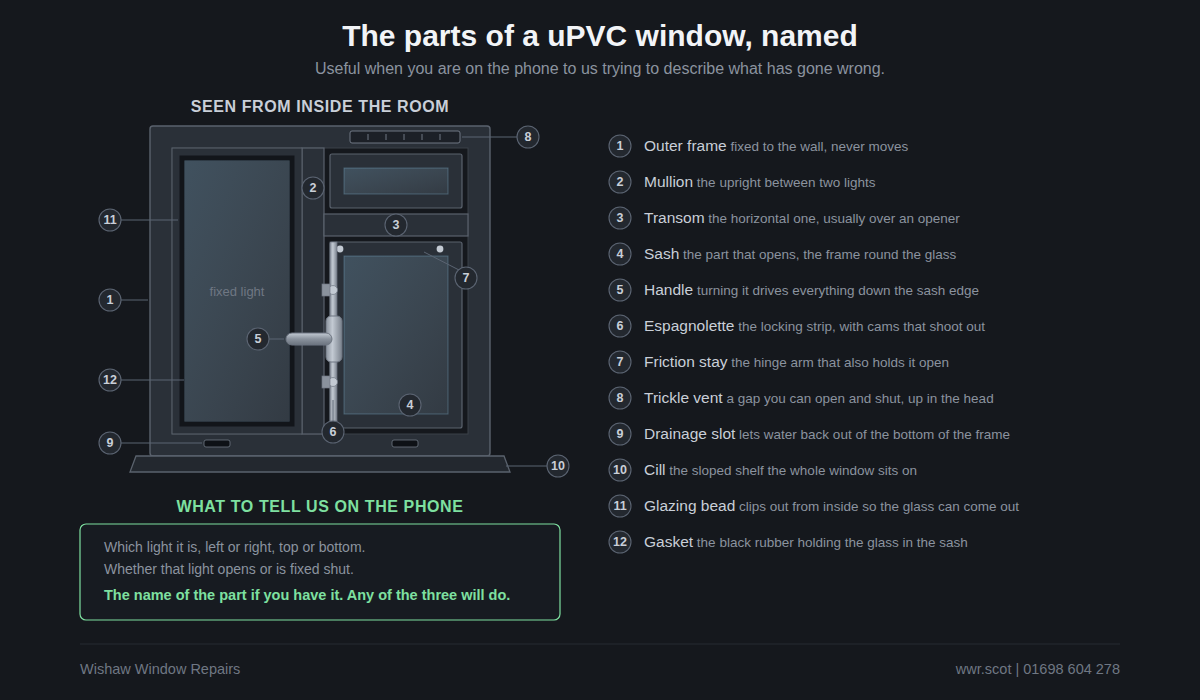
Wash the frames, and do it gently
Warm water and a bit of washing up liquid, a soft cloth, and that’s it. Rinse it off afterwards.
What to avoid: abrasive cream cleaners, scouring pads, wire wool, and solvents. uPVC has a smooth outer skin, and once you’ve scratched through it the surface underneath is porous, holds dirt and yellows faster. People trying to clean discolouration off often make it permanently worse in an afternoon.
Also avoid pressure washing the frames. It looks satisfying and it drives water past the seals and into the drainage channels, and on an older window it can lift a gasket clean out of its groove.
For stubborn marks there are proper uPVC cleaners made for the job. Use them on a small hidden bit first.
Clear the drainage slots
This is the one nobody knows about and it’s probably the most valuable thing on this page.
Look along the bottom of the outer frame, on the outside. You’ll find small slots, sometimes with little plastic flap covers over them. They’re there to let rainwater that gets past the outer seal drain away.
When they block with dirt, moss, dead insects and general muck, water sits inside the bottom of the frame instead of draining. That standing water rots the edges of sealed units, corrodes hinges from underneath, and eventually finds its way inside onto your sill. A huge number of “leaking window” call-outs are blocked drainage, nothing more.
Clear them with a thin stick, a cable tie, or a blast from a plant sprayer. Not a screwdriver, and not anything you might jam in there and break off.
Lubricate the moving parts, correctly
This is where people go wrong most often, so it’s worth being specific.
Hinges and mechanism: a light machine oil or a proper silicone lubricant on the moving pivots of hinges, and along the locking points and cams on the edge of the door or window. Open it, work the handle a few times to spread it, wipe the excess.
Locks and cylinders: a dry lubricant, PTFE or graphite based, squirted into the keyway. Not thick oil. Not WD40. Wet oil in a cylinder collects dust and gums the lock up, and we replace locks every year that were finished off by well meant oiling.
Friction hinges on windows: careful here. The friction is what holds the window open. Lubricate the pivots, but don’t drown the whole stay in oil or you’ll have a window that swings shut on its own and no obvious reason why.
Rubber seals: nothing oily. A silicone-based rubber conditioner, or just clean them with soapy water and leave them alone. Oil degrades rubber over time.
Check the seals
Run a finger round the gasket. It should still feel soft and springy. If it’s gone hard, cracked, shiny-flat, or has shrunk back leaving a gap at a corner, it’s stopped sealing and it’s worth replacing before winter. Cheap part, warm house.
While you’re there, look at the silicone where the frame meets the brickwork, particularly at the bottom corners. If it’s cracked or lifted, reseal it.
Give everything a working test
Open and close each window and door properly and pay attention to how it feels.
Does anything need lifting, leaning on, or a shove? That’s alignment, and it’s the single biggest cause of premature part failure. Does a handle feel stiffer than it did? That’s an early warning, and it’s much cheaper attended to now than after the mechanism dies. Does a window hold where you leave it, or drift shut? That’s the friction stays going. Does anything rattle when it’s shut and locked? Seals or keeps.
None of these are emergencies. All of them are cheaper caught in spring than discovered in December.
Look at the glass
Any misting between the panes, on any window, means a sealed unit has gone. Check them all while you’re at it, including the ones you never look at, because units fitted at the same time tend to fail around the same time and you may find two.
Also worth a look for chips and small cracks at the edges of panes, which can spread.
What not to do, in summary
Don’t force anything stiff. Forcing is how a five pound part becomes a hundred pound part.
Don’t pressure wash the frames, don’t use abrasives on the uPVC, and don’t put wet oil in a lock.
Don’t paint uPVC unless you know exactly what you’re doing and are using a proper system for it, because ordinary paint on uPVC peels and looks dreadful within a year or two.
Don’t ignore a door that has started needing a lift to lock. It’s the clearest warning any door gives you.
The short version
Wash the frames gently, clear the drainage slots, lubricate the metal properly with the right stuff, check the seals, and operate everything once while paying attention. Twenty minutes, once a year, and you’ll spend far less on repairs over the following decade.
If your annual check turns something up, or you’d rather have someone go round the house and tell you what’s what, we’re happy to do that. We’ve been repairing windows and doors around Wishaw and Lanarkshire for over thirty years, there’s no call-out charge, and we’d far rather adjust a door now than replace its mechanism next winter.
Send a photo on WhatsApp or call us on 01698 604 278.
If you would rather someone else did the check, we cover East Kilbride and the towns around it.
If you would rather someone else did all of this once a year, that is exactly what our window service is.
- Draughty and stiff windows
- A window that will not stay open
- A broken window handle
- Window hinge replacement
- Tilt and turn problems
- Window restrictors and child safety
- A lost window handle key
- Seals and gaskets
- Windows rattling in the wind
- Sash jammers
- How long uPVC windows last
- How secure your door lock really is
Photographs on WhatsApp are the quickest route to an answer. Contact us here.
There are around fifty more plain English guides in our advice section.
Written by the team at Wishaw Window Repairs. Over thirty years repairing uPVC windows and doors across Lanarkshire.