
Every summer, the same conversation. The weather turns, bedroom windows go open at night, and somebody looks at a wide open first floor window with a toddler in the room and thinks: that is not right.
They are correct, and the fix is one of the least expensive things we do.
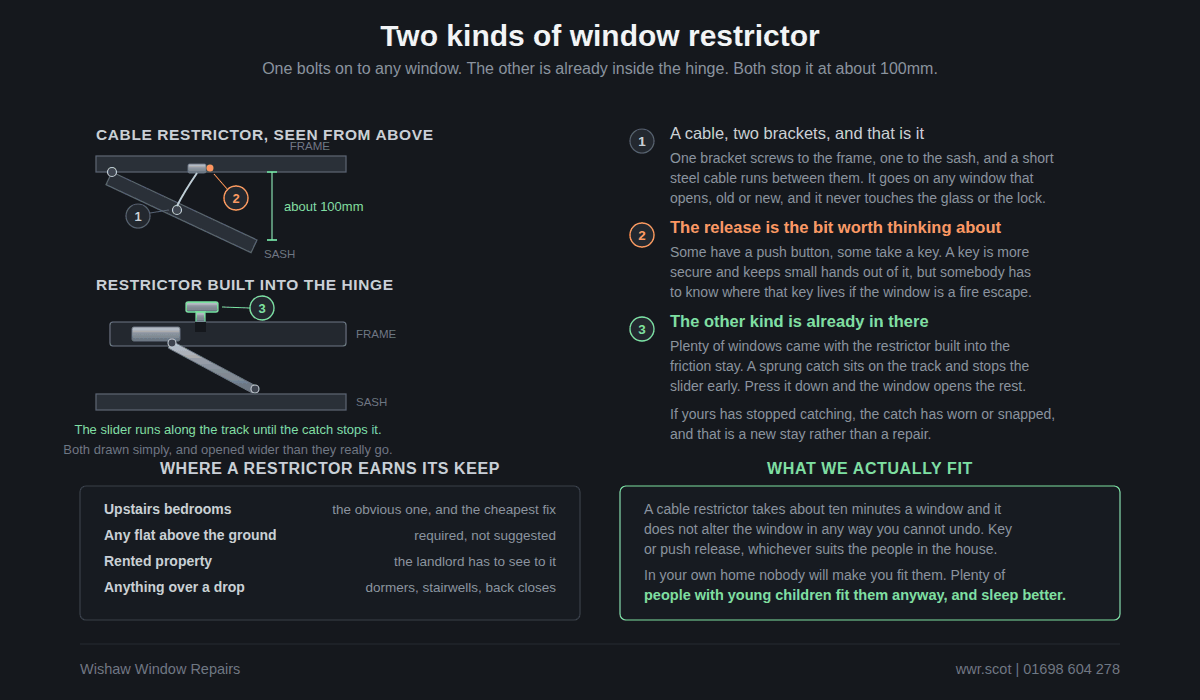
What a restrictor is
A window restrictor limits how far an opening sash can travel. That is the whole of it. The window still opens and still ventilates, it just stops at a set point instead of swinging wide. Two kinds are in common use on uPVC.
The cable restrictor is the one most people picture. A short stainless cable, usually sheathed, with a bracket screwed to the frame at one end and one screwed to the sash at the other. The window opens until the cable pulls taut and stops. They are cheap, visible, and they retrofit to almost anything. The better ones have a small key operated or push button release on the frame bracket so the cable can be unhooked when you need the window fully open.
The integrated hinge restrictor is built into the friction stay itself. The stay carries a small sprung catch that engages part way along its travel, stopping the sash there. Press or slide the release and the hinge continues its normal travel. These are neater, since nothing is visible with the window shut, and they are the usual choice on new installations. Being part of the hinge, they are best fitted when old stays are being replaced anyway.
The hundred millimetre figure
The number you will see quoted everywhere is 100mm. A restrictor limits the opening to around four inches, and the reasoning is straightforward: it is the gap generally taken as too small for a child to pass through. It is not a magic threshold and it varies with the shape of the opening, but it is the figure the industry works to.
It stops a body going through. It does not stop a determined child pulling a restrictor off a frame it was screwed into badly, which is why the fixings matter as much as the device, and it does nothing about a window somebody has already released and left wide.
Guidance for a house is not the same as the rules for a flat
We will describe this as it stands rather than tell you what your obligations are.
For an ordinary owner occupied house, restrictors on upstairs windows are guidance and good practice. Nobody is inspecting your bedroom. It is a sensible thing to do and it is your call.
For flats, rented property and buildings in public or communal use, the picture is different. There are requirements around the safety of openings above ground level, and in Scotland those sit under the Scottish Building Standards and the building warrant system rather than the English regulations you will find if you search this from a London based site. A landlord, factor or housing association works to a different standard than a homeowner, and social landlords tend to have their own policy on top.
If the property is rented or communal, or the work needs a warrant, the council building standards department or a competent installer will confirm what applies. We can tell you what a restrictor does and fit one properly. We are not the people to tell you what the law requires of you.
Escape windows, the other half of the problem
A restrictor stops a window opening. In a fire, an upstairs window is sometimes the way out.
Both are true at once, which is why any restrictor on a window that serves as an escape route has to be releasable by an adult without tools and without hunting for anything. That is why key operated and quick release types exist. You get the restriction day to day and a window that opens fully when it matters.
Two rules if you fit them. The release has to be something an adult can operate in the dark, in a hurry, under stress. And everyone who might need it has to know it is there and how it works. A restrictor nobody understands, on a window somebody needs to get out of, is worse than no restrictor at all.
The same holds for key locking handles: the key lives beside the window, not in a drawer downstairs.
The thing under the window matters more than the window
Something we say on nearly every one of these jobs. The restrictor is not the most important part of the answer.
Small children do not generally open windows and climb out of them. They climb onto something and go through an opening that was already there. A bed pushed under a window, a toy box, a chest of drawers, a sill deep enough to kneel on. Move the furniture and you have removed the mechanism of most of these accidents before the restrictor comes into it.
Do both. But do the furniture first, because it costs nothing and takes ten minutes.
Fitting them
Restrictors are cheap, they retrofit to most uPVC windows, and fitting one is a short job on an existing frame. Nothing is cut and the glass is not touched. On a cable type it is about getting the brackets onto solid fixings so the load is taken properly when the cable snaps taut.
Our view, for what it is worth: any window a small child can reach is worth fitting one to, whether or not anything requires it. Upstairs bedrooms obviously. Landings. Anything over a stairwell or a drop to a path.
A few we get asked
Do restrictors stop the window closing properly?
No. They only limit travel in the open direction. The window still shuts and locks exactly as it did.
Can they go on any window?
Most uPVC casement windows, yes. Tilt and turn windows are usually restricted differently, since the tilt position is already a limited opening. That is a look rather than a guess.
Are they a substitute for a locking handle?
They do different jobs. A locking handle stops the window being opened at all. A restrictor limits it once opened. Plenty of houses have both, and the same warning about keys applies to each.
If you want some fitted
Tell us which windows, or send a photo of one open on WhatsApp so we can see the hinge and the frame. We will tell you which type suits and what it comes to. It is usually a single short visit for several windows, and no call out charge for coming to look.
We are on 01698 604 278, Monday to Friday, and we cover Wishaw, Motherwell and the wider Lanarkshire area.
Restrictors can be added to most uPVC windows, and we usually fit them on the same visit as any other window repair work.
Related advice
Stuck on something else? Our window and door advice section covers around fifty of the faults we see most.
Written by the team at Wishaw Window Repairs. Over thirty years repairing uPVC windows and doors across Lanarkshire.