
Start with the good news. Losing the little key for a locking window handle is a minor problem with a cheap solution, and it does not involve a locksmith, a new window, or anything being cut out of your wall.
One point of scope first. This article explains what the lock is for and how the handle gets replaced. It does not explain how to get a locked handle open without its key, and we would not put that on a public website. If your window is locked shut and you need it open today, that is a phone call, not a web page.
What that lock is actually protecting
The small key that comes with a uPVC window handle is not a security key in the way a door key is. It is a very simple wafer lock, and across the industry there is a small pool of common key patterns in circulation. A handful of designs cover an enormous number of the handles fitted in this country, and it is entirely normal for a key from one house to open a handle in another.
That sounds like a scandal until you understand what the lock is there to do.
It is not there to resist someone attacking the window. Security on a uPVC window comes from the mechanism inside the sash, the locking points gripping into keeps around the frame, and from the glass itself. The key lock in the handle does one job: it stops the handle being turned. That matters in one scenario, where somebody has broken a pane, reached through the hole and gone for the handle. A locked handle means breaking the glass gains them nothing, because the window still will not open.
For that purpose a simple lock is enough. The low security is deliberate rather than a defect. It also means your handle is not a bespoke item that has to be matched to an existing key. It is a stock part.
The handle comes off, and nothing else does
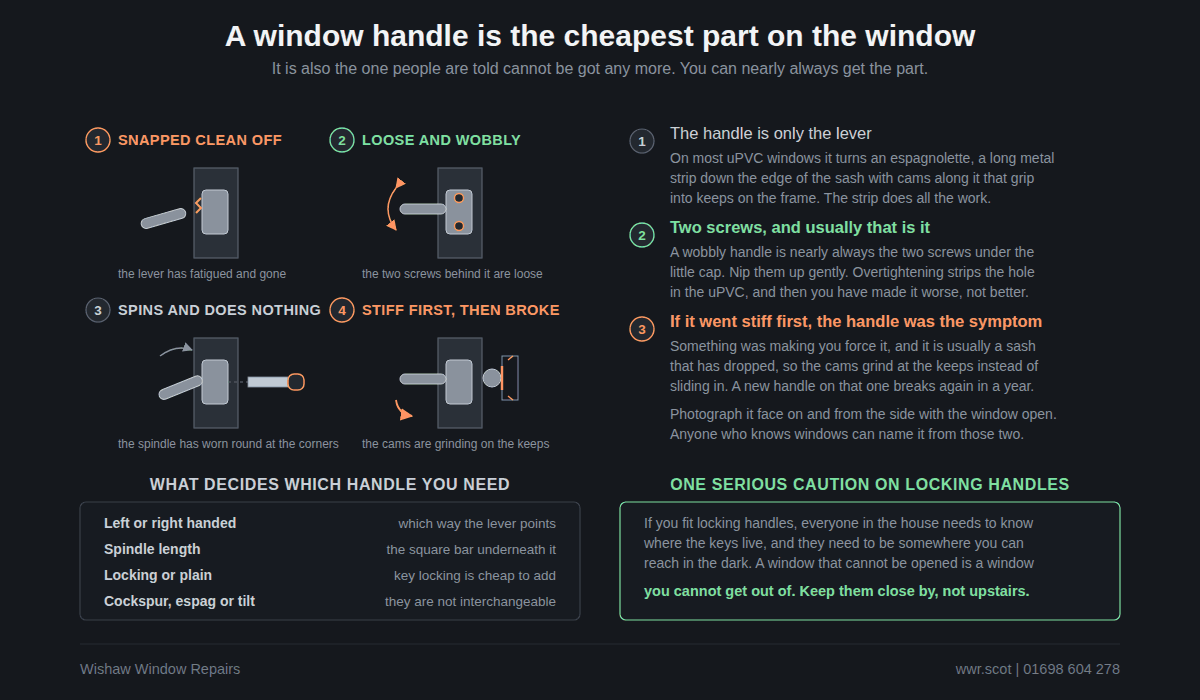
A window handle is held on by two screws through its face into the sash, usually hidden under a small plastic flap that swings or prises aside. Undo those two screws and the handle lifts off, bringing with it a square metal bar, the spindle, that was sitting down in the drive slot of the locking mechanism.
Put a new handle on, spindle into the same slot, two screws back in, and you are done. It is a five minute job on an accessible window and there is no reason a reasonably practical person should not do it themselves.
What is not touched: the frame, the sealed unit, the beads holding the glass in, the mechanism inside the sash, the hinges. None of it. Anyone telling you a lost handle key means a new window is either mistaken or hoping you are.
Matching the handle, which is where it goes wrong
The failures we get called to are almost always somebody who ordered a handle online, got it home, and found it does not fit. Three things have to match.
Spindle length. The square bar underneath the handle has to reach the drive slot in the mechanism and sit properly in it. Too short and it will not engage, or it engages by a few millimetres and rounds off within weeks. Too long and the handle will not sit flat against the sash. Lengths vary by manufacturer and by how deep the sash section is. This is the one people get wrong most often.
Screw centres. The distance between the two fixing screws. Get a handle with different centres and you are drilling fresh holes into a sash that already has two, which is untidy and weakens the fixing. Measure it, centre of one screw to centre of the other.
Cranked or inline. Look at the handle from the side. On an inline handle the lever runs straight out from the base plate on the same plane. On a cranked handle the lever is stepped, offset away from the base so it clears the frame or a deep sill as it swings. Fit an inline handle where a cranked one was and the lever fouls the frame before it completes its turn. They look near enough identical face on and completely different from the side, which is why every photo we ask for includes a side view.
Some patterns are handed as well, left or right, and a few older or continental systems need their own handle entirely.
One key gone usually means the set has gone
Think about where those keys have been for the last ten years. A drawer, a windowsill, the back of a cupboard, a bag that went to the tip. If one has vanished, the rest are rarely sitting in a tidy row somewhere.
So think past the single window. If you have a house full of locking handles and no confidence about the keys, replacing the lot at once with a keyed alike set is a sensible move. Every handle in the house then takes the same key, so you keep one on a hook by the back door and one somewhere sensible upstairs, and anybody can open any window with either.
That is not just convenience, it is the escape point. A locked window is a window nobody can get out of, and in a fire, hunting for the right small key among four different ones is a scenario worth designing out of your house. One key, known location, everyone told.
What to photograph before you order anything
Whether you are sorting it yourself or want a figure from us first, take these:
- The handle face on, window shut, so the shape and finish are clear.
- The handle from the side, so we can see whether it is cranked or inline.
- The window open with the handle turned, showing the edge of the sash and the mechanism running down it.
- The two fixing screws with a tape measure across them, centre to centre.
- Any key you still have, with the code stamped on it.
Send those over on WhatsApp and we can identify the handle and tell you what it takes.
Sorting it
We keep a wide range of window handles on the van, locking and non-locking, cranked and inline, in the usual spindle lengths, because it is one of the most frequent things we are asked for around Wishaw and Motherwell. If yours turns out to be a straight swap on one window, we will tell you that.
If the handle is locked shut and the window has to come open, ring us rather than taking a screwdriver to it. Forcing a locking handle usually damages the drive slot in the mechanism underneath, and then you have turned a handle job into a mechanism job.
01698 604 278, weekdays 8 till 5, and no call out charge to come and look.
If the key is gone for good, the lock or the handle gets changed, which is a standard uPVC window repair and not a reason to replace anything.
Related advice
You can also message us here.
If you would rather just ask, call 01698 604 278 and we will tell you straight. There are around fifty more guides in our advice section.
Written by the team at Wishaw Window Repairs. Over thirty years repairing uPVC windows and doors across Lanarkshire.