
A customer over in Coatbridge asked me last year whether the little metal things her neighbour had fitted to his windows were worth bothering with, or whether they were just something sold to worried people. Fair question, and it deserves a straight answer rather than a sales one.
Sash jammers are worth fitting in the right places. They’re also frequently fitted in the wrong places, screwed into the wrong part of the frame, and sold as a substitute for something they cannot replace.
What the thing actually is
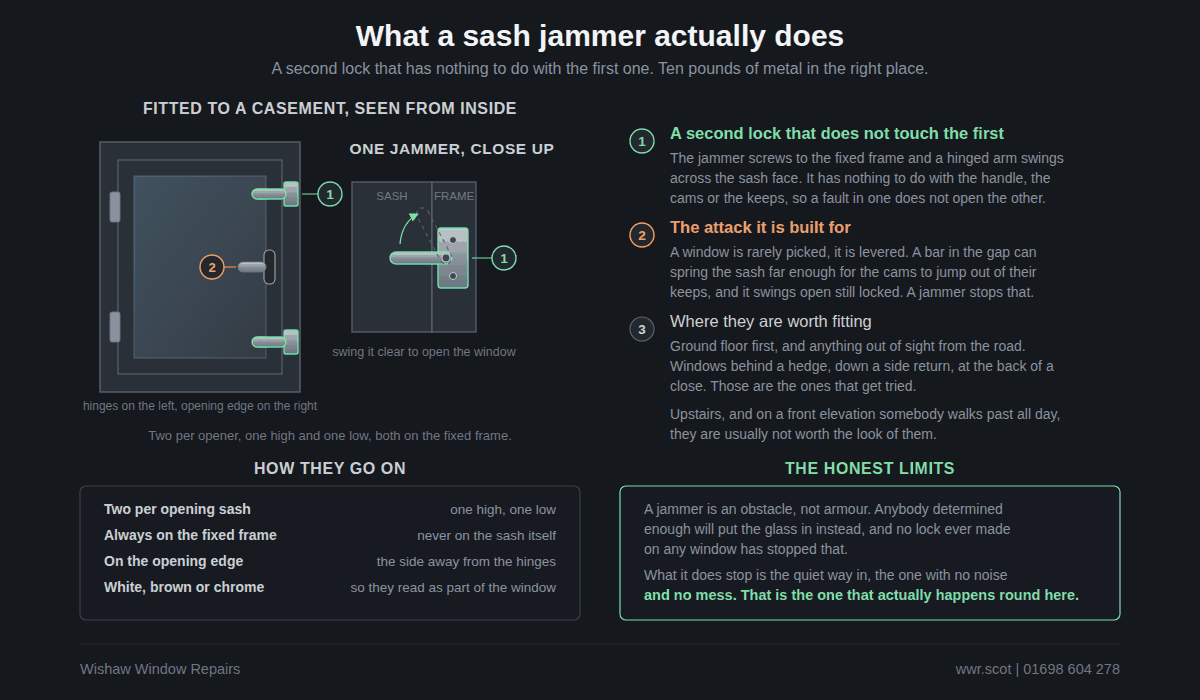
A sash jammer is a small block of metal, usually zinc alloy, screwed to the fixed frame of a window or door. Hinged to that block is a short arm. Swing the arm across and it lands over the face of the opening sash, so the sash physically cannot travel outwards past it. Swing it back and the window opens normally.
That’s the whole device. No key on the basic ones, though keyed versions exist, and no connection whatsoever to the window’s own locking mechanism. It’s a lump of metal in the way.
The important word is independent. Your multipoint window lock pulls cams into keeps along the edge of the sash. A jammer blocks the sash face in a different plane, at a point of its own choosing, with its own screws into its own bit of frame. Whatever defeats one doesn’t automatically defeat the other, and that’s the entire reason the things exist.
The attack they’re there for
Multipoint locks hold at specific points. Between and around those points a uPVC sash has a certain amount of flex in it, and older or lower specification hardware can allow the sash to be sprung away from the frame far enough for the cams to come out of their keeps. It’s a levering attack, it needs a tool and a bit of room to work, and it’s quiet.
I’m not going into how it’s done, for obvious reasons. The relevant point for a homeowner is that it works against the geometry of the lock rather than the strength of any one component, so a mechanism can be in perfect condition and still be vulnerable.
A jammer interrupts that. It adds resistance where the lock designer never put a locking point, it doesn’t disengage when the mechanism does, and the arm sits flat across the sash face so there’s little to get purchase on. It also stops the sash flexing far enough for the attack to develop in the first place.
Where they belong
Not everywhere. Fitting them to every window in the house is money spent on windows nobody was ever going to try.
Ground floor windows earn them, particularly round the back or the side, out of sight of the street and screened by a fence or a hedge. That’s where somebody has time and privacy to work.
So does any window reachable from a flat roof, a garage roof, an extension or a substantial wall. People fit good locks downstairs and forget that the bathroom window above the kitchen extension is effectively a ground floor window.
And French and patio doors, where they arguably do more good than on any window. A pair of French doors has a slave leaf held top and bottom by shoot bolts, and that leaf is usually the weak point of the set. A jammer or two on the slave, one on the master, resists the spreading and levering that door sets are prone to. On sliding patio doors they also stop the sliding leaf being lifted in its track.
Where they’re largely pointless is upstairs windows nobody can reach, and any opening a person couldn’t get through anyway.
The caveats, and they matter
They must be screwed into the reinforcement. This is the one that turns a security device into decoration. uPVC on its own is a soft plastic, and a screw driven into nothing but the outer wall of a frame will pull out under load without much drama. Frames are usually reinforced with a steel or aluminium section inside the main chamber, and the screws have to reach it. That means longer screws than the ones in the packet, in the right position, and knowing the reinforcement is actually there, because not every frame carries it along its whole length. A jammer that comes off in one movement is worse than no jammer, because you think you have something and you don’t.
They must not trap anybody. This is the serious one. Some windows are there to be climbed out of in a fire, and a window jammed shut from the inside by something a person in a panic can’t find or operate in the dark is a genuine hazard. Scotland’s building standards set out requirements for escape and rescue windows in habitable rooms, and the detail depends on the age of the property and how the room is used, so your local authority building standards department or a competent professional is the place to confirm what applies to your house. As a rule of thumb, don’t fit a jammer to a bedroom escape window, and if you fit one anywhere upstairs make sure everybody in the house knows it’s there and can release it without a key or a tool.
They’re visible. No getting round it. They’re a metal block on your window frame, and on a smart bay window in a front room plenty of people take one look and decide no. White ones on white frames are less obtrusive than chrome, but nobody has ever called a sash jammer handsome.
They’re only as good as what they’re fitted to. A jammer on a sash with worn hinges and flat seals is holding a loose window slightly less loosely. Sort the window first.
So are they worth it
Yes, with the sentence that follows attached. They cost very little, they take minutes to fit properly, and on a back window or a set of French doors they add a real obstacle that’s independent of the main lock.
But they are secondary security, and secondary is doing real work in that sentence. If the budget isn’t large, the first money goes on the primary locks: a properly rated three star anti-snap cylinder, a sound multipoint mechanism, keeps in good condition, and a door aligned so every locking point engages fully. We’ve written that up separately in our piece on whether your uPVC door lock is actually secure, and it’s the more important read of the two.
The answer we give when people ask is both. Get the primary locks right, then add jammers to the openings that are genuinely accessible.
If you want a hand with it
We fit jammers as part of a wider look at a house rather than on their own, because on their own they’re rarely the thing that needs doing most. Tell us which openings you’re worried about and we’ll say honestly whether a jammer is the right answer, or whether the money is better spent on the cylinder, the keeps or the alignment.
Photos of the window or door are enough to start with. WhatsApp them over or ring 01698 604 278, weekdays 8 till 5. We’re a family firm, we’ve been fixing windows and doors round Wishaw and Lanarkshire for over thirty years, and there’s no call out charge for a look.
Fitting jammers is a small job, and we usually do it alongside whatever else needs looking at during a window repair visit.
Related advice
Not sure? Ask us, there is no charge for looking.
There are around fifty more plain English guides in our advice section.
Written by the team at Wishaw Window Repairs. Over thirty years repairing uPVC windows and doors across Lanarkshire.