
A customer in Crookston rang us in the spring having been quoted for a new bedroom window. The frame was sound, the glass was sound, the handle worked. What had failed was a strip of metal about the length of your forearm, tucked along the top edge of the opening sash, out of sight unless you open the window and look.
That strip is the friction stay, and it is the single most common failure on a uPVC window. It is also one of the cheapest parts on it.
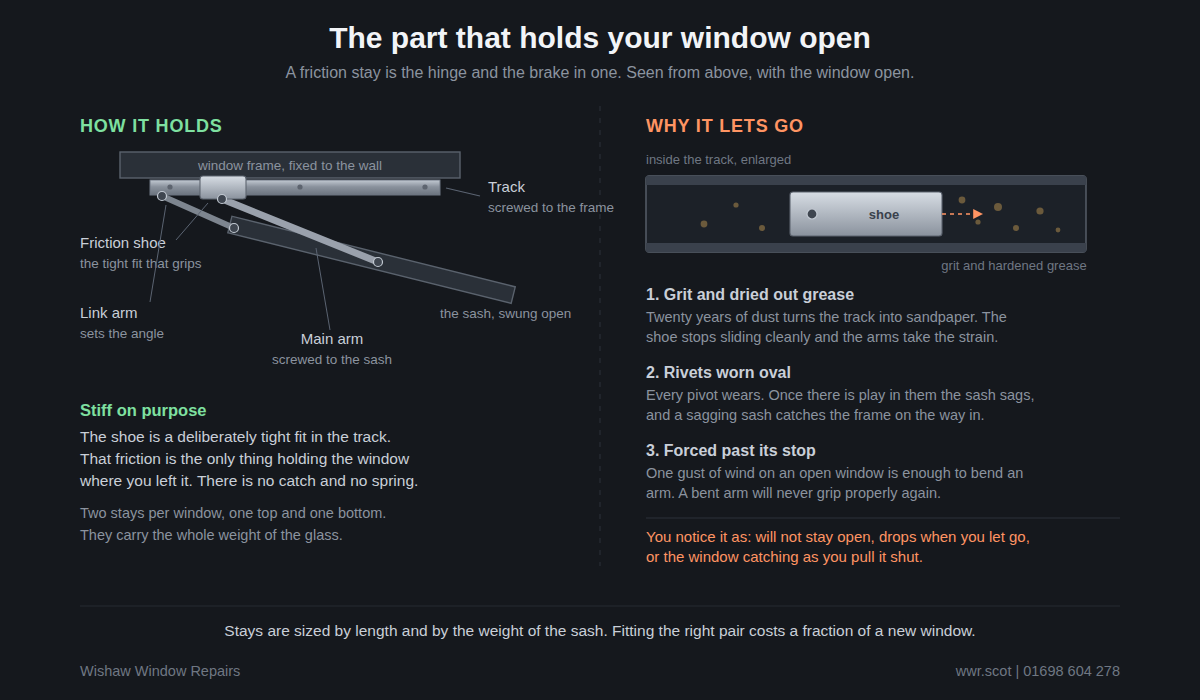
The part carrying the weight
A uPVC opener does not hang on butt hinges like an internal door. It sits on a pair of friction stays, scissor-action arms running along the top and bottom of the sash, or up each side on a side-hung window. Open the window and you can see them: a channel screwed to the frame, a slider running in that channel, and arms linking the slider to the sash.
Two jobs, one part. The stay carries the entire weight of the sash, glass included, and provides the friction that holds the window wherever you leave it. There is no separate catch doing that. The stiffness is built into the pivot points of the arm, and it is the only thing stopping a wide open window swinging about in a gust. When a stay fails you are not losing a convenience feature, you are losing the thing holding the window up.
How you know it has gone past adjusting
Plenty of hinge complaints are an adjustment job. The stay is sound, the geometry has drifted, and moving the fixings or the keeps brings the sash back square. If that is what yours needs, we will say so.
These are the signs the stay itself is finished:
- The sash has dropped at the far corner, away from the hinge, and the gap along the top is visibly wider than the gap along the bottom.
- It catches on the frame on the way past and needs lifting to clear.
- It will not stay where you put it, drifting shut on a still day.
- It has become hard to pull closed, or hard to push open, in a way that has got steadily worse.
- There is a visible bend or twist in the arm. Sight along it with the window open. A stay should be flat.
- There is rust. Orange staining, pitting, a chalky bloom on the slider, or a gritty feel as it moves.
Bent metal does not come back straight, and a corroded stay does not come back to life with a squirt of anything. Once you can see either, it is a replacement.
Why rust is the one that kills them in Scotland
Most stays are steel, and from the day they go in they live in the wettest part of a wall, in a climate that spends a good chunk of the year damp. They get rained on directly every time the window is open in weather.
What happens is not the dramatic rusting-through you might picture. The arms seize at the rivets first, the slider binds in its channel, and the homeowner pushes harder, which is entirely reasonable. The extra force bends the arm or tears the fixing screws out of the sash. By the time anyone rings us the hinge has usually taken a couple of years of being forced.
This is the argument for stainless steel stays. They cost a little more and they still want an occasional drop of oil at the pivots, but they hold up far better in this climate. The price difference is small against doing the job twice, so we fit stainless as a matter of course.
Sizes, and why they go in pairs
Stays are not one size. They come in lengths matched to the sash and in load ratings matched to the weight they carry. A big opener or a thick triple-glazed unit needs a stay rated for it, and fit a light one instead and you have bought the same fault again in a couple of years.
And they go in matching pairs, always. One new stay against one twenty year old one leaves the sash out of true and pushes the load onto the new arm. False economy of a few pounds.
The bit that is genuinely serious
On a ground floor window, a stay that lets go is annoying. On a first floor window it is not.
Think about someone leaning out to clean the outside of an upstairs window, or a child pushing against an open one. The whole weight of that sash, plus anything pressing on it, is held by two pieces of metal you already know are failing. If the arm goes or a fixing pulls out, the sash swings free with nothing holding it.
So if an upstairs stay is bent, badly corroded or pulling loose, stop using that window until it is sorted. Do not prop it open and do not lean on it. That is not us being dramatic, it is the one part of this job where leaving it costs more than fixing it.
What actually gets touched
The frame stays where it is and the glass stays where it is. The sash comes off, the old stays come off with it, the new ones go on in the same screw positions or close to them, and the sash goes back. Then the keeps and handle get checked, because a sash that has sat low for a year usually needs the locking points nudged back into line too.
Nothing is cut and nothing is made good afterwards. A window with new stays generally opens more sweetly than it has in a decade.
Getting a figure
Friction stays live on the van in a range of sizes, because worn hinges are behind more of our callouts than anything else. It is a low cost part against the price of a window, and the number of people told they need a new one because of a broken hinge is the reason this advice section exists at all.
Open the window, photograph the hinge arm, then take a second photo of the window shut from outside so we can see how the gaps run. WhatsApp those over and we can usually tell you what it needs before anyone turns up, and bring the right stays with us. No call out charge.
The number is 01698 604 278, Monday to Friday, 8 till 5.
Hinges are one of the parts we carry, so a hinge change is usually a single visit window repair.
Related advice
See our window repair service page for what we do and where. Not sure? Ask us, there is no charge for looking.
More like this: browse all fifty guides in our window and door advice section.
Written by the team at Wishaw Window Repairs. Over thirty years repairing uPVC windows and doors across Lanarkshire.