
Two complaints, one part to blame most of the time.
The first is the window that won’t hold itself open. You push it out on a warm day, let go, and it swings shut on you, or creeps closed inch by inch until it’s resting against the frame. The second is the window that’s visibly gone out of shape: the gap along the top is wider than the gap along the bottom, or a corner of the opener catches on the frame and you have to lift it to get it shut.
Both usually come back to the hinges. And both are repairs, not replacements.
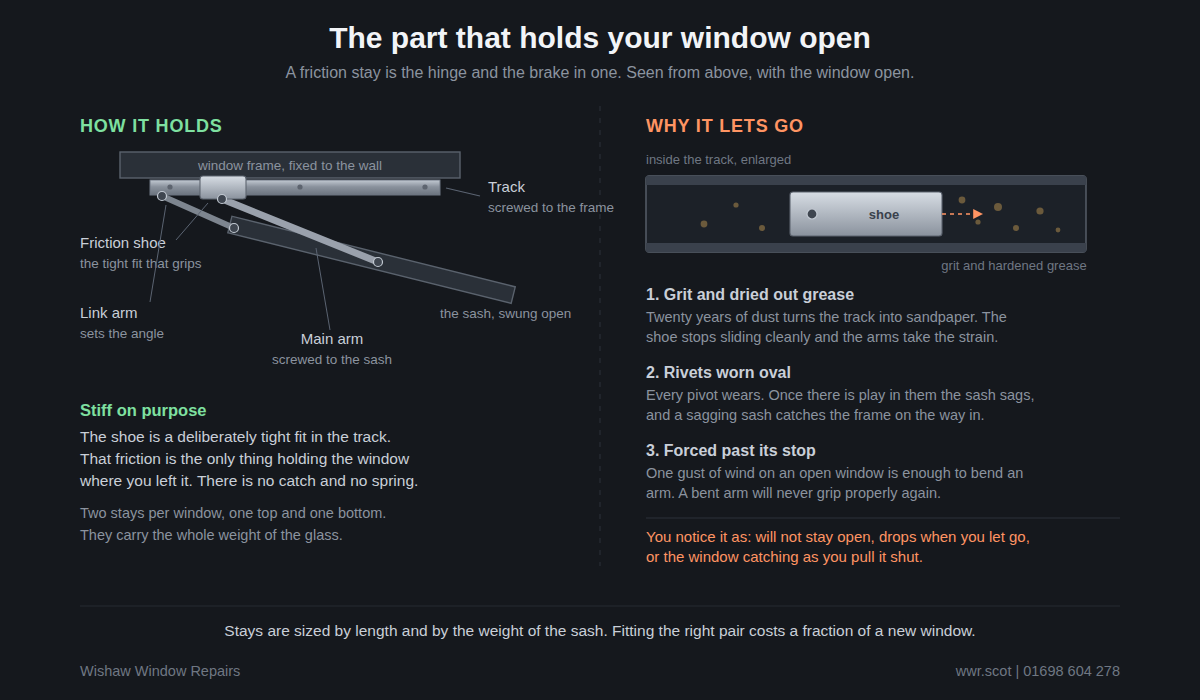
The part doing the work
A uPVC opening window doesn’t hang on ordinary hinges like a door. It sits on a pair of friction hinges, sometimes called friction stays. They’re the metal arms you can see running along the top and bottom of the opener when the window is open. They do two jobs at once: they carry the weight of the sash, and they grip just enough to hold it wherever you leave it, whether that’s an inch open or wide out.
That grip is the friction part of the name. It comes from a bit of deliberate stiffness built into the arm. Once that stiffness goes, or the arm wears loose in its track, the window stops holding its position and starts drifting shut on its own.
So why won’t it stay open?
Usually because the friction has worn out of the stay after years of opening and closing. Sometimes it’s because someone has oiled it. That sounds counterintuitive, and it catches people out: a squeaky hinge feels like it wants oil, but pour lubricant into a friction stay and you’ve just removed the very friction that was holding the window up. There’s a difference between lubricating the moving pivots and drowning the whole thing.
If the window is heavy, a large opener or a thick unit of glass, the stays have a harder life and tend to give up sooner. Same if the window is on an exposed elevation catching the wind, where it gets pulled and knocked about more than a sheltered one.
Either way, the answer is a new pair of stays, matched to the size and weight of that opener. It’s a quick swap on the existing frame. You get a window that holds where you put it and, as a bonus, usually feels smoother to open than it has in years.
And why has it dropped?
A dropped sash is the same family of fault a stage further on. When the stays wear, the sash stops being held square in the opening and starts to sag under its own weight. What you see is uneven gaps around the edge, a corner that fouls the frame, a window that needs a shove or a lift to close, or a draught that’s appeared along the top edge where the seal no longer meets.
If it’s caught early, sometimes it’s just a matter of adjustment: the hinge positions and the keeps are tweaked to bring the sash back square. If the stays themselves have worn or bent, they’re replaced. Neither job involves touching the glass or the frame.
What not to do while you’re waiting
Don’t prop it open with something heavy. A window resting on a worn stay with a book or a brick holding it out is putting strain in exactly the wrong direction, and a stay that’s already tired can let go with the window swinging in the wind. Every year we see openers that have been damaged, or hinges torn out entirely, because a gust caught a propped window.
And don’t force a dropped sash shut by shouldering it. That’s how you end up cracking a corner weld or snapping a handle, and then a small job becomes a couple of jobs.
One thing that’s often not the hinges
Occasionally a window that won’t stay open is actually a window with a broken restrictor or a jammed child-safety stay, which limits how far it can travel and can make the whole thing feel wrong. And occasionally what looks like a dropped sash is actually a bit of grit or old sealant in the way, stopping the window seating properly. Both are worth a look before assuming the worst, and both are easy fixes.
Getting it sorted
Friction stays are one of the most common parts we carry, because worn hinges are behind a huge proportion of the window problems we get called out to around Wishaw and Lanarkshire. It’s an inexpensive part and a short visit.
If you can, open the window and take a photo of the hinge arm along the top or bottom edge, and one of the window shut from the outside so we can see the gaps. Send those over on WhatsApp and we can usually tell you what’s needed before we arrive, and bring the right stays with us. There’s no call-out charge either way.
Call us on 01698 604 278 and we’ll get it hanging square and holding where you leave it.
Friction stays wear out on nearly every window eventually, and swapping them is routine window repair work.
Related advice
See our window repair service page for what we do and where. If you would rather just ask, get in touch.
There are around fifty more plain English guides in our advice section.
Written by the team at Wishaw Window Repairs. Over thirty years repairing uPVC windows and doors across Lanarkshire.