
The number you’ll see quoted everywhere is twenty to twenty five years, and it isn’t wrong exactly. But it’s a very blunt answer to a question that deserves a better one, because a window isn’t a single thing with a single lifespan. It’s a frame with a set of components bolted into it, and they wear out at completely different rates.
Understanding that is what saves people money. If you treat the whole window as one item with an expiry date, you end up replacing perfectly good frames. If you treat it as a frame with serviceable parts, you get twice the life out of it for a fraction of the cost.
So here’s the honest breakdown, part by part.
The frame: thirty years and often more
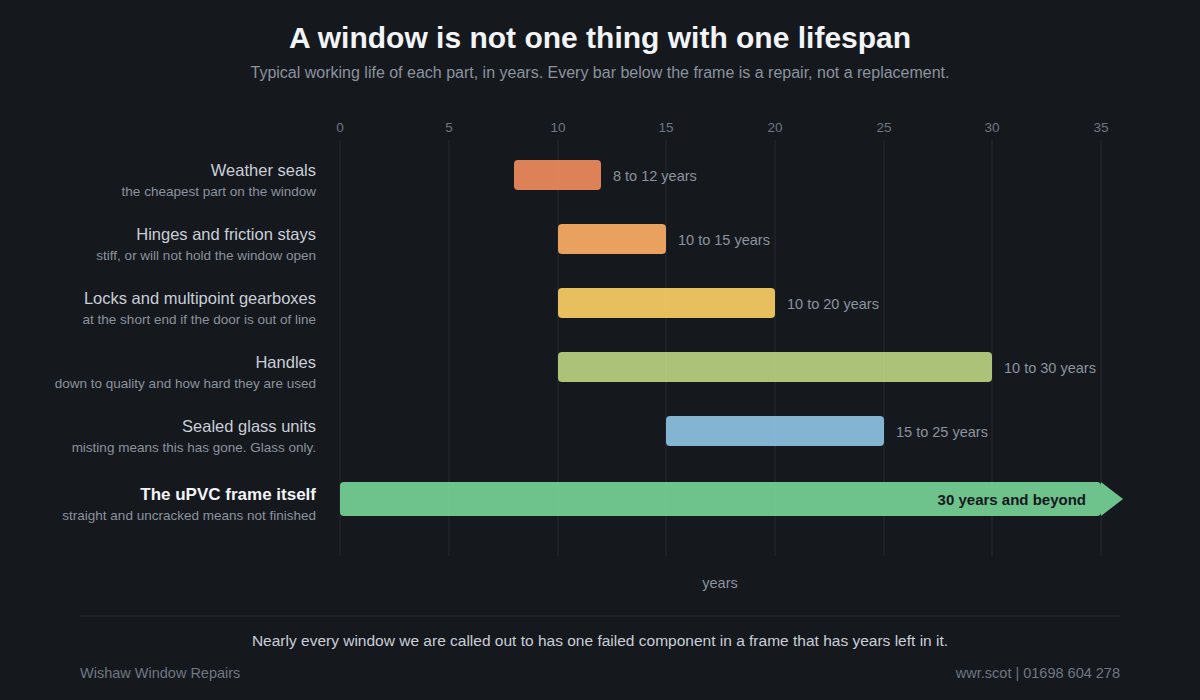
The uPVC frame itself is the long-lived bit. It doesn’t rot, it doesn’t rust, and modern profiles are UV stabilised so they hold up in sunlight. A well made frame, properly fitted, will commonly do thirty years and beyond without any structural problem at all.
What eventually finishes a frame is not usually age but damage. The uPVC going brittle and cracking, particularly on cheaper older profiles or on frames that have taken decades of harsh sun. Corner welds opening up. Physical damage. Discolouration, which is cosmetic rather than structural, though it’s often what makes people decide the window has had it.
The important point: if the frame is straight, solid and uncracked, it isn’t finished, whatever its age. A twenty year old frame in good condition is not a window awaiting replacement.
The sealed glass units: fifteen to twenty five years
This is the part that fails most visibly, and the one that gets whole windows condemned unnecessarily. The double glazed unit is a manufactured item with a seal round the edge, and that seal has a working life. Fifteen to twenty five years is typical, more if it’s a good unit in a sheltered position, less if it’s a big south-facing pane cooking in the sun and freezing overnight.
When it goes, you get misting between the panes. And when it goes, only the glass unit is replaced. The frame stays. That’s the single most useful thing to know about the lifespan of a window.
Hinges and friction stays: ten to fifteen years
Hinges live outdoors, get rained on, take grit and salt, and carry weight through thousands of cycles. Ten to fifteen years is a fair expectation, less on an exposed elevation or on a very heavy opener.
They announce themselves. Stiff to open, won’t hold position, window sagging out of square. Cheap part, quick swap.
Locks and multipoint mechanisms: ten to twenty years
The multipoint gearbox in a door, and the espagnolette in a window, are mechanical assemblies doing real work every day. They last well if the door or window stays in alignment, and they die early if it doesn’t. A door that has to be lifted and leaned on to lock is grinding its mechanism to death, and it may not see ten years. The same door kept aligned might do twenty.
That’s why alignment matters so much more than most people realise. It’s not fussiness. It’s the difference between a mechanism lasting a decade and lasting two.
Weather seals and gaskets: ten years or so
The shortest-lived part, and the cheapest. The rubber hardens and shrinks and stops sealing, and you notice it as draughts and rattles. Replacing seals is a small job that makes a house noticeably warmer, and it’s overdue on an enormous number of houses.
Handles: highly variable
Anything from ten years to thirty depending on quality and how hard they’ve been used. A handle on a door that sticks gets forced daily and fails early. A handle on a well aligned door barely wears at all.
What actually determines whether yours last
Four things, roughly in order of importance.
Alignment. Everything above wears faster when the door or window isn’t sitting square. This is the one factor that affects nearly every other component, and it’s the one nobody thinks about.
Exposure. South and west facing, or anywhere that catches the weather off open ground, ages seals, hinges and glass units faster. Sheltered north-facing windows can look almost new at twenty years.
Fitting quality. A window that was packed and fixed properly, and sealed to the brickwork properly, will outlast an identical window that wasn’t. Nothing you can do about it now, but it explains why two houses of the same age can be in such different states.
A bit of maintenance. Cleaning the frames, keeping the drainage slots at the bottom of the frame clear, lubricating the moving parts of hinges and mechanisms once a year, not forcing anything that’s stiff. It genuinely adds years, and it costs nothing but twenty minutes each spring.
So when do you actually replace rather than repair?
Only a few situations, honestly. When the frame itself has failed, gone brittle, cracked or physically damaged beyond repair. When you’re upgrading from single glazing and want the warmth and quiet that no repair can give you. When parts for a very old or obscure system genuinely aren’t available any more, which does happen but far less often than people are told. Or when you’re changing the look of the house and it’s a choice rather than a necessity.
Everything else on this page is a repair. Glass, hinges, locks, handles, seals: all parts, all replaceable, all a small fraction of the cost of a new window.
Where yours stand
If you’ve got windows around the twenty year mark and you’re wondering whether they’re on borrowed time, the useful thing is to have someone look at the frames rather than guess from the date. Sound frames mean you’re looking at servicing components as they go, which is a manageable trickle of small costs rather than one enormous one.
We’ve been repairing windows and doors around Wishaw and Lanarkshire for over thirty years, so we’ve watched an awful lot of them age. There’s no call-out charge, and if we think a window is genuinely beyond repair we’ll say so.
Send a photo on WhatsApp or give us a call on 01698 604 278.
Plenty of the windows we still service around Carluke and Lanark were fitted in the nineties and are working away fine.
Most of what wears out first is hardware rather than frame, which is why a uPVC window repair buys you years more out of windows that look finished.
- Repair or replace
- Choosing a repair company
- Cleaning uPVC frames
- Yellowed uPVC frames
- Trickle vents
- Getting ready for winter
- Window energy ratings
- The rules in Scotland
- What a guarantee actually covers
- Secondary glazing or new windows
- Why double glazing mists up
- The yearly maintenance check
See our window and door replacement page for what we do and where. Ring 01698 604 278 or contact us here.
More like this: browse all fifty guides in our window and door advice section.
Written by the team at Wishaw Window Repairs. Over thirty years repairing uPVC windows and doors across Lanarkshire.