
Secondary glazing has a bad reputation it half deserves. For a lot of houses it’s the wrong answer, a fiddly thing bolted onto a window that should simply have been replaced. For a smaller group it’s clearly right, and better than a replacement window could be. The trick is knowing which group you’re in.
Start with what it actually is, because a surprising number of people picture something else.
Secondary glazing is an entirely separate window fitted on the inside of the one you already have. Its own slim frame, usually aluminium, fixed to the internal reveal or the face of the existing frame, carrying its own single pane. The original window stays exactly where it is, untouched, still doing its job as the weatherproof outer layer. You end up with two independent windows and a wide gap of air between them.
It is not double glazing, and the difference matters. A sealed unit is two panes bonded to a spacer with a narrow cavity of dry argon, made as one item in a factory. Secondary glazing is two separate windows with a wide gap of ordinary room air between them, and that gap is both its great strength and the source of its main problem.
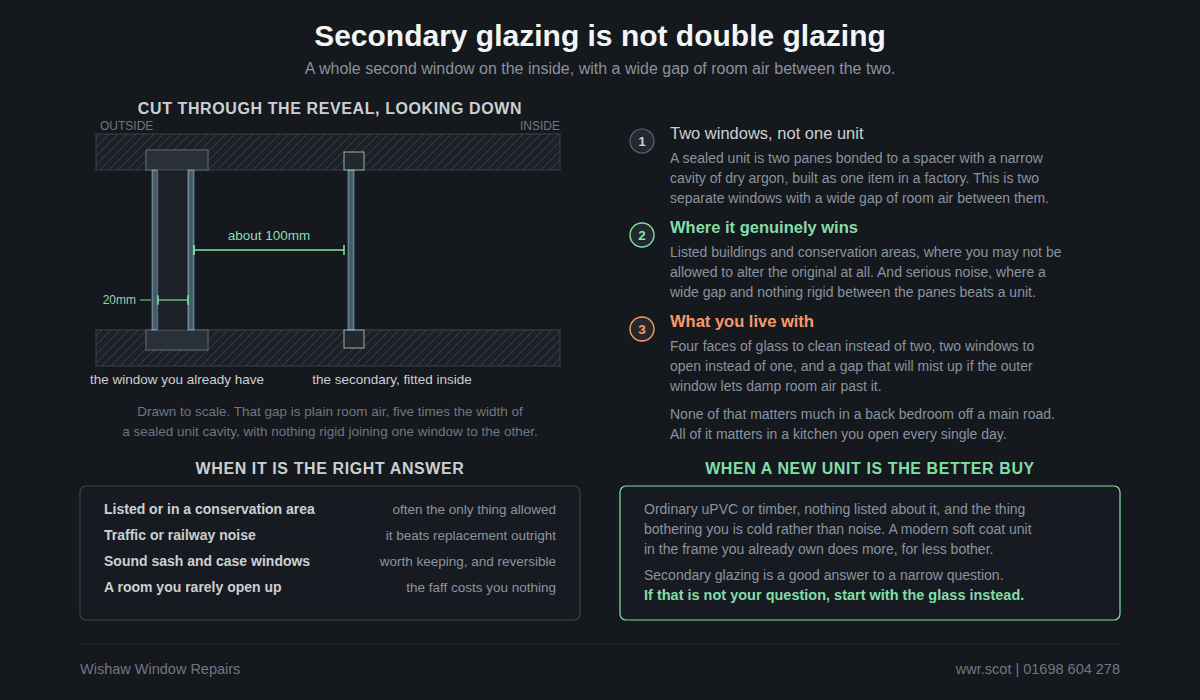
Where it genuinely wins
Listed buildings and conservation areas. If a property is listed, or sits in a conservation area, the original windows are often part of what’s protected and you may not be permitted to alter or replace them. Secondary glazing sidesteps that, because you aren’t touching the original at all. From the street nothing has changed. Consent is still a matter for the council and you should ask before ordering anything, but secondary glazing is very often the route that gets approved when replacement won’t be.
Serious noise. This is where secondary glazing genuinely outperforms a modern sealed unit, and it surprises people. Sound is dealt with by mass, by distance, and by breaking the physical path the vibration travels along. In a sealed unit the two panes are rigidly connected by the spacer bar all the way round, so vibration crosses easily, and the cavity is narrow. Secondary glazing gives you two independent frames with no rigid connection between them and a gap several times wider. For a main road or a busy junction, a properly fitted secondary system with a decent air gap will usually beat replacement windows.
Tenement sash and case windows worth keeping. Plenty of Lanarkshire and Glasgow tenement flats have original timber sash and case windows in decent structural order and rather better made than what would replace them. If the timber is sound and the cords and weights still work, you can overhaul the original and put secondary glazing behind it, ending up warmer and quieter with the character intact. Ripping out a good sash and case window can’t be undone.
Where it doesn’t win
In an ordinary house with ordinary uPVC or timber windows and no conservation constraint, secondary glazing is generally not the sensible route.
It’s fiddly to open. You’ve now got two windows to unlatch and slide or swing before any air comes in, and in practice people stop opening them. That’s a real problem in a kitchen or a bathroom, and worth thinking hard about before putting it in a bedroom you need to ventilate.
It’s another thing to clean. Four glass surfaces instead of two, and the two facing the cavity can only be got at by taking the secondary panel out.
It looks like what it is. A second frame sitting inside your reveal, visible from indoors, with a slightly institutional quality to it. Some people don’t mind. Some mind a lot after six months.
And it does nothing for a window that has actually failed. If the outer window is rotten, or the uPVC frame has cracked, or the sealed unit has blown, secondary glazing repairs none of that. You’ve built a second layer in front of an unresolved problem.
The condensation issue, which is the one people get caught by
This deserves proper attention, because it’s the most common way secondary glazing goes wrong.
Once you fit an inner window, the space between the two becomes a cavity. Warm damp air from inside your house wants to get into it, and there is always more moisture in a heated occupied room than people realise: cooking, washing, drying clothes, breathing. If that moist air reaches the cavity and touches the cold inner face of the outer window, it condenses. You get water sitting between the two layers, on a surface you can’t easily reach, in a spot with poor ventilation.
The direction of airtightness is what decides whether this happens.
The inner secondary panel wants to be as airtight as you can make it, because that’s what stops room air getting into the cavity in the first place.
The outer window wants to be reasonably weathertight but is allowed to breathe a little, so any small amount of moisture that does get into the cavity can escape outwards rather than sitting there.
It goes wrong when that’s the wrong way round: a draughty old outer window, a well sealed inner panel, and a warm humid room pushing moisture past the inner seals faster than it can clear. Then you get running condensation between the layers, and on a timber outer window that eventually means rot in the very frame you were trying to preserve.
Which is why draught proofing and overhauling the original window is not an optional extra beforehand. It’s part of the job.
Being straight about what we do
We repair uPVC windows and doors. Sealed units, handles, hinges, friction stays, locks, seals, doors that have dropped or won’t shut. That’s the business, around Wishaw and Motherwell and the wider Lanarkshire area, and it’s been that for over thirty years.
Secondary glazing is not something we install, and this article isn’t a lead in to a quote. It exists because people weighing this up get sold at from both directions, by replacement companies who want to sell windows and secondary glazing specialists who want to sell panels, and somebody ought to lay out the actual trade off.
So, plainly. If you’re in a listed building or a conservation area, or noise is the real problem, or you’ve got sash and case windows worth saving, talk to a secondary glazing specialist and to your council’s planning department. That job isn’t ours.
If you’ve got uPVC windows with a blown unit, a stiff handle or a draught coming through, that is ours, and it’s usually smaller and cheaper than you’re expecting. Sealed unit replacements start at £75 and there’s no call out charge.
Send a photo on WhatsApp or ring 01698 604 278 if you want a straight opinion on which of those you’ve got.
If you do decide the frames have had their day, our replacement window page covers what we fit and what is involved.
Related advice
See our vertical sliding windows page for what we do and where. Our contact details are here.
Browse the rest of our window and door advice for around fifty guides on common window and door problems.
Written by the team at Wishaw Window Repairs. Over thirty years repairing uPVC windows and doors across Lanarkshire.