
For most houses in Lanarkshire, no. Not because triple glazing is bad, it isn’t, but because the thing it’s compared against has moved. A modern A rated double glazed unit is a long way from what was going into houses in the nineties, and the step from that to triple is a much smaller step than the one people imagine they’re taking.
That’s the answer. Here’s the reasoning behind it, because it’s the reasoning that tells you whether you’re one of the houses where triple does make sense.
What a triple glazed unit actually is
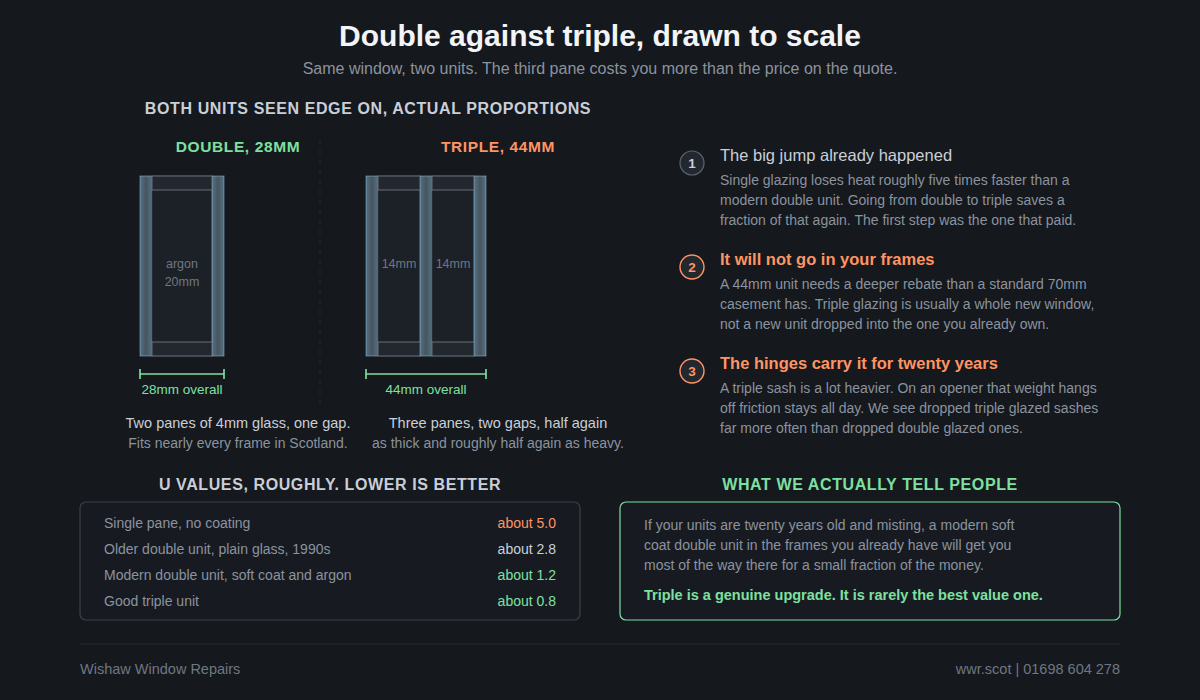
Three panes of glass instead of two, which means two cavities instead of one, and two spacer bars round the edge instead of one. Both cavities are filled with argon, and there’s usually a low emissivity coating on two surfaces rather than one.
Each cavity works the same way a single cavity does. The gas in it is a poor conductor, and it’s trapped in a gap narrow enough that it can’t circulate freely, so heat crossing from the warm pane to the cold one has to work at it. Two of those in series is better than one of them. That much is simple physics and there’s no argument about it.
The argument is about how much better, and about what else changes when you add the third pane.
The gain is real. It’s also much smaller than the last one.
The jump from single glazing to double was enormous. You went from one sheet of glass with nothing behind it to an insulated assembly, and people felt it standing in the room. The cold draught down the wall in front of the window stopped, and so did the water streaming down the inside on winter mornings.
Going from a modern A rated double unit to a triple is a genuine improvement, but it’s an improvement on something already doing its job reasonably well. Insulation runs into diminishing returns fast. Taking loft insulation from nothing to a decent depth transforms a house. Doubling it again does very little. Glazing behaves the same way.
Where you’ll notice it is standing right next to the glass in January, because the inner pane sits a little warmer. Where you probably won’t notice it is on the gas bill, not in a way you could pick out from a change in the weather.
The weight is the part nobody mentions
A triple unit has three panes of glass in it rather than two. It’s about half as heavy again as the equivalent double unit, and it’s considerably thicker.
Both matter more than the U value does, because a window isn’t just glass. It’s glass carried by hinges, and on an opener that weight hangs off a pair of friction stays sized for what was in the frame originally. Put a much heavier unit in and the stays wear faster, the sash drops out of square at the far corner, the lock stops engaging cleanly and you’re forcing the handle. That’s a repair bill turning up a few years after the upgrade that was meant to save you money.
Thickness is the bigger obstacle. The rebate in a uPVC frame, the recess the glass sits in, is sized for the unit the frame was designed around, and a triple unit usually won’t physically fit an older frame. So a triple upgrade very often isn’t a glass job at all. It’s new frames, new sills, the whole window out of the wall. At that point you’re comparing a full replacement against a sealed unit, which is a completely different conversation.
If anyone offers to drop triple units into your existing frames, ask them to show you the rebate depth first.
You also let in less sun
Every pane of glass and every coating on it reflects and absorbs a bit of the sunlight trying to get through. Add a third pane and a second low emissivity coating and less solar energy reaches the room. The measure for this is the g value, and triple glazing has a lower one.
In a hot climate that’s a benefit. In Scotland it’s a genuine trade off. Our winter days are short and the sun sits low, and free heat coming through a south facing window on a bright cold afternoon is heat you haven’t paid for. A triple unit gives some of that back in exchange for the better insulation. On a north facing wall it hardly matters. On the sunny side it partly cancels out the gain you bought.
Rooms read slightly duller as well. It’s subtle and plenty of people never notice, but it’s worth knowing before rather than after.
When triple is the right call
There are houses where we’d say yes without hesitating.
New build, or a full replacement where the frames are going anyway. If you’re buying frames regardless, they can be specified to carry triple units properly, hinges and all, and the extra is a much smaller proportion of the job. Triple in a system designed for it is a different proposition from triple wedged into one that wasn’t.
Very exposed sites. A house on open ground catching the weather off a hillside loses heat through its glazing far faster than a mid terrace does, and the extra pane earns more there than it does on a sheltered street.
Serious noise, with a caveat. Triple can help against a main road, but it isn’t automatic, and three identical panes with two matched cavities are sometimes no better acoustically than a well specified double. What kills noise is panes of different thicknesses, so they don’t resonate at the same frequency, and a laminated pane whose interlayer damps the vibration. If noise is the problem, specify for noise rather than counting panes.
Where that leaves most houses round here
A solid uPVC frame, straight, uncracked, with the hinges and locks working, and tired sealed units that have misted or gone cold. That’s the situation in an enormous number of houses in Wishaw and Motherwell, and in that situation the sensible move is new A rated double glazed units into the frames you’ve already got. Same frames, same day, no mess, and you pick up nearly all of the available benefit for a small fraction of what a triple glazed replacement would run to.
Come back to triple when the frames themselves are done. That’s the moment it stops being an expensive way to buy a small improvement and starts being a reasonable specification decision.
If you want an honest look at whether your frames are worth keeping, send a photo over on WhatsApp or ring 01698 604 278. We’ll tell you straight, including if the answer is that they’ve had it.
If you are weighing it up against simply upgrading the glass in the frames you already have, that is a glass unit replacement.
Related advice
See our window and door replacement page for what we do and where. If you would rather just ask, get in touch.
Browse the rest of our window and door advice for around fifty guides on common window and door problems.
Written by the team at Wishaw Window Repairs. Over thirty years repairing uPVC windows and doors across Lanarkshire.