
Two different numbers get quoted at homeowners, they measure different things, and salespeople are not always careful about which one they’re waving at you. Worth ten minutes of your time to get them straight, because it changes what you ask for.
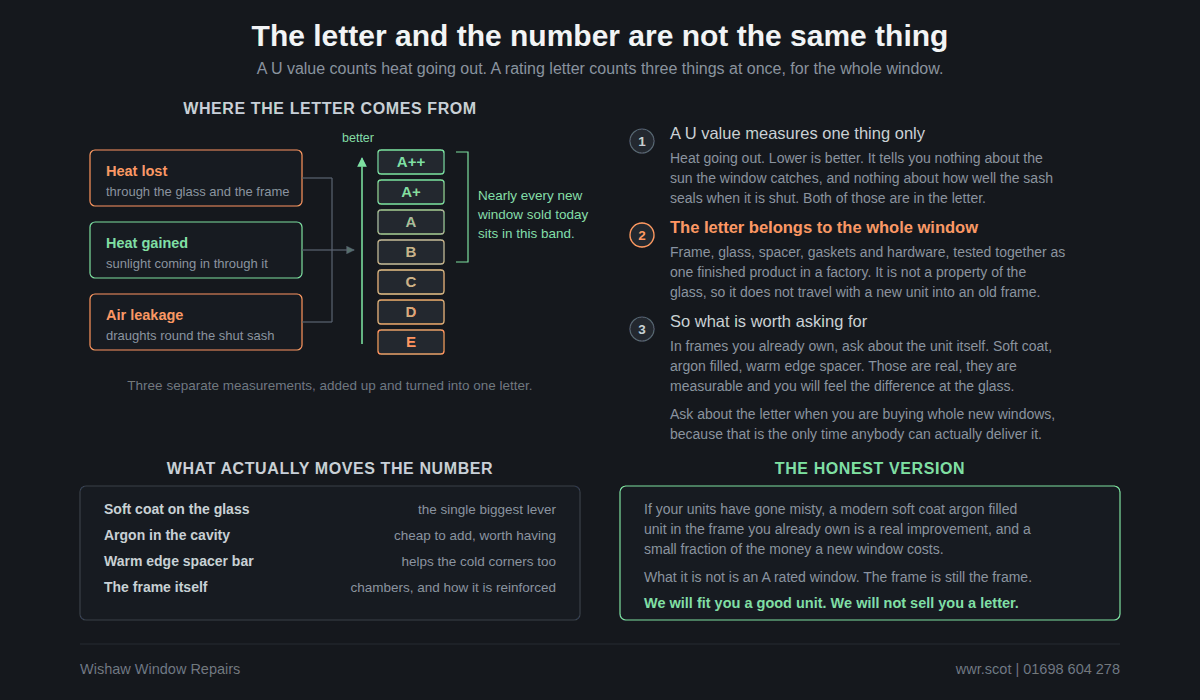
A window energy rating is a letter. The scale runs from A++ at the top, down through A+, A, B and onwards. It’s a whole window measure, which is the important part: it takes the glass, the frame, the spacer, the seals, everything, and works out how the finished window behaves as one object.
A U value is a number, and lower is better. It measures heat loss and nothing else. A window with a U value of 1.2 is losing heat more slowly than one at 1.6.
Why the letter and the number don’t agree
The rating letter is doing more arithmetic than the U value is. It combines three things.
Heat lost through the window, which is the U value doing its job. Heat gained through the window, because glass lets sunlight in and that sunlight warms the room, so a window that leaks a bit but catches a lot of sun can score better than you’d expect. And air leakage, meaning the draughts round the opening sash when it’s shut.
Put those together and you get a letter. That’s why you’ll occasionally see two windows with similar U values sitting on different letters. One of them is catching more solar gain or sealing up tighter.
Neither number is a lie. They’re answering different questions.
The bit the trade is quietest about
Here’s the thing that matters most for anybody in an older house.
An energy rating belongs to a whole window as it left the factory. Frame, glass, spacer, seals, all of it, tested together as one product. It is not a property of the glass on its own.
So when a sealed unit goes misty in a window you’ve had since the early 2000s, and somebody offers to fit “A rated glass” into that frame, the rating doesn’t come with it. You’ll get a better sealed unit than the one that failed, and that’s a genuine improvement. But the frame is the frame, the gaskets are however old they are, and the window as a whole is not now an A rated window. It’s a twenty year old window with a new pane in it.
That’s not a reason to avoid the job. It’s a reason not to pay a premium for a letter that isn’t actually being delivered. We fit good modern units as a matter of course. We just don’t dress it up as something it isn’t.
What actually moves the number
Four things do most of the work, and it’s useful to know what they are so you can ask sensible questions.
The low emissivity coating. A microscopically thin metallic layer on one of the internal glass faces, usually the inside face of the outer pane. It’s transparent to you, but it reflects long wave heat back into the room instead of letting it radiate out through the glass. This is the single biggest change between old double glazing and new. Early double glazing often had no coating at all, just two bits of clear float glass with air between them.
The gas fill. The cavity between the panes is usually filled with argon rather than air. Argon is denser and moves more sluggishly, so it carries less heat across the gap by convection. You can’t see it and you can’t test it from your living room, so you’re taking it on trust, which is one argument for units from a supplier with a name to protect.
The spacer bar. The strip running round the edge of the unit that holds the two panes apart. Traditionally aluminium, which is superb at conducting heat, which is exactly what you don’t want at the edge of a window. That’s why old units get cold round the perimeter and why condensation forms on the border of the glass first. Warm edge spacers use plastic or composite or thin stainless steel instead, and the cold bridge round the edge largely disappears. If you look at the edge of a unit through the glass and see bright silver metal, it’s an aluminium spacer and it’s an older unit.
The frame. A uPVC frame is hollow and chambered, and the number of chambers and whether they’re foam filled affects how much heat crosses it. It’s why the same glass in two different frames gives two different ratings.
The honest scale of the difference
Nearly all of the real gain is in the first step.
Going from a failed unit, or an uncoated unit from twenty five years ago, to a modern coated argon filled unit with a warm edge spacer is a large improvement. You’ll feel it standing next to the window in January, which is where people actually notice glazing performance, more than on a bill.
Going from A to A+ is a small improvement. It’s real, it’s measurable in a laboratory, and it is not going to be the thing you notice. By the time you’re comparing letters at the top of the scale you’re deep into diminishing returns, and the money is often better spent on the draughty window at the back of the house that nobody’s looked at in a decade.
If a company is building a sales pitch around the gap between A and A+, they’ve run out of better arguments.
What to do with this
If your glazing is misted, blown or clearly from another era, replacing the sealed unit gets you the great majority of the available benefit for a fraction of the cost of a new window. If a frame is genuinely finished, cracked, rotten or beyond parts, then a new window is the right spend and the rating is worth looking at properly.
Most houses around Wishaw and Motherwell that we go out to sit in the first category.
Send us a photo of the window on WhatsApp, including a shot along the edge of the glass if you can get one, and we can usually tell you what sort of unit you’ve got and whether it’s worth doing. Or ring 01698 604 278 and ask.
You can often lift the performance of an existing window a long way just by fitting better glass, which is a sealed unit replacement rather than a new window.
Related advice
See our window and door replacement page for what we do and where. Photographs on WhatsApp are the quickest route to an answer. Contact us here.
There are around fifty more plain English guides in our advice section.
Written by the team at Wishaw Window Repairs. Over thirty years repairing uPVC windows and doors across Lanarkshire.