
A customer out at Nitshill walked me round the outside of her house a while back. The windows at the north facing back of the property were still a decent white. The two on the front, facing south west and getting sun all afternoon, were the colour of weak tea. Same windows, same year, same installer. Fifteen years of sunlight landing on one side and not the other.
She’d been told she needed the lot replaced. She didn’t. The hardware was sound, the units clear, the frames solid. She had a cosmetic problem on two windows, and it’s worth understanding what that problem actually is before anyone spends thousands on it.
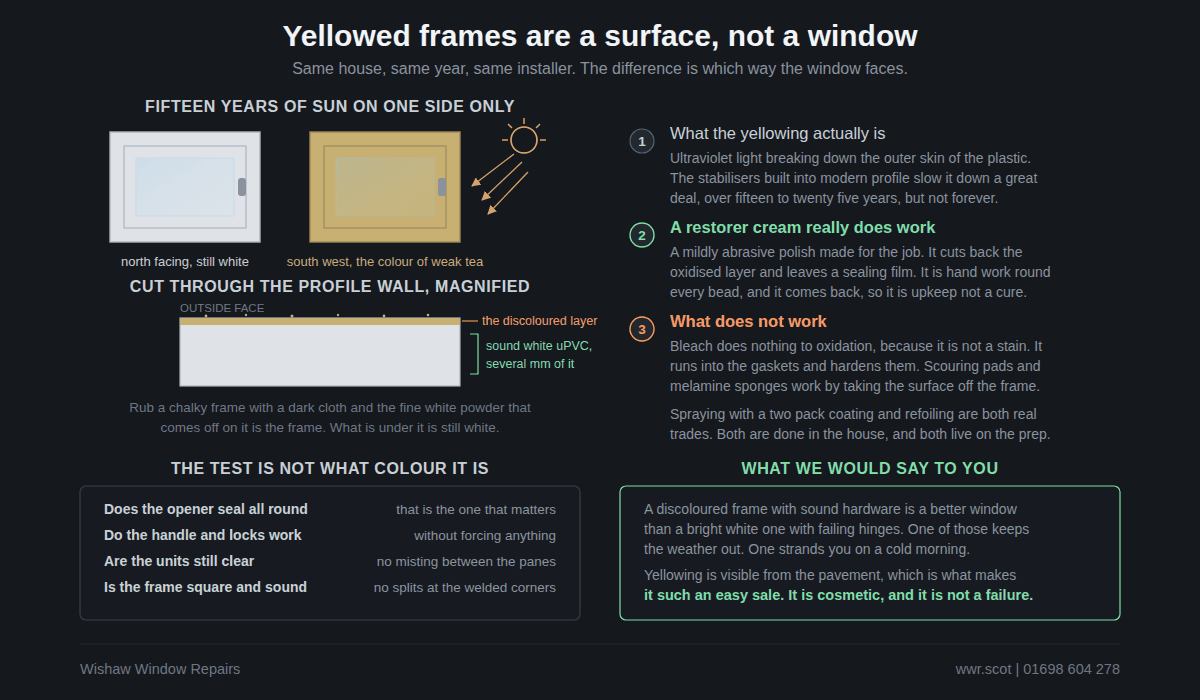
What yellowing actually is
uPVC is a plastic, and plastics don’t much care for ultraviolet light. Modern profile is made with UV stabilisers and titanium dioxide precisely to slow this down, and it does slow it down a great deal, but it doesn’t stop it forever.
Over roughly fifteen to twenty five years, depending on how much direct sun the frame gets, the outer surface starts to break down. The stabilisers are used up, the polymer chains at the surface degrade, and the material discolours towards yellow and then towards a chalky, dull finish where the smooth extruded skin has gone and a rougher, porous surface is exposed. Rub a chalky frame with a dark cloth and you’ll pick up a fine white powder. That powder is the frame.
Two things follow, and both matter. It’s largely a south and west elevation problem in Scotland, so north facing frames on the same house can still look nearly new when the front is well gone. If somebody quotes for replacing every window in the house on the grounds of discolouration, walk round the back and look.
And it’s surface deep. The top layer of a profile several millimetres thick. The frame underneath is still white and structurally fine.
What genuinely helps
A proper uPVC restorer cream is the honest answer, and it works better than most people expect.
These are mildly abrasive polishing compounds made for the job. They cut back the degraded, oxidised outer layer, expose the sounder material below it, and leave a sealing film behind. On a frame gone chalky and grey the difference can be dramatic. On one gone deep yellow it’s less so, but still worth doing.
Two caveats, said plainly.
It is work. Applied by hand, worked in, buffed off, panel by panel, around every opener and every bead. A house full of windows is a weekend, not an afternoon, and your arms will know about it.
And it comes back. You’ve removed the degraded layer, not stopped the process, and the sun goes on shining. Depending on the elevation you might get a few years before it dulls again. Maintenance, not a cure, and anyone selling it as permanent is overselling it.
Some restorer products are strong enough to strip the print off a foiled woodgrain finish, so this is for white frames. Test somewhere hidden either way.
What does not work
Bleach. Suggested constantly, and it does nothing at all for oxidation, because oxidation isn’t a stain and there’s no organic matter to bleach. It lightens mould and nothing else. Meanwhile it runs down into the gaskets and hardens them, and gets into the hinges. Frames the same colour they were, and seals that have aged five years in an afternoon.
Scouring pads, wire wool and melamine foam sponges do remove discolouration, in the sense that they remove the surface of the frame. What’s left is rougher, holds dirt, and degrades faster from then on. It looks better for a fortnight.
Spray painting and refoiling
There is a genuine trade doing this, and done properly it’s a real option.
Spraying uses a specialist two pack coating made to adhere to PVC, applied after the frames are cleaned, keyed and masked. The masking is most of the job. Every gasket, every hinge, every pane edge and the glass itself has to be protected, and it’s done in your house with the windows still in the wall. Not a job for a rattle can and ordinary paint, which peels off uPVC in sheets within a year or two and leaves you worse off than the yellowing did.
Refoiling applies a new decorative film over the existing profile, which is how a lot of white frames become anthracite grey. It lives or dies on the preparation and on the edges and corners.
Both are specialist work and both are quoted individually. Cost sits well below new windows and well above a tub of restorer cream, and the sensible thing is a figure from somebody who does it regularly rather than a range you read online.
Durability is the fair question to put to them. A well applied spray finish on a sound frame lasts a good number of years, but it’s still a coating on plastic living outdoors and it will need attention eventually. Ask what the finish is, ask what happens at the gasket edges, and ask where you stand if it fails.
The verdict, since somebody has probably quoted you
If the frames are sound, yellowing is a cosmetic fault and a very poor reason to replace working windows.
Worth being blunt about, because discoloured frames are one of the easiest sales in the business. They’re visible from the pavement and they make a house feel tired, so a salesman in your living room has an argument that makes itself. What he tends not to mention is that the yellow layer is a few microns thick and the window behind it is doing its job.
The test isn’t what colour the frame is. It’s whether the window works. Does the opener shut evenly and seal all the way round? Do the handles and locks operate without force? Are the units clear, the frame square and free of cracks? Good answers there mean you have a working window and a cosmetic decision, not a replacement decision.
Put it the other way round. A discoloured frame with sound hardware is a better window than a bright white one with failing hinges and a mechanism on its way out. One of those keeps the weather out and one is going to strand you on a cold morning, and it isn’t the yellow one.
There are frames genuinely at the end of their life, cracked at the welds, distorted, sashes dropped beyond adjustment. That’s a different conversation. Colour alone doesn’t put a window in that category.
Have a look and let us know
If you’re staring at yellowed frames wondering whether you’re being told the truth, send a couple of photos over on WhatsApp, one close up and one of the whole window. We’ll say whether it’s a cosmetic job or a genuine one, and we don’t charge for an opinion. Ring 01698 604 278 if you’d rather talk it through.
Discoloured frames are usually still perfectly sound, and a proper clean and window service often makes more difference than people expect.
Related advice
You will find around fifty more guides like this one in our advice section.
Written by the team at Wishaw Window Repairs. Over thirty years repairing uPVC windows and doors across Lanarkshire.