
I was out at a house in Newton Mearns not long ago where the owner had been quoted for a complete new composite door, frame and all, because the lock had stopped working. The quote was on the kitchen table and she was not far off signing it. The gearbox had failed. We changed it that afternoon.
That job is not unusual. People think of a composite door as a sealed unit that either works or does not, and once you know what one is actually made of, the repair question answers itself.
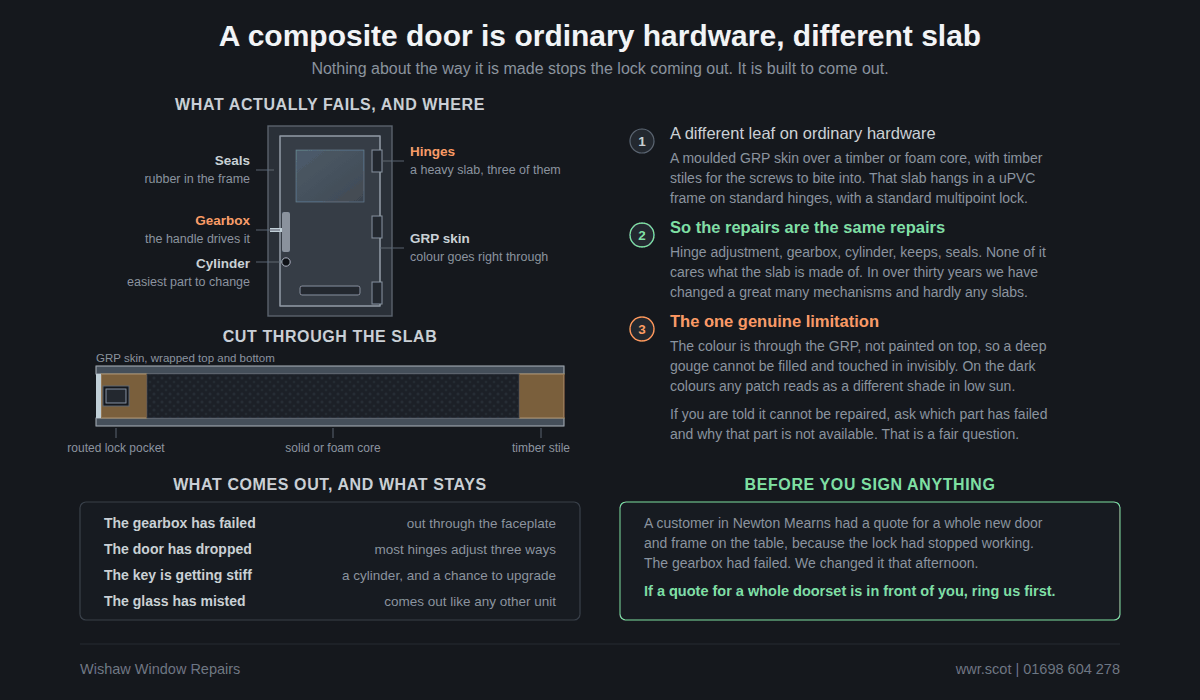
What a composite door is
A composite door is a slab with a core and a skin. The core is solid timber, or a rigid foam, or in better doors a combination of the two with timber stiles round the edges for the hinges and lock to bite into. Wrapped round that is a moulded skin of GRP, which is glass reinforced plastic, the same family of material as a boat hull. The skin gives you the woodgrain texture and the colour, and that colour usually goes through the material rather than sitting on top as paint.
That slab is then hung in a frame, and here is the important part: the frame is uPVC or aluminium, exactly like any other door in the range. The hinges are standard door hinges. The lock is a standard multipoint mechanism running down the edge of the slab. The cylinder is a standard euro cylinder.
A composite door is a different door leaf hung on entirely ordinary hardware.
Which means the repairs are the same repairs
Every fault we fix on a uPVC door, we fix on a composite door with the same parts and the same methods. Hinge adjustment, gearbox replacement, cylinder change, keep repositioning, seal renewal. None of it cares what the slab is made of.
The slab itself very rarely fails. GRP does not rot, it does not warp the way timber does, and it does not go brittle in sunlight the way old uPVC can. In over thirty years we have replaced a great many mechanisms and hardly any composite slabs.
The things that do go wrong
Hinge sag. This is the one composite doors genuinely suffer from more than others, and it is simply weight. A solid core slab is noticeably heavier than a foam filled uPVC door of the same size, and all of it hangs off three hinges. Over time the leaf drops at the outer edge, the hooks stop meeting their keeps, and you start lifting and leaning on the handle to lock up. Most composite hinges adjust in three directions, so a lot of these are corrected on the spot. Catching it early matters, because a dropped door forces the mechanism every time it is used.
The gearbox. The centre section of the multipoint lock, the bit the handle drives through the spindle, containing the gears and cams that convert your handle lift into the movement of the hooks. It wears, and it wears faster on a door that is out of alignment. When it goes you get a handle that lifts and does nothing, or one that jams halfway. On many mechanisms it comes out on its own without disturbing the rest of the locking strip.
The cylinder. The barrel the key goes into. Cylinders fail through wear, through a worn key rounding off the pins, or occasionally through a snapped cam inside. It is the easiest part on the whole door to change, and the one worth upgrading if yours has no anti-snap section.
Seals. There is a compression seal in the frame that the door closes against, and often another in the door edge. Rubber hardens and takes a set over the years, and once flattened it stops sealing. Draughts, whistling in a wind, a door that feels loose when shut. Seals come in lengths and are replaced without touching anything structural.
Cosmetic damage to the skin. A scrape from a bike pedal, a scuff from a wheelie bin, a dent where something has been dropped against it. The GRP skin is tough but not indestructible.
The belief that the whole door has to go
The idea that a composite door must be replaced entire when the lock fails is wrong, and worth being blunt about.
Nothing in the construction ties the lock to the slab in a way that prevents replacement. The mechanism sits in a routed pocket in the edge of the door, held in by screws through a faceplate, precisely so it can come out. Manufacturers build them that way because they expect mechanisms to be serviced over a door’s life.
If someone tells you the door cannot be repaired, ask which part has failed and why that part is not available. A straight answer is reasonable to expect. Sometimes an obsolete mechanism means fitting a different make of gearbox with the same backset and hook positions, which is a normal part of the job rather than a reason to give up on the door.
The one genuine limitation
Colour matching a damaged skin is difficult, and I would rather say so than pretend otherwise.
Because the colour is generally through the GRP rather than a coat on top, a deep gouge cannot be touched in the way a painted timber door can. Filler and paint on a textured woodgrain surface will show, particularly in low sun and particularly on the popular dark colours where any patch reads as a different shade. Small chips near an edge can often be made acceptable. A long scrape across the middle of a front door usually cannot be made invisible.
If the damage is structural, we can nearly always repair it. If it is purely cosmetic and in a prominent position, be realistic about what a repair will look like, and weigh that against a new slab hung in your existing frame, which is a far smaller job than a whole new doorset.
Questions we get asked
My composite door has dropped. Is the door itself bending?
Almost never. It is the hinges taking the weight and the leaf sitting lower than it was. The slab is rigid. Adjustment usually brings it back.
Can you fit a new lock if the door is an unusual make?
Usually yes. What matters is the measurements of the mechanism, chiefly the backset and the spacing of the hooks, not the badge on the door. We measure the old one and match it.
The glass unit in my composite door is misted. Can that be changed?
Yes, in most cases the unit comes out of the door in the same way as any other sealed unit. Misted and blown unit replacements start from £75 depending on size and glass type. Glazing in a door has to be safety glass, and it gets replaced with safety glass, which is not something to compromise on.
Where to go from here
Send us a photo on WhatsApp: one of the whole door from a few steps back, and one of the maker’s name stamped on the metal faceplate in the door edge if you can find it. That is usually enough for us to say what the part is.
No call out charge, weekdays 08:00 to 17:00, phone 01698 604 278. And if you have a quote for a full replacement sitting in front of you, ring us before you sign it.
Composite doors use much the same locks, hinges and handles as uPVC, so they are covered by our normal door repair service.
Related advice
See our door repair service page for what we do and where. There are before and after photographs of jobs like this in the gallery. You can also message us here.
Stuck on something else? Our window and door advice section covers around fifty of the faults we see most.
Written by the team at Wishaw Window Repairs. Over thirty years repairing uPVC windows and doors across Lanarkshire.