
Stop for a second before you put any more pressure on that key.
A key that won’t turn is annoying, and if you’re standing in the rain with shopping it’s worse than annoying. But the one thing that turns this from a small job into a genuinely expensive one is snapping the key off inside the cylinder. Once that happens, the lock has to come out, and if half a key is jammed in the mechanism it can take a lot longer than it needs to.
So here’s what’s likely going on, in the order worth checking, and where the line is between something you can sort and something that needs a van.
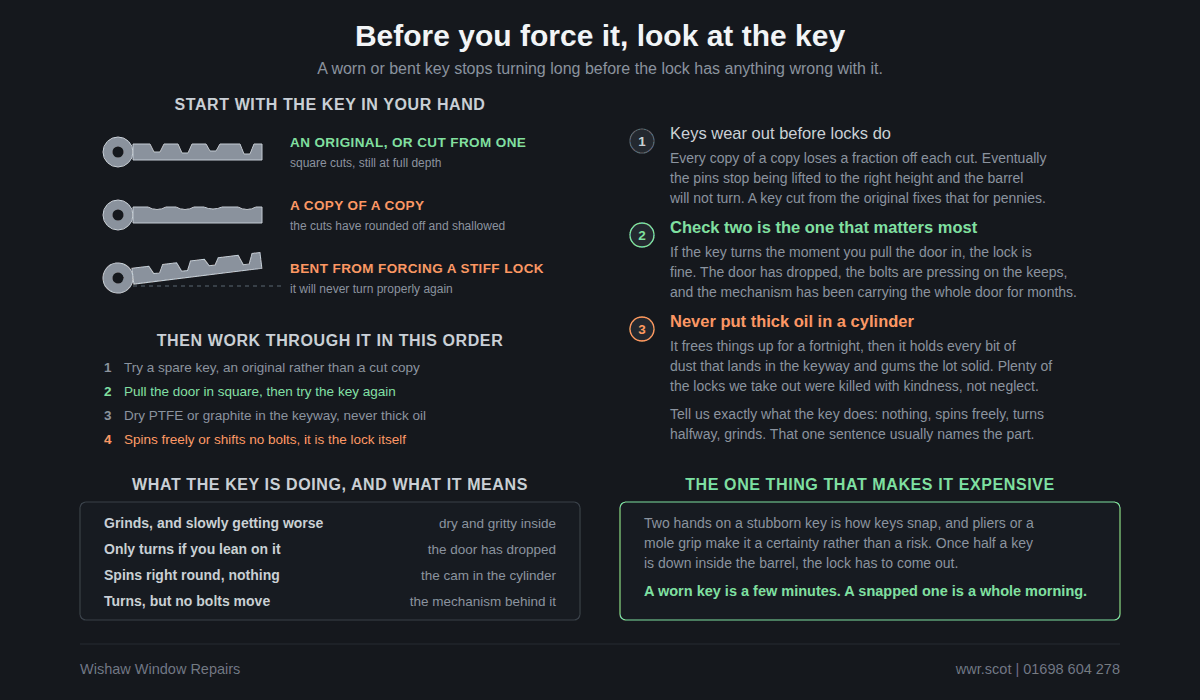
First: is it the key or the lock?
Look at the key itself. Keys wear out, especially copies of copies, and a worn or slightly bent key will start refusing to turn long before the lock has anything wrong with it.
If you’ve got a spare somewhere, particularly an original rather than a cut copy, try that one. If the spare turns sweetly and your everyday key doesn’t, you’ve found your problem and the answer is a new key cut from the original, not a new lock. That’s the cheapest outcome on this page and it’s more common than you’d think.
While you’ve got the key in your hand, check it isn’t visibly twisted. A key that’s been used to force a stiff lock for months often has a slight bend in it, and once it’s bent it will never work properly again.
Second: is the door taking the weight of the lock?
This is the big one, and it’s the reason most calls come in.
Try this. Pull the door firmly towards you, or push it in if it opens outwards, so it’s sitting square in its frame, and then try the key. If it suddenly turns, the lock is fine and the door is out of alignment.
What’s happening is that the door has dropped or shifted, so the locking bolts and the frame are pressing against each other. All that pressure lands on the mechanism, and the key can’t overcome it. People live with this for months, leaning on the door every time they lock up, until eventually the mechanism gives out under the strain.
The fix is alignment. The hinges are adjusted and the keeps in the frame repositioned so the door sits square and nothing is fighting anything. It’s a short job and it prevents the much bigger job that misalignment eventually causes.
Third: is the lock dry or dirty?
Cylinders take in dust, grit and rain over the years. A lock that’s gone gradually gritty and reluctant, where the key goes in but grinds round, often just needs cleaning and lubricating.
Use a proper lock lubricant, a dry PTFE or graphite type, squirted into the keyway. What you should avoid is thick oil like WD40 or 3-in-1 in the cylinder. It works for a fortnight, then it collects dust and gums the mechanism up worse than before, and the sticky residue is a pain to clean out. Plenty of locks we replace were killed with kindness.
Worth a mention: in properly cold weather a lock can freeze, particularly on a north-facing door. Warm the key in your hand, don’t pour hot water on the lock, and never use a flame near uPVC.
Fourth: has the mechanism actually failed?
Some symptoms point past all of the above.
If the key turns all the way round and round with no resistance and nothing happens, the cylinder or the cam inside it has broken, or the mechanism it drives has failed. If the key turns but the bolts don’t move, same conclusion. If the handle lifts fine but the key does nothing at all, it’s the cylinder rather than the alignment.
These are all replaceable parts. A cylinder swap takes minutes. A multipoint mechanism, the long metal strip down the edge of the door that drives all the hooks and bolts, is a bigger part but still a repair on your existing door, not a new door.
What not to do
Don’t force it. Two hands on a key in a stubborn lock is how keys snap.
Don’t use pliers or a mole grip on the key for extra leverage. That’s a snapped key with certainty rather than probability.
Don’t keep going if it’s got dramatically worse in the last day or two. A lock that has been slowly deteriorating and has now nearly stopped is about to fail completely, and the moment it does you may be on the wrong side of the door.
And if you’ve got out but can’t lock up, treat it as urgent rather than something to sort at the weekend. An unlockable front door overnight is a different order of problem.
If you’re locked out right now
If the door is shut and you can’t get in, don’t start attacking the lock. Damaging the cylinder can make a straightforward job into a more involved one, and it can damage the handle and mechanism behind it too.
Get in touch, tell us what the door is doing, and we’ll tell you what we can do and how quickly. If it needs a new cylinder we can usually key alike so one key runs your front and back doors afterwards, which is a small thing that makes life easier.
Getting it sorted
Sticking locks, worn cylinders, failed gearboxes and doors that need bringing back into alignment are everyday work for us across Wishaw and Lanarkshire, and there’s no call-out charge.
If you can, take a photo of the door handle and the barrel, and tell us exactly what the key does: nothing, spins freely, turns halfway, grinds. Send it on WhatsApp and we’ll have a good idea before we set off.
Call us on 01698 604 278.
Nine times out of ten this is alignment or a worn cylinder, and both are ordinary door repair jobs.
Related advice
See our door repair service page for what we do and where. Photographs on WhatsApp are the quickest route to an answer. Contact us here.
More like this: browse all fifty guides in our window and door advice section.
Written by the team at Wishaw Window Repairs. Over thirty years repairing uPVC windows and doors across Lanarkshire.