
Keys don’t snap in healthy locks.
That’s worth sitting with for a moment, because almost everybody whose key has just broken off in the door assumes they’ve been unlucky, or that they used too much force, or that it was a cheap copy. Occasionally it is a bad copy. Far more often the key is the last part of a chain that’s been going wrong for weeks, and it broke because it was the softest thing in the system.
A key is a thin piece of brass or nickel silver. The lock it turns is steel. The mechanism that lock drives weighs a couple of kilos. When something in that chain gets stiff, the key is always what gives first.
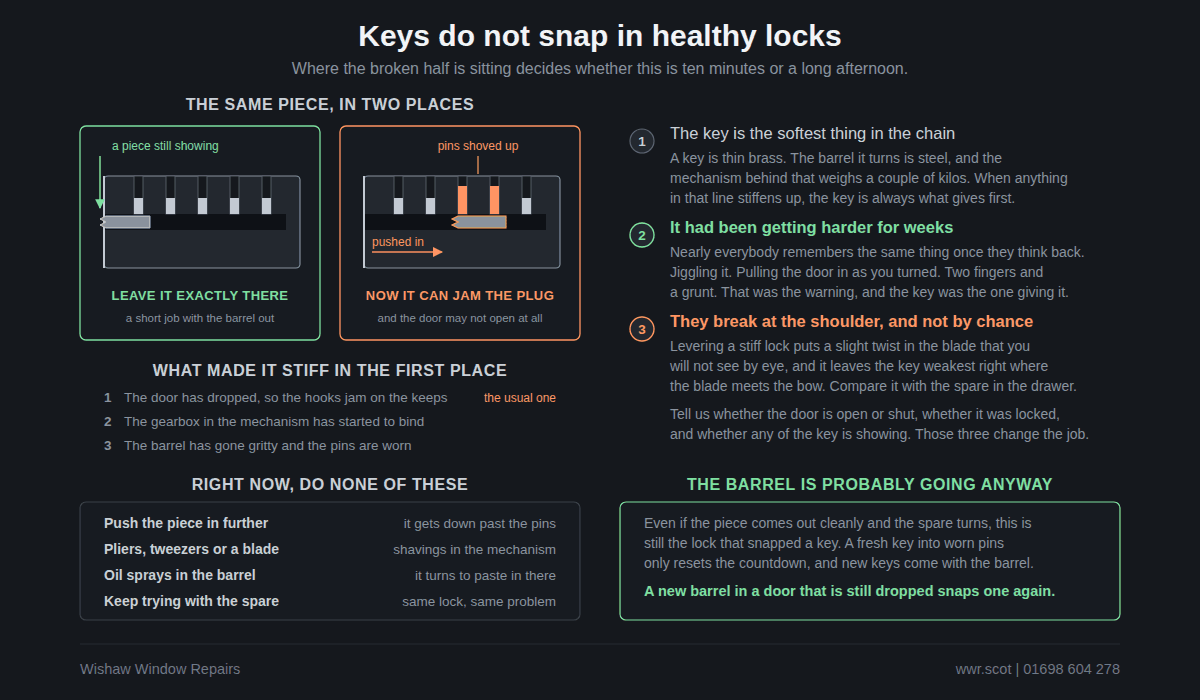
Why it actually broke
Think back over the last month or two. Almost everybody, once they think about it, remembers the same thing: it had been getting harder. You had to jiggle it. You started pulling the door towards you as you turned. Maybe you’d taken to using the key with two fingers and a bit of a grunt.
That stiffness came from somewhere, and it’s nearly always one of three things.
The door has dropped, so the locking hooks are pressing hard against the keeps in the frame, and the key is being asked to deadlock against all that load. This is the most common one by a distance.
The gearbox inside the multipoint mechanism is failing, so the cam on the cylinder is turning against something that’s already binding.
Or the cylinder itself has gone gritty inside, the pins are worn or dirty, and the key is having to force its way round the plug.
In all three cases the key had been telling you for weeks. Snapping it was just the point where it stopped being able to.
There’s a related detail. A key that’s been used to lever a stiff lock develops a slight twist, and you often can’t see it by eye. Once it’s twisted it’s weaker at the shoulder, which is exactly where they usually break. If the spare in the drawer still looks perfectly straight while your everyday key doesn’t, that tells you a lot.
What to do right now
Stop. Whatever half a key is doing in there, more pressure makes it worse.
Don’t push the remaining piece any further in. If part of it is still standing proud, leave it exactly where it is. A piece sitting near the mouth of the keyway is a straightforward extraction. The same piece driven down into the plug is a longer job, and if it gets past the pins it can jam the cylinder in a position where the door won’t open at all.
Don’t squirt WD40 or 3-in-1 into the cylinder. This is the instinct almost everyone has and it makes things worse. Oil based lubricants work for a fortnight, then they collect dust and grit and turn to a paste inside the pin chambers. Plenty of the cylinders we take out have been killed with kindness. If you want to lubricate a lock, the right thing is a dry PTFE spray or graphite, which leaves no film for dirt to stick to.
Don’t go at it with pliers, tweezers, a blade or anything else. Not because it’s a secret, but because the failure mode is bad. Slip and you’ll push the piece deeper, scratch up the plug, or leave metal shavings in the mechanism, and a repair that was going to be quick stops being quick.
And if the door is shut and locked with the broken half inside it, ring somebody. That’s the honest answer. There isn’t a clever tip for this one, and anything you’d find online that promises otherwise is either going to fail or is going to damage a door that costs a lot more than the lock.
What a repairer does
With the door open, the cylinder comes out in a couple of minutes. There’s a single long screw in the edge of the door, in line with the keyhole, and once it’s out the cylinder slides free. Then the broken piece can be dealt with on a bench rather than at arm’s length on a doorstep in the rain.
With the door shut and locked, it depends on what’s still in there and what condition the cylinder is in. That’s a look and a judgement rather than something to describe from a distance. Tell whoever you call whether the door is open or shut, whether the piece is visible, and whether the door was locked or unlocked when it happened. Those three answers change the job completely and they’ll want them before setting off.
The cylinder is very likely being replaced anyway
This is the part worth being straight about.
Even if the broken piece comes out cleanly and your spare key turns, the lock that broke your key is still the lock that broke your key. The pins are worn or fouled, or the plug is tight, or it’s been fighting a misaligned door for months. Put a fresh key into it and you’ve reset the countdown rather than fixed anything.
So in most cases the cylinder gets changed. It’s a small part, it takes minutes, and it comes with new keys. If you’ve a front and back door, they can usually be keyed alike so one key does both, which is a small mercy after the week you’ve had.
While it’s being done, it’s worth asking about an anti-snap cylinder if you haven’t got one. A lot of older uPVC doors around Wishaw still carry the barrel they were fitted with, and the early ones can be snapped by anyone who knows the trick. Since the cylinder is coming out anyway, that’s the cheap moment to sort it.
And the underlying stiffness still has to be dealt with, or you’ll be back here. That means checking the door’s alignment, adjusting the hinges, and moving the keeps if they need it. A new cylinder in a door that’s still dropped is a new key snapping in six months.
Getting it sorted
Tell us what happened, whether you’re locked out, and whether there’s a piece of key showing. Photos over WhatsApp are the fastest way to get a rough idea of what’s involved, and there’s no call out charge for coming to look. We’re across Wishaw, Motherwell and the wider Lanarkshire area, Monday to Friday.
01698 604 278.
Once the broken piece is out, the cylinder normally gets replaced, which is one of the most common uPVC door repairs we get called out for.
Related advice
- How secure your door lock really is
- A key that will not turn
- Measuring a euro cylinder
- Being locked out
See our door repair service page for what we do and where. Not sure? Ask us, there is no charge for looking.
If you would rather just ask, call 01698 604 278 and we will tell you straight. There are around fifty more guides in our advice section.
Written by the team at Wishaw Window Repairs. Over thirty years repairing uPVC windows and doors across Lanarkshire.