
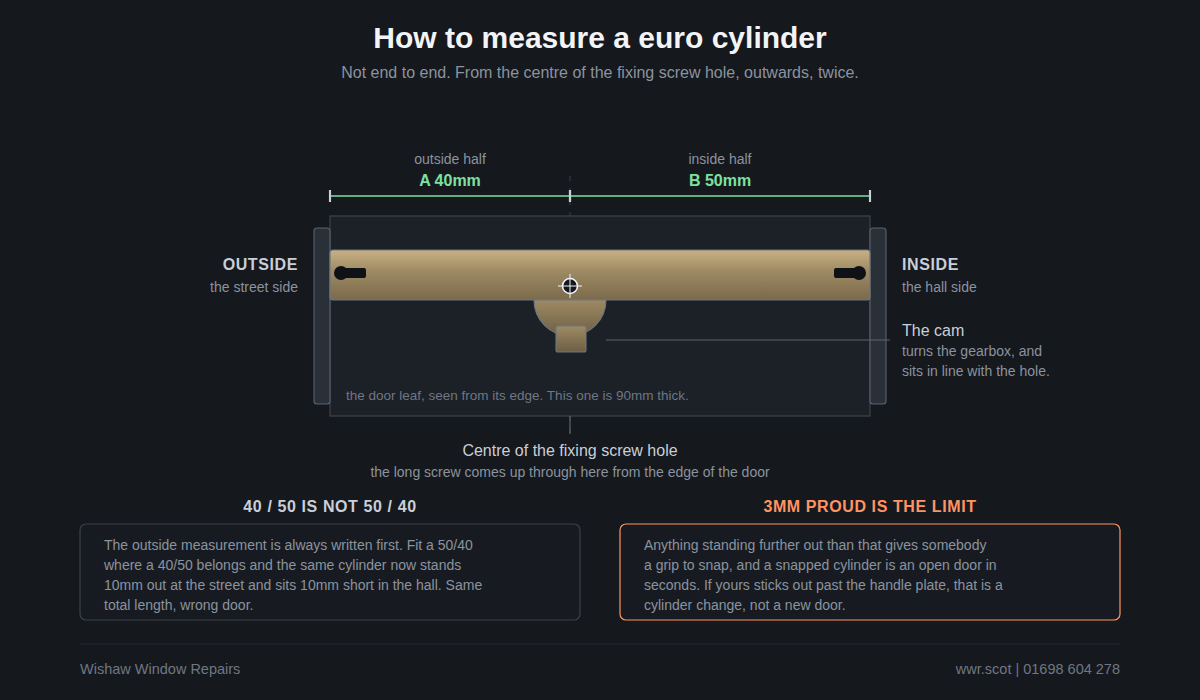
The single biggest reason people end up with the wrong lock barrel is that they measure it from the wrong place. They measure the whole thing, get 90mm, order a 45/45, and find it doesn’t work. The measurement is taken from the centre of the screw hole outwards, in two directions, and it gives you two numbers rather than one.
That’s the whole article in a paragraph. The rest is why, and how to get those two numbers off your own door without any special tools.
What a euro cylinder actually is
The euro cylinder is the barrel your key goes into. That’s all it is. It sits in the middle of the door edge, roughly level with the handle, and it looks a bit like a fat brass or nickel figure of eight lying on its side.
It is not the lock. The lock is the long metal strip running down the edge of the door with the hooks and rollers on it, the multipoint mechanism, and that’s a separate part entirely. The cylinder’s only job is to turn a small tab, called the cam, which sits at its waist. When you turn your key, the cam rotates and pokes the mechanism into deadlocking. Take the cylinder out and the door still works with the handle. It just won’t lock.
This matters because when someone says their lock has failed, half the time it’s the cylinder, which is a small part, and half the time it’s the mechanism, which is a bigger one. Knowing which is which saves you money.
Two halves, usually different lengths
Down the middle of the cylinder there’s a single fixing screw hole. That hole is your zero point. You measure from the centre of it out to the external face of the cylinder, and from the centre of it out to the internal face.
So a 40/50 cylinder measures 40mm on one side and 50mm on the other, and it’s 90mm overall. A 45/45 is also 90mm overall, but it will sit differently in the door and one side may end up proud while the other is buried.
The halves are rarely equal, and there’s a reason for that. A uPVC door usually has more material and a chunkier handle backplate on the inside than the outside, and the cylinder has to reach the inner face of both. Fitting a symmetrical cylinder into a door that wants an asymmetrical one is how you end up with a barrel sticking out.
British convention writes the external measurement first, but not everybody follows it, so say plainly which figure is the outside.
Getting the measurement without taking it apart
You can do this two ways.
The easy way is with the door open and a screwdriver. Look at the edge of the door, in line with the keyhole. There’s one screw there, usually a long thin one, going straight through the door edge into the cylinder. Take it out. Then put your key in and turn it a few degrees, maybe ten or fifteen, and hold it there while you pull. The cam has to be lined up with the body of the cylinder for it to clear the mechanism, and that slight turn is what does it. The cylinder slides out into your hand. Lay it on a tape measure, find the centre of the screw hole, and read off both directions.
Put it back the same way, key turned slightly, and don’t overtighten the screw when it goes home.
The other way, if you’d rather not remove anything, is to measure the door thickness and the projection. Measure how thick the door leaf is at the lock, then measure how far the cylinder sticks out past the handle backplate on each side. Add the projections to the thickness and you’ve got the overall length. Halving it and working from the screw hole outwards gets you close, though the first method is the one that gives you a figure you can rely on.
Either way, measure in millimetres. Cylinders go up in five millimetre steps and getting it out by one step is enough to cause a problem.
Too long is a security problem, too short just doesn’t work
If the cylinder projects more than a couple of millimetres beyond the handle, it’s a genuine weakness. A barrel standing proud can be gripped and snapped, and once it snaps at the fixing hole the cam is exposed. It’s a fast, quiet way into a house and it’s been well known to the wrong people for years. This is exactly why anti-snap cylinders exist, and why we’d always rather fit one at the same time as anything else we’re doing on the door.
Flush, or very slightly under flush, is what you want.
Go the other way and buy one that’s too short and the fault is more mundane. The key won’t reach, or the cam sits too far inside the mechanism to engage it cleanly, and you get a key that turns partway and stops. A short cylinder also leaves the fixing screw pulling the barrel at an angle, which wears it.
A short FAQ
Can I keep my existing keys?
Not with a new cylinder, unless it’s rekeyed to your old key, which is a specialist job and rarely worth it on a domestic door. What’s usually more useful is keying alike, so one key runs your front and back door.
Is a thumbturn a good idea?
On a door with glass in it or near it, think carefully. A thumbturn means anyone reaching through a broken panel can open the door without a key. On a solid door with no glazing nearby it’s a sensible thing, particularly for getting out in a hurry.
Does the brand written on the side matter?
Less than the size and the snap resistance. Fit the right length and something with proper anti-snap protection and you’re ahead of most doors in the street.
If this sounds like more bother than it’s worth
It’s a ten minute job for us. Genuinely. We carry cylinders in the van in the common sizes, and there’s no call out charge for coming to look, so there’s no cost in finding out whether you need a new barrel or just an adjustment.
If you’d rather check before we come, take a photo of the door edge with the handle in shot and send it over on WhatsApp, and tell us what the key does. We cover Wishaw, Motherwell and across Lanarkshire. The number is 01698 604 278.
If you would rather not measure it yourself, we will do it on the visit as part of a normal door repair.
Related advice
You can also message us here.
There are around fifty more plain English guides in our advice section.
Written by the team at Wishaw Window Repairs. Over thirty years repairing uPVC windows and doors across Lanarkshire.