
Standing on your own doorstep with a key that turns and a door that will not open is a horrible feeling, and the first thing worth saying is that it is usually the lock that has failed rather than anything you have done.
This page is about what has gone wrong and what a repairer actually does when they turn up. It does not explain how to open a locked door, for reasons that should be obvious.
The usual reasons a door will not open
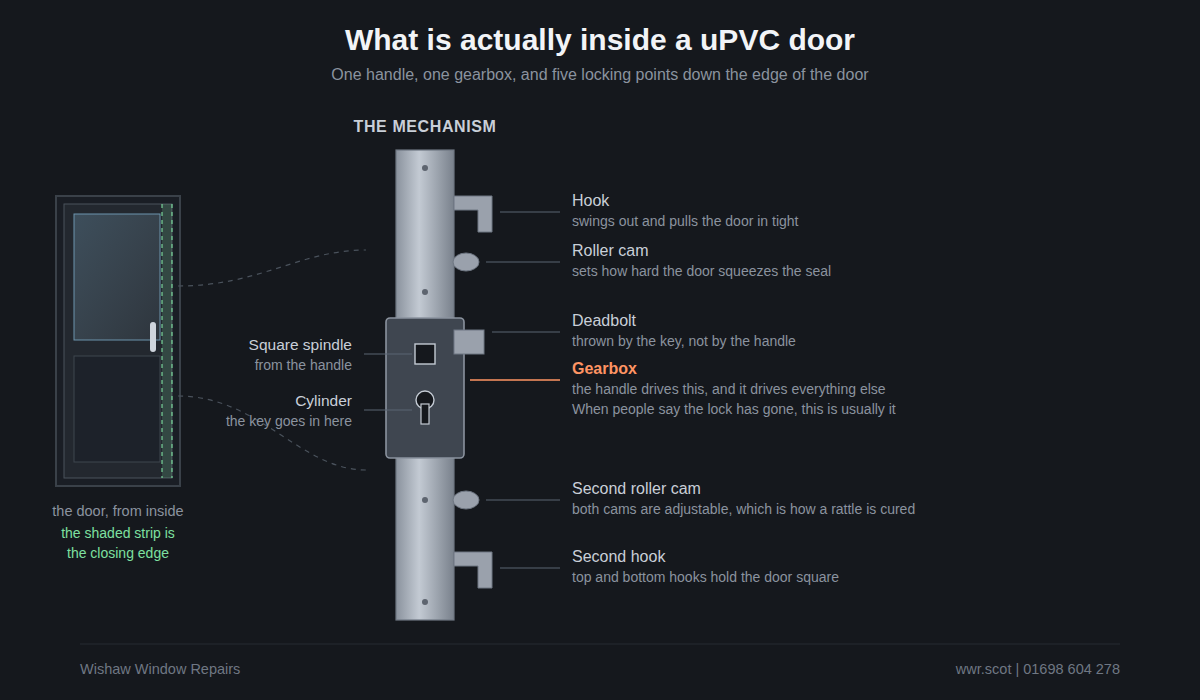
The key turns but the door stays shut. If the key goes in, turns freely and feels like it is moving something, but nothing releases, the cylinder is doing its job and the mechanism behind it is not. The usual cause is a failed gearbox: the lock case buried in the edge of the door, containing the gears and cams that translate a key turn and a handle lift into movement of the hooks. When its internals break, the key turns and the hooks stay exactly where they are.
The key turns and turns, with no resistance at all. Often a snapped cam. The cam is the small tongue on the back of the cylinder that pokes into the gearbox and drives it. When it shears, the key spins in a cylinder connected to nothing.
The door has slammed with the handle up. On a uPVC multipoint door, lifting the handle throws the hooks out of the door edge. If the handle is up when the door swings shut and the mechanism engages, the door has effectively locked itself with you on the wrong side.
The key will not go in, or will not turn. Sometimes ice, sometimes a worn key that has been getting sticky for months, sometimes a cylinder that has taken a knock. This is the group most likely to have a simple answer.
Why a stiff lock is nearly always a warning
Almost every gearbox failure we attend was announced in advance. The handle had been getting harder to lift, or the key needed a particular knack, and everyone in the house had quietly learned to work around it.
Here is why. A door that has dropped even slightly presents its hooks to the keeps at the wrong height, so the mechanism drags them into position against the frame every time you lock up. The gearbox takes a load it was never designed for, and that load falls on small gears and cast cams inside a case not much bigger than a matchbox. They wear, they crack, and eventually one breaks. A lock that failed out of nowhere had usually been complaining for months.
If lifting your handle takes a heave, get it looked at while the door still opens. An alignment adjustment is a small job. Being locked out is not.
What a repairer actually does when they arrive
The first thing is questions, and they are not small talk. Does the key turn, and does it turn all the way? Does the handle move? Was it stiff before? Is there another door into the house? Is anyone or anything inside that changes the urgency, a child, an animal, something left on the hob? The answers narrow the fault down a long way before anybody touches the door.
Then a look at the door itself: where it sits in the frame, whether it has dropped, whether the hooks are visible in the gap.
After that, non destructive methods come first. Always. There is a proper order that starts with the least damaging option and only moves on once that option is genuinely exhausted, and a competent person works through it patiently rather than reaching for a drill in the first two minutes. Every step down that ladder costs you more money.
If it does come to drilling, what gets drilled is the cylinder. Not the door, not the frame, not the mechanism. The cylinder is a self contained barrel sitting in a slot through the door, held by a single screw through the edge. Sacrificing it means a new cylinder and a new set of keys, and that is the whole extent of it. Plenty of people are braced for a wrecked front door and are surprised when the outcome is a new barrel and a tidy finish.
Once the door is open, the actual fault gets diagnosed. Very often the cylinder was only in the way and the real problem is the gearbox, in which case that gets changed too.
When to question what you are being told
If somebody at your door tells you the whole door needs replacing because the lock has failed, that is not right, and you are entitled to push back.
A uPVC or composite door is a frame, a slab and a set of replaceable hardware. The mechanism sits in a routed pocket in the door edge, held in with screws through a faceplate, because it is meant to come out. The cylinder is held by one screw. There is no fault in the locking hardware that requires a new door.
Even a claim that the entire multipoint mechanism must go deserves a question. Sometimes it is true, because the whole strip is worn or an obsolete pattern is easiest to swap wholesale. But on a lot of mechanisms the gearbox is a separate centre section that comes out on its own, leaving the strip in place. Ask why the smaller repair is not possible. A reasonable tradesperson will answer without any difficulty.
Be wary too of a price that only arrives after the work is done. Ask before anyone starts what the likely cost is, and what happens to that figure if the cylinder has to be sacrificed.
Three habits that stop it happening
Leave a spare with somebody you trust. A neighbour, a relative round the corner, whoever it is. It is the single most useful thing on this page and it costs the price of cutting a key.
Deal with a stiff lock before it strands you. Said already, but it bears repeating, because almost every lockout we attend had a warning.
And never leave your only key sitting in the inside of the cylinder. This one surprises people. On a standard euro cylinder, a key left in the inside can block the outside from working at all, so whoever comes home with the spare cannot get their key to turn. Take it out and keep it well away from the door and away from the letterplate.
If you are standing outside right now
Ring 01698 604 278. We are on the phone weekdays from 08:00 to 17:00 and closed at weekends, so if it is Saturday night you want a 24 hour locksmith rather than us. The same advice about non destructive entry and questioning a replacement quote applies to whoever you call.
If you are reading this because your lock is stiff rather than because you are stuck outside, that is the better time to ring. Send a short video on WhatsApp of the handle lifting and the key turning and we will tell you what we think is happening. No call out charge, and we cover Wishaw, Motherwell and the wider Lanarkshire area.
Once you are back in, the mechanism that caused it is worth looking at properly, and that is what our uPVC door repair service is for.
Related advice
See our door repair service page for what we do and where. Photographs on WhatsApp are the quickest route to an answer. Contact us here.
Browse the rest of our window and door advice for around fifty guides on common window and door problems.
Written by the team at Wishaw Window Repairs. Over thirty years repairing uPVC windows and doors across Lanarkshire.