
Start by closing one door at a time.
That one test tells us more than anything else you can do before we arrive, and hardly anyone tries it, because a pair of French doors feels like one object rather than two. It is not. It is two separate leaves with two separate jobs, and when they will not shut, one of them is usually innocent.
This page is about hinged French doors, the kind that swing open in the middle. Sliding patio doors run on rollers in a track and fail in different ways, so they are covered separately.
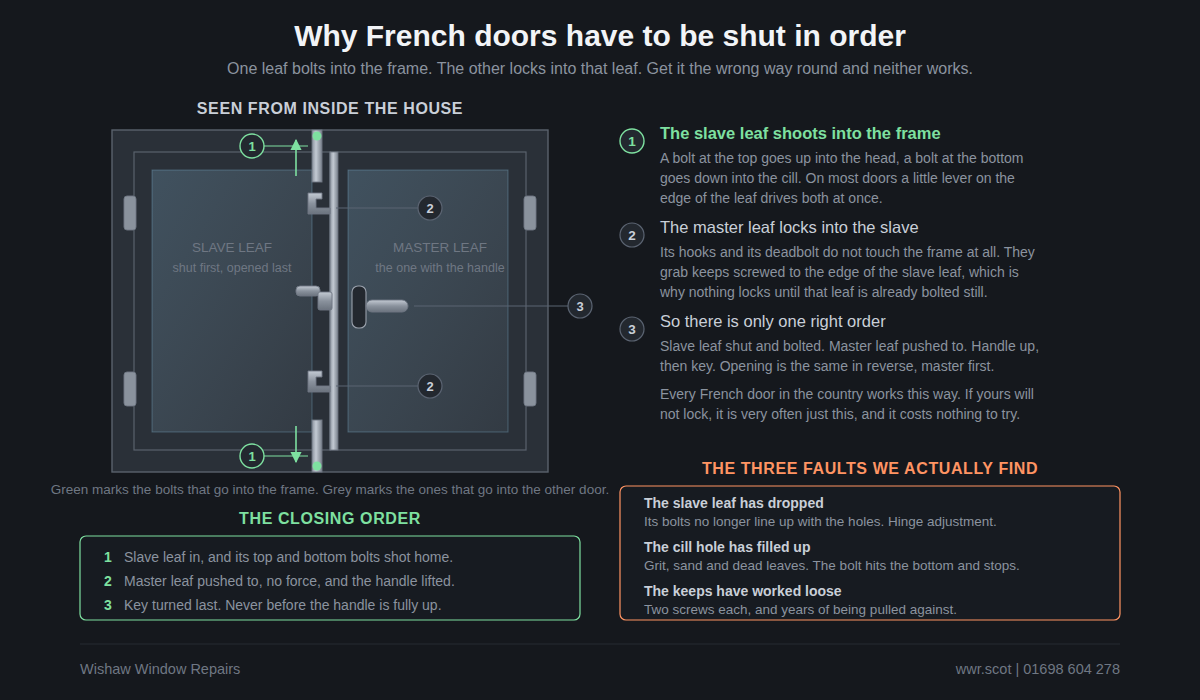
Master and slave, and the order they close in
On a pair of French doors, one leaf is the master and one is the slave. The slave is the one you leave shut most of the time. It has no keyhole and often no outside handle. The master is the one you actually use day to day, with the cylinder and the multipoint lock in it.
They have to close in that order. The slave goes first and gets locked into position, then the master shuts against it. The master’s hooks do not engage the frame at all: they engage keeps fitted into the closing edge of the slave leaf. That is the bit people rarely realise. The slave door effectively becomes part of the frame once it is secured, and the master locks to it.
Which is why a fault in the slave leaf shows up as a problem with the master. If the slave is not sitting exactly where it should, the master’s hooks arrive somewhere slightly different from where they expect the keeps to be, and the handle will not lift.
Shoot bolts, and why the top one is always the culprit
The slave leaf is held by shoot bolts. Lift its handle, or on some doors turn a small lever at the top and bottom of the closing edge, and two steel bolts drive upwards into the head of the frame and downwards into the threshold. Each one drops into a socket, sometimes a moulded plastic keep, sometimes a drilled hole with a metal sleeve.
Two bolts, two holes. That is all there is to it.
The top one is where the trouble is, and there is a straightforward reason. Gravity works on a door hanging from hinges. Over years the leaf sags a fraction at the outer edge, which tips the closing edge slightly: up at the bottom, down at the top. The bottom bolt still finds its hole, sometimes more easily than before. The top bolt now arrives a couple of millimetres low, catches the lip of its keep, and stops.
What you feel is a slave door that seems shut but has a slight spring in it, or one you can push and feel move at the top while the bottom stays put. What you then find is that the master will not lock, because the slave is not being held rigid.
You can check this without tools. Open the slave door, lift its handle and watch the top bolt extend. If it comes out fully and cleanly, the bolt is fine and the problem is that it is no longer lining up with its socket. If it is sluggish, short or crooked, the bolt or its linkage has worn.
Fine in January, binding in July
A common complaint is that the doors were perfect all winter and started catching in the summer. Nothing is broken. uPVC expands with heat, and dark coloured or foiled doors in direct sun expand a good deal more than white ones. A pair of leaves that clears comfortably in the cold can lose that clearance on a hot afternoon and rub in the middle.
The tell is that it comes and goes. If your doors bind at four in the afternoon and close fine by ten at night, that is thermal movement, and an alignment adjustment gives you enough clearance to cover both extremes.
If they bind all year round, something has genuinely moved, and sometimes it is the opening rather than the doors. French doors are wide, and a wide frame has a lot of unsupported span across the head. Masonry settlement above, a lintel that has moved, or a frame fitted without proper packing can leave the head bowed downwards in the middle, and the leaves catch along the top. A threshold can do the reverse and lift, usually where it sits on a screed or a timber floor that has taken water, and then the bottoms catch instead.
Both are easy to spot. Shut the doors and look at the gap between the two leaves from top to bottom. It should be even the whole way. Tight in the middle and open at both ends, or the reverse, points at the frame. If a crack has appeared above the door as well, say so, because that is sometimes a job for a builder rather than a window firm.
Working out which leaf is out
Back to where we started, because this is the whole diagnostic.
Close the slave leaf on its own and secure it. Does it sit flush, with an even gap all round, and do both shoot bolts go home without you lifting or leaning on anything? If yes, the slave is fine.
Now open the slave and close the master on its own. It will not lock, because it has nothing to lock into, but you can see how it sits in the opening. Even gap down the hinge side, even gap at the top, closing edge parallel with the frame? If yes, the master is fine.
If each door is fine alone but the pair will not work together, the problem is in the middle: the keeps on the slave’s closing edge, the seal between them, or thermal expansion.
If one is visibly out on its own, that is your dropped leaf, and uPVC French door hinges adjust in two or three planes, so a fair number of these get corrected on the spot with no parts at all.
Whatever you find, stop forcing it meanwhile. The temptation with a door that nearly locks is to lift, lean and shoulder it, and every time you do, the whole misalignment goes through the gearbox. Gearboxes fail from exactly that kind of loading. A door that needs a shove today becomes a snapped handle and a dead lock case in a month or two, which turns a free adjustment into a parts job.
What to do about it
Film it rather than photograph it. Thirty seconds of you closing each leaf on its own, then both together, shows us in one go what a dozen messages could not. Send it on WhatsApp and we will tell you whether it is an adjustment, a shoot bolt or a keep.
We repair French doors across Wishaw, Motherwell and the wider Lanarkshire area, there is no call out charge, and it is almost never a replacement. The number is 01698 604 278, weekdays 08:00 to 17:00.
French doors go out of alignment more than any other type, and getting them shutting properly again is bread and butter uPVC door repair.
Related advice
There are around fifty more plain English guides in our advice section.
Written by the team at Wishaw Window Repairs. Over thirty years repairing uPVC windows and doors across Lanarkshire.