
Big doors take a lot of abuse. A sliding patio door carries the weight of a very large pane of glass on a set of small wheels, and a pair of French doors has to meet in the middle within a millimetre or two to lock properly. Everything about them is fine while they’re aligned. Once they’re slightly out, you notice immediately.
The complaints come in a handful of recognisable forms, and they split neatly between the sliding kind and the pair-of-doors kind, so let’s do them separately.
Sliding patio doors
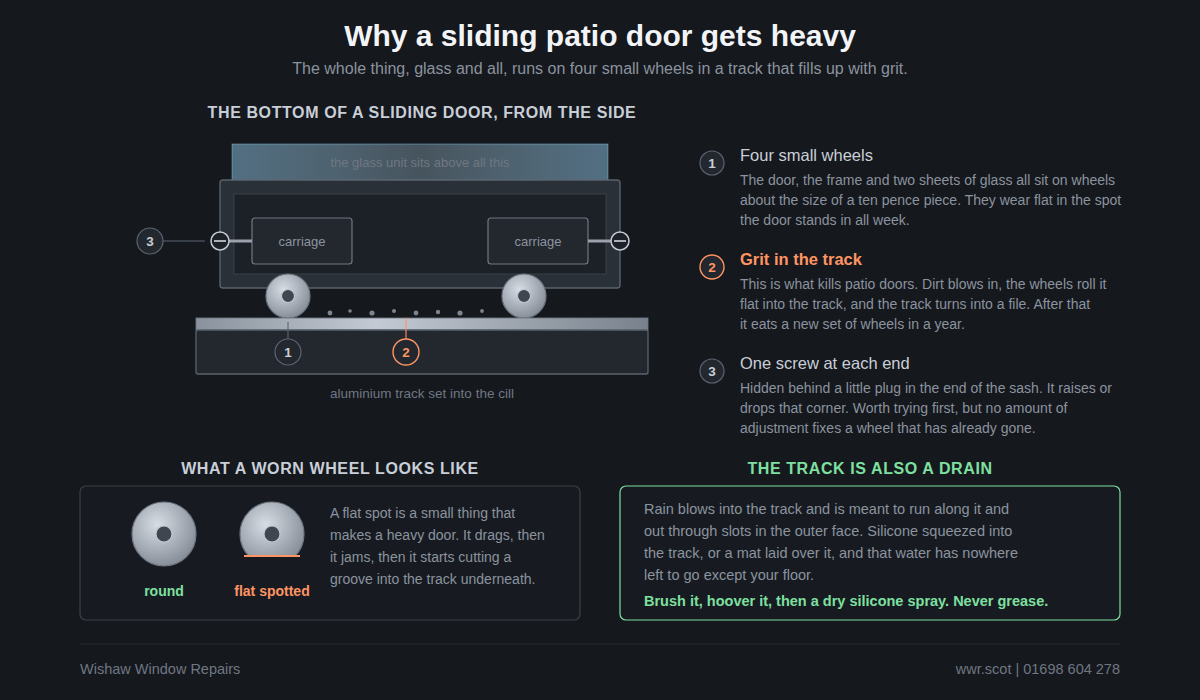
It’s getting harder and harder to slide. This is the classic, and nine times out of ten it’s the rollers. A sliding door runs on wheels that sit in a track along the bottom of the frame. Over years the wheels wear flat, seize up, or collapse under the weight, and the door starts dragging instead of rolling. What often happens first is that it becomes a two-handed job, then a shoulder job, and then one day it barely moves.
Before you assume the worst, look in the track. Grit, sand, dropped stones, dog hair and old lubricant build up into a solid ridge that the wheels have to climb over every time. Give the track a proper clean out with a vacuum and a stiff brush and see whether it improves. Sometimes that’s the whole problem, particularly on a door that opens onto a gravel path or a building site.
If it’s still heavy after cleaning, the rollers have gone and they need replacing. They’re a replaceable part, they come out with the door, and it’s a job of an hour or two rather than a new door. Most sliding doors also have an adjustment screw at each end of the bottom rail that sets the height, and getting that right afterwards is what makes the difference between a door that works and a door that works beautifully.
It’s dropped, or it catches at one end. Same cause. As the rollers wear unevenly, the door sits low at one end, the top of the door drifts out of parallel with the frame, and it catches or leaves a gap. New rollers and a proper height adjustment brings it back.
It slides fine but won’t lock. On a slider the lock is usually a hook or a set of hooks on the leading edge engaging into a keep on the fixed frame. If the door has dropped even slightly, the hook no longer meets the keep. Fixing the height usually fixes the lock at the same time. If the hook mechanism itself has failed, that’s a replaceable part too.
It rattles or draughts along the middle. The interlocking stiles where the two panels overlap have brush seals in them. When those wear down, air comes straight through the overlap. Fresh seals sort it.
French doors
French doors have a different set of problems, because instead of running on wheels they hang on hinges and have to meet each other in the middle.
One door won’t lock, or you have to lift and lean. Almost always a dropped door. Hinges wear, the leaf sags, and the multipoint hooks stop lining up with the keeps in the frame. If you find yourself pulling the door towards you or lifting it to get the handle up, that’s the symptom. uPVC French door hinges are usually adjustable in two or three directions, so a lot of these are corrected on the spot without any new parts.
The slave door won’t stay shut. On a pair of French doors, one leaf is the master and one is the slave. The slave door is held by shoot bolts that fire into the frame at the top and the bottom when you lift its handle, and then the master door locks against it. If the slave door feels loose, the shoot bolts aren’t reaching their keeps, either because the door has dropped or because the keeps have worked loose or worn.
The doors bind against each other in the middle. Often seasonal. uPVC expands in heat, and doors that clear each other comfortably in winter can rub in a July heatwave. If it only happens in warm weather, an alignment adjustment usually gives you the clearance you need year round. If they bind all year, something has moved more seriously and wants looking at.
The handle has gone stiff or floppy. On any door with a multipoint mechanism, a handle getting progressively harder to lift is a warning, not just an irritation. It means the mechanism is under strain from misalignment, or the gearbox inside is wearing out. Left alone, either the handle snaps or the gearbox fails, and a failed gearbox on a door you use to get in and out of the garden is inconvenient at best.
The thing that ties all of it together
Nearly every fault on this page is alignment or a worn moving part. Neither is a reason to replace a door, and both are cheaper and quicker to fix than people expect, because the frame and the glass, which are the expensive bits, stay exactly where they are.
The reason it’s worth catching early is that misalignment doesn’t sit still. A door that’s slightly out wears its rollers, hinges, seals and mechanism faster than a door that’s square, so a small adjustment now often prevents a parts bill later.
Worth knowing about security too
Patio and French doors are at the back of the house, out of sight of the street, which makes them the doors people worry about. If yours has its original cylinder from years back, it’s worth asking about an anti-snap upgrade at the same time as any adjustment work. Same visit, small cost, and a genuine difference.
Getting it sorted
We repair sliding patio doors and French doors throughout Wishaw and Lanarkshire, and it’s very rarely a replacement job. There’s no call-out charge.
A short video is worth more than a photo with these, so if you can, film the door doing whatever it’s doing, sticking, dropping, refusing to lock, and send it over on WhatsApp. Seeing it move tells us straight away whether it’s an adjustment or a part.
Call us on 01698 604 278 and we’ll get them running properly again.
We cover the south side of Glasgow for this sort of work as well as Lanarkshire.
Sliding patio doors, French doors and bifolds all come under the same uPVC door repair service.
Related advice
You will find around fifty more guides like this one in our advice section.
Written by the team at Wishaw Window Repairs. Over thirty years repairing uPVC windows and doors across Lanarkshire.