
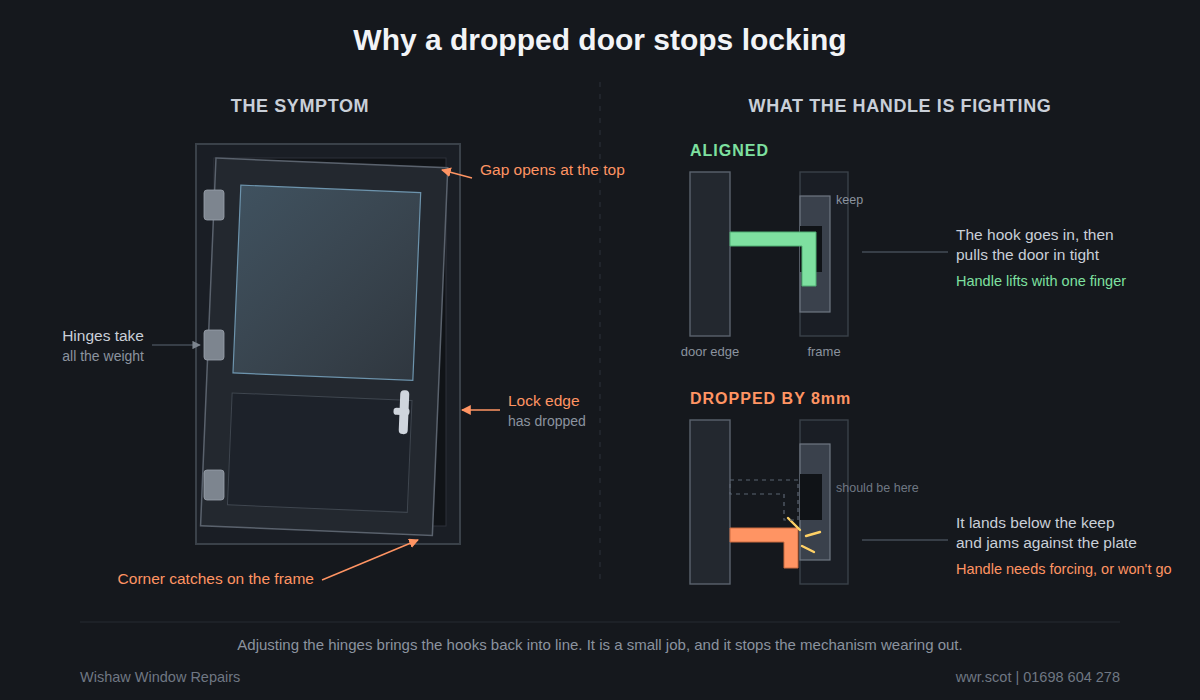
You can see it before you can feel it. The gap down the hinge side of the door is wider at the top than the bottom, or the handle side is rubbing a shiny mark on the frame near the threshold, or the door catches the sill on the way past and you’ve started lifting it slightly as you close it.
That’s a dropped door. It’s the single most common cause of stiff handles, keys that won’t turn and hooks that won’t find their keeps, and on most doors it’s correctable with an allen key in about twenty minutes.
This is one of the few jobs on a uPVC door that a careful homeowner can genuinely do themselves. So here’s how, and just as importantly, here’s where it stops being worth trying.
What the hinges can do
uPVC door hinges aren’t like the simple butt hinges on an internal wooden door. They’re adjustable, and depending on the type you’ve got, they adjust in up to three separate directions.
Height, or vertical. Raises and lowers the whole leaf in the frame. This is the one that fixes a door catching on the threshold, or a lock hook sitting below its keep.
Compression. Pulls the door tighter into the weather seal, or lets it sit further out. Too loose and you get draughts and a rattle. Too tight and the door is hard to close and the seal gets crushed flat over time. This one also affects how hard the handle is to lift, because it changes how firmly the hooks are pressed against the keeps.
Lateral, or side to side. Moves the leaf towards or away from the hinge jamb, which changes the gap down the closing edge.
Not every hinge has all three. Rail or butt style hinges usually give you all of them. Flag hinges often give height and compression only. Have a proper look before you start turning things.
Doing it
Most adjustment screws are hidden under plastic caps, which either pop off with a thumbnail or lever off gently with a small flat screwdriver. Underneath you’ll find allen key sockets, commonly 4mm or 5mm.
- Shut the door and look at the gaps. All the way round. Note where it’s tight and where it’s wide. It helps to pencil a mark on the frame level with the top corner of the door so you can see what you’ve moved.
- Pop the caps off every hinge, not just one. You need to see what you’ve got before you turn anything.
- Turn a quarter turn at a time. Not a full turn. A quarter, then shut the door and test it. These adjustments are finer than people expect and it is very easy to overshoot and end up worse than you started.
- Move all the hinges together. This is the rule that matters most. If you raise the top hinge and leave the bottom one, you are not moving the door, you are twisting the leaf. A twisted door won’t seal along its whole length no matter what you do to the lock afterwards, and on a door with a big glazed panel you can put the frame of the leaf under a strain it wasn’t built for.
- Test with the handle, not just your eye. The door might look square and still lift stiffly. Lifting the handle smoothly with one hand is the result you’re after.
- Put the caps back on. They’re not decoration, they keep water and grit out of the adjuster.
If a quarter turn one way makes it worse, go the other way. And if an adjuster has reached the end of its travel and the door still isn’t right, stop there rather than forcing it.
Leave the keeps alone until the door is square
The keeps are the metal plates on the frame that the hooks and rollers land in, and they’re fitted on slotted holes so they can be nudged up or down a few millimetres.
People start here, because it looks like the obvious fix. The hook isn’t going in the hole, so move the hole.
Don’t. If the door has dropped, moving the keeps to chase it means the leaf is still sitting crooked in the frame, the seal is still compressed unevenly on one side, and the door is still leaning on its hinges wrong. You’ve hidden the symptom and left the cause. Then it drops another millimetre and you’re back out with the screwdriver.
Alignment first, always. Keeps afterwards, for fine tuning, once the door itself is sitting where it should.
Where hinge adjustment stops helping
Adjustment has a range, and a door that’s dropped a long way has usually used it up for a reason.
If the hinges themselves are worn, and you can often tell by grabbing the closing edge of an open door and lifting, feeling for play or a clunk, then adjusting them just relocates the problem. The wear is still there, the door will settle back down within weeks, and you’ll be turning the same screws again. Worn hinges get replaced, and it isn’t a big job.
The other one that adjustment can’t touch is a sagged leaf. This happens on doors carrying heavy glass, particularly wide doors with a large sealed unit or a decorative panel low down. Over years, the weight works on the corner joints of the door frame itself and the leaf goes very slightly out of square, dropping at the corner furthest from the hinges. Look at the door itself rather than the gap around it. If the leaf has gone out of square, no hinge adjustment fixes it, because the hinges are holding a shape that’s changed. Sometimes the glass can be reset and the leaf squared up as part of that. Sometimes it can’t.
Worth knowing, because it’s the difference between a twenty minute job and a conversation, and you’d rather have that conversation than spend a Saturday turning screws that were never going to work.
If you’d rather not
There’s no shame in it, and there’s no call out charge, so it costs nothing to have somebody look at it who does this every day. Hinge adjustments, worn hinges, keeps repositioned, all done on the door you’ve got. We’re in Wishaw and out across Lanarkshire most days.
A photo helps more than a description here. Shut the door, stand back, and take one picture of the whole door in its frame so we can see the gaps. Send it on WhatsApp, or ring 01698 604 278 and tell us what it’s catching on.
If adjusting the hinges does not bring it back into line, the hinges themselves are worn, and replacing them is a standard door repair.
Related advice
- How secure your door lock really is
- A door that will not lock in the heat
- Patio and French door repairs
- French doors that will not close
Photographs on WhatsApp are the quickest route to an answer. Contact us here.
You will find around fifty more guides like this one in our advice section.
Written by the team at Wishaw Window Repairs. Over thirty years repairing uPVC windows and doors across Lanarkshire.