
We got a call last spring from a woman in East Kilbride who was convinced her back door was broken because she had to heave the handle up before the key would go round. She’d had it eight years and thought it had developed a fault.
It hadn’t. That’s how the door has always worked. But the reason she’d noticed it was that the lift had gone from easy to a proper shove, and that part was a fault, and it was about six weeks off breaking something expensive.
So this article is two things. First, why lifting the handle is meant to happen. Second, what it means when the lift starts fighting you.
Lifting the handle is the lock
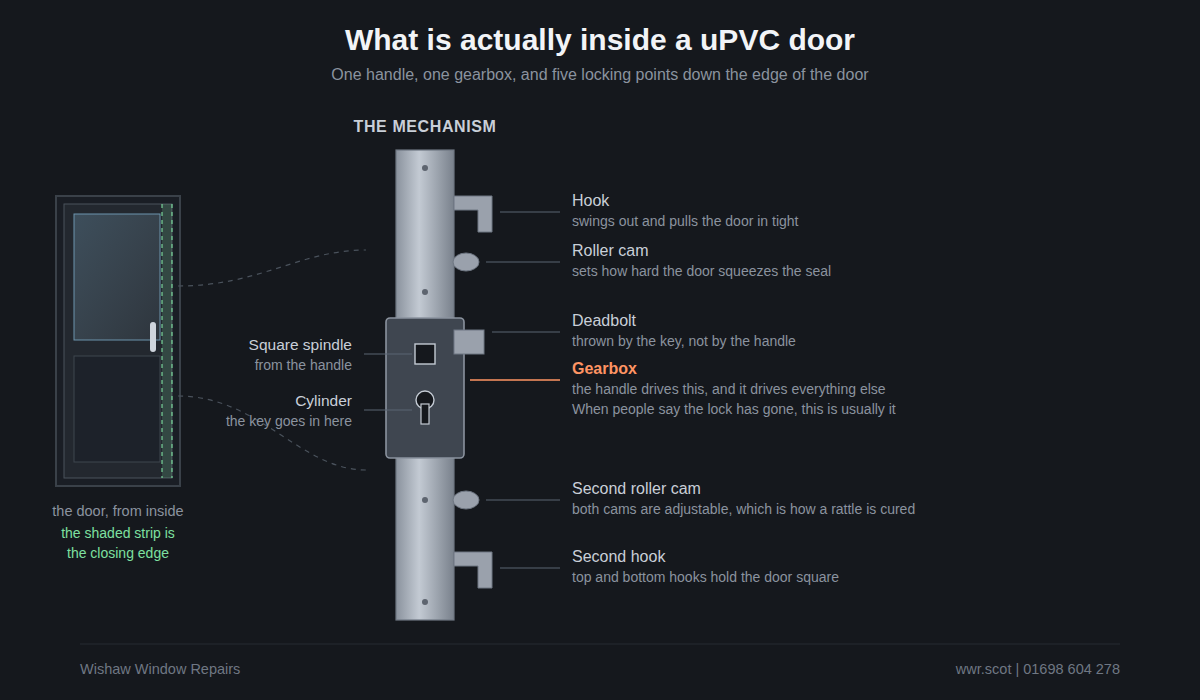
A uPVC door doesn’t lock like a wooden one. There’s no single bolt shooting into a hole in the frame. Instead there’s a multipoint mechanism, a long steel strip running the full height of the door edge, carrying hooks, rollers, and usually a deadbolt near the middle.
Lifting the handle is what drives all of those out at once. The handle turns a square spindle, the spindle turns the gearbox in the middle of the mechanism, and the gearbox pushes the drive rails up and down the door so every hook and roller shoots out into its keep on the frame at the same moment. That’s the noise you hear.
The key does something different and smaller. Once the points are out, turning the key deadlocks them so they can’t be driven back. On most doors the key alone throws nothing at all.
Which means lifting isn’t optional and it isn’t a design flaw. If someone has told you a door that needs lifting is faulty or out of date, they were probably measuring you for a new one.
Now the actual problem
A healthy multipoint lifts with one hand, smoothly, without you bracing against the door. If yours does anything else, take it seriously.
The three ways it goes wrong:
The handle has become stiff to lift. You can still do it, but you’re leaning on the door or using both hands, and it’s got worse over months.
The handle won’t lift at all. It moves an inch and stops dead against something solid.
The handle lifts fine but the key still won’t turn. The points are out, but something is stopping the deadlock.
Every one of those has the same first diagnostic step, and it’s the most useful test in this trade.
Open the door and try it
Swing the door wide open, so the edge of it is nowhere near the frame, and lift the handle.
That’s it. That’s the test, and it splits the problem cleanly in two.
If it lifts freely with the door open, the mechanism is fine. All of it. The gearbox is working, the drive rails are moving, the hooks are coming out. The resistance you feel with the door closed is the hooks and rollers hitting the frame instead of sliding into the keeps, because the door is no longer sitting where it used to. That’s an alignment job, not a lock job.
If it’s stiff with the door open too, nothing is touching the frame and it’s still hard, so the fault is inside the door. Usually the gearbox, sometimes wear in the drive rails or a spindle that’s rounded off. That’s a mechanism replacement.
Same test for the key. Door open, key turns sweetly, and the lock is healthy.
I’d say this test saves more wasted callouts and more wrongly replaced parts than anything else I could tell you.
What alignment actually means
Doors move. The hinges wear slightly, the frame settles, the leaf takes a knock, the plastic expands in July and contracts in January. A couple of millimetres is all it takes for a hook to catch on the lip of its keep rather than drop in.
Bringing it back is two adjustments. The hinges have adjustment built in, so the whole leaf can be raised, dropped, moved side to side and pulled tighter into or away from the seal. And the keeps, the metal plates on the frame that the hooks land in, are on slotted screw holes so they can be shifted a few millimetres up or down.
Order matters. The hinges come first, because they move the whole door and put everything back where it belongs. The keeps come after, to fine tune. Anyone who reaches for the keeps first is chasing the symptom around the frame.
Forcing a stiff handle is how gearboxes die
This is the bit worth taking away.
The gearbox is a small casting with a cog and a set of levers in it, sat in the middle of that long steel strip. It’s built to move the drive rails, and nothing more. It is not built to be used as a lever to shove a fifty kilo door back into position.
When the door is out of alignment, every lift is you loading that gearbox against a hook that’s jammed on a keep. It’ll take it for a while. Then a tooth goes, or a cast lever cracks, and it happens with a small snap and the handle goes loose and floppy in your hand.
At that point the door usually can’t be locked at all, and if it happened while it was locked, you’re on the wrong side of it. The mechanism has to come out, which means the door has to open, which is a much longer afternoon than it needed to be.
An alignment while the handle is merely stiff is a short job. The same door two months later, after the gearbox has gone, is a part and a fitting. The stiffness was the warning.
Don’t wait for the snap
If your handle has started needing a shove, get it looked at while it’s still only stiff. If it’s already gone floppy or won’t lift at all, treat it as urgent rather than a weekend job, because a front door you cannot secure at night is a worry you don’t need.
Ring us on 01698 604 278, or send a short video on WhatsApp of the handle doing what it’s doing, door open and door shut. Those two clips usually tell us the answer before we’ve left Wishaw. No call out charge either way.
When lifting the handle stops working altogether it is the multipoint mechanism, and fitting a new one is routine uPVC door repair work.
Related advice
Ring 01698 604 278 or contact us here.
Stuck on something else? Our window and door advice section covers around fifty of the faults we see most.
Written by the team at Wishaw Window Repairs. Over thirty years repairing uPVC windows and doors across Lanarkshire.