
A door is the one part of the house you use every single day, and it is usually the last thing anybody thinks about until it stops locking on a cold morning or starts letting a draught across the hall. We are a family run outfit based in Wishaw, and doors are about half of what we do: repairs, locks, hinges, panels, glass and full replacements. This page pulls all of it together in one place so you can work out what you actually need before you ring anybody.
If it is windows you are after rather than doors, our windows in Wishaw page does the same job for those.
Repair or replace, and how to tell which you need
Most people ring us assuming the door is finished. It usually is not. A uPVC or composite door is a frame, a slab, a hinge set, a multipoint lock and a cylinder, and every one of those parts can be replaced on its own without touching the rest. The slab and the frame are the expensive bits, and they are also the parts that last longest.
What tends to go is the mechanism. A door that has to be lifted, shoved or leaned on before the key will turn has almost always dropped on its hinges, which is an adjustment rather than a replacement. A handle that spins loose has a broken spindle or a snapped spring cassette. A key that will not turn is usually a worn cylinder or a gearbox on its way out. None of those need a new door.
Replacement genuinely is the answer when the frame itself has gone, when the slab has delaminated or blown at the bottom edge, when a timber door has rotted through, or when the whole thing is old enough that parts are simply no longer manufactured. It is also the answer when what you want is different from what you have: a solid panel where there is glass, a wider opening, or a front door that does not look like it was fitted in 1998.
We will tell you which one it is. If a thirty pound part fixes it we will say so, because we would rather do the small job well and be the people you call the next time than sell you something you did not need.
uPVC door repairs in Wishaw
This is the bulk of our door work and most of it falls into a handful of faults we see week in, week out. Our uPVC door repairs page covers the service itself, and there is a fuller run through of the everyday problems below.
A dropped door is the most common of the lot. The hinges take the whole weight of the slab, and over years of opening and closing that weight pulls the door out of square by a few millimetres. Suddenly the lock keeps will not line up. Almost every uPVC and composite hinge has adjustment built in for exactly this, and there is a walkthrough in adjusting a dropped uPVC door.
Handles are next. A snapped door handle and a handle that spins loose are different faults with different fixes, and neither means the lock is broken. Getting the right replacement is mostly a question of measuring the screw centres and the spindle, which is easy enough once you know to do it.
Then there are the lock faults. A door that will not lock without lifting the handle is behaving normally, and that surprises people. A key that will not turn usually is not. A key snapped off in the lock can often be extracted without destroying the cylinder if nobody has been at it with pliers first. And if you are locked out of your uPVC door there is a page on what your options actually are.
Seasonal faults catch people out too. A door that will not lock in hot weather is expanding, and the fix is an adjustment rather than a new door. At the other end of the year a draughty front door is nearly always a perished weather seal or a compression setting that has drifted, both of which are cheap to put right.
If the door is a set of French or patio doors the parts are different again, and those have their own page on patio, French and sliding door repairs, with advice on French doors that will not close. Composite doors have their own quirks, covered in composite door repairs. For the wider picture on what any of it costs, there is uPVC door repair costs.
Locks, cylinders and the security side
The multipoint mechanism running up the edge of a uPVC or composite door is what actually secures it. Turning the key throws hooks, rollers or deadbolts into the frame at several points, which is why these doors are hard to lever open. The cylinder, the barrel the key goes into, is a separate part and it is the part that gets attacked.
Older cylinders can be snapped by hand in seconds by anybody who has watched a video about it. Anti snap cylinders to the current British standard are designed to break in a controlled place and leave the locking cam intact, and swapping one in is a ten minute job on most doors. If your cylinder sticks out more than a couple of millimetres past the handle plate, that is worth a look. There is more on all of it in uPVC door lock security.
A gearbox failure is the other lock job we do regularly. You will usually get warning: the handle starts feeling gritty, or you have to jiggle it, or it works nine times out of ten. Getting it changed at that point is a straightforward swap. Leaving it until it fails completely with the door locked shut is a much bigger and messier job, so if the handle has started feeling wrong, ring us.
If the door works but nothing about it feels right any more, a full door service is often the answer. Hinges reset, keeps realigned, compression set properly, moving parts lubricated and seals checked, all in one visit. It is the cheapest way to add years to a door that somebody has been meaning to sort out for a while.
The door types we fit
Composite doors are the standard choice for a front door now, and with good reason. A solid timber or foam core is wrapped in a glass reinforced plastic skin, which gives you the thickness and the thud of a timber door with none of the sanding and painting. They come in a wide range of colours and glazing designs and they hold their finish. Palladio, the range we fit most often, is built differently again: a 65mm fibreglass monocoque with an insulated core rather than a skinned slab.
uPVC front and back doors remain the sensible answer where budget matters or where the door is not on show. They are lighter than composite, cheaper, and perfectly secure with the right hardware. A back door taking a beating from a north facing wall does not need to be a composite door to do its job.
French doors give you a full width opening with two leaves, and they suit a rear wall where the opening is wide but not enormous. Patio doors slide instead of swinging, which is the right call when there is furniture or a path immediately outside. Bi-fold doors concertina back against the wall and open up almost the entire wall, and they are the most involved of the three to fit and to keep running properly. All three are on our patio and French door page for the repair side.
Where the door itself is sound but the panel is tired, dated or damaged, a replacement door panel gets you a new looking door for a fraction of the cost of a new one, because the frame, the hinges and the lock all stay where they are. It is one of the better value jobs we do and a lot of people do not know it is an option.
Composite or uPVC, and what actually separates them
Quotes for these two can be a long way apart and both be fair, so it helps to know what you are paying for.
Thickness and weight come first. A composite slab is typically around 44mm and heavy, and that weight is most of why it feels solid and why it insulates and sounds better. A uPVC door is a lighter hollow profile with insulation in the chambers. Both keep the weather out. They do not feel the same in the hand.
The finish is second. Composite colour goes right through the skin, so a scratch does not show white underneath, and the surface does not need painting. Coloured uPVC is a foil laminated onto the profile, which is durable but is a surface layer. Anthracite grey is the colour everybody asks for at the moment in both.
Hardware is third and it matters more than either of the above. Hinges, the multipoint mechanism, the cylinder and the handle are the parts that wear, and they are the parts you will be dealing with in ten years. A recognised brand you can still buy spares for is worth more than an extra few millimetres of slab. Ask what is going in, and ask whether the cylinder is anti snap.
Fitting is fourth and it is where jobs actually go wrong. A well made door hung badly will drop, drag and stop locking. A lot of firms sell doors and subcontract the fitting to whoever is available that week. With us there is no subcontractor from quote to finish, which is a large part of why the work stays right.
Glass in doors
Any glass in a door, and any glass in a side panel next to a door, has to be safety glass. That is not a preference, it is the building regulations, and it means toughened or laminated rather than ordinary float glass. The same applies to any pane whose bottom edge sits below 800mm from the floor. The difference between the two types, and when each is the better choice, is set out in toughened or laminated glass.
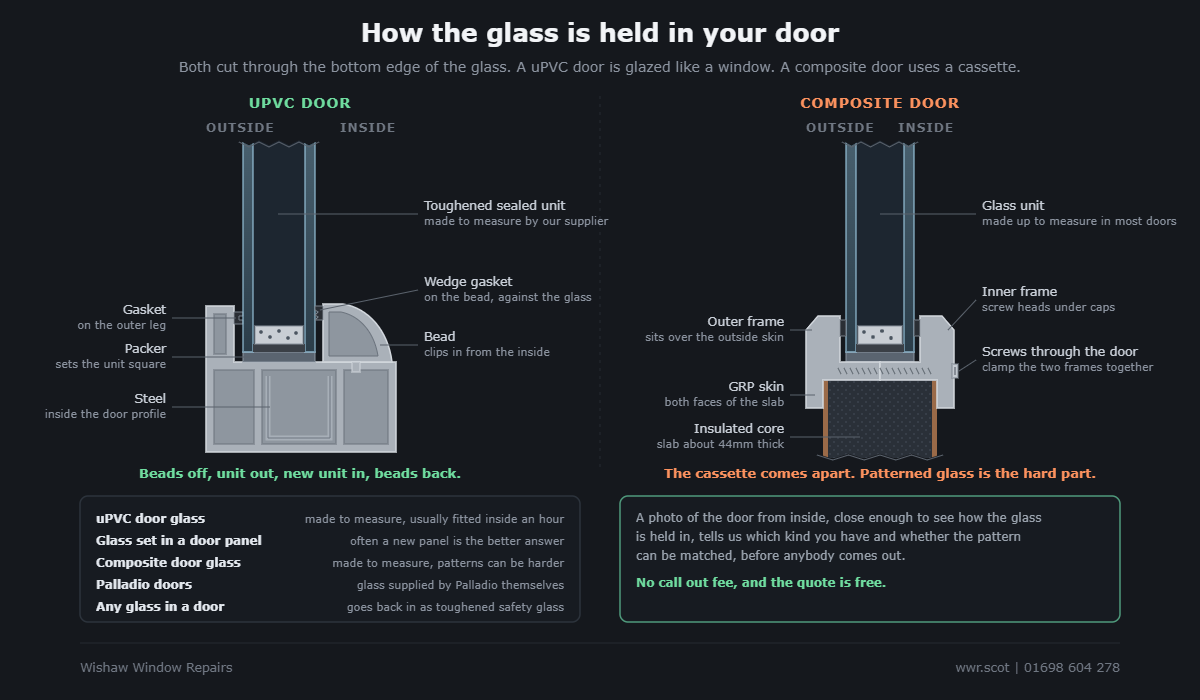
Door glass mists up for the same reason window glass does, and it is fixed the same way: the sealed unit is replaced and the door stays where it is. There is more in misted double glazing and on our glass unit replacement page. If privacy is the issue, obscure patterns are covered in choosing obscure glass. Composite door glass sits in a cassette rather than behind beads, and our door glass replacement page explains how that changes the job.
What it costs
There is no call out fee. You pay for the work done.
Sealed unit replacements start from £75, and that figure is for a hopper sized pane, the small opener above a window. Everything beyond that is quoted on the job, because every job genuinely is different. A cylinder swap, a gearbox, a hinge set, a replacement panel and a new composite door on a new frame are five different pieces of work with five different parts bills, and publishing invented ranges would only mislead you.
What moves the price on a door job is which part has failed, whether the mechanism is a current pattern or something long discontinued, whether the glass is toughened or laminated and what size it is, and whether the frame is staying or going. We would rather look at it, tell you what it needs, tell you what that costs and let you decide with nothing owed either way. There is more on how we price in uPVC door repair costs and on our repair prices page.
The quickest way to a rough figure without anybody travelling is a photograph. Send us a picture of the whole door and a close up of whatever is giving trouble, plus the make and model stamped on the edge of the lock if you can see it, and we can usually tell you what we are looking at.
Worth a read alongside this: secondary glazing or new windows if you are weighing options in an older property, and repair or replace for the honest version of that decision.
Doors, in our customers’ words
One new door and one repair, from our Google reviews.
“Had a new door fitted by Wishaw windows today. Workmanship excellent attention to detail first class. Love my door”
Patricia, Google review
“Jim came and replaced my locks and repairs the handles on the side door on the same day I called.”
Adele, Google review
Every one of our reviews is on Google, and there is a selection on our reviews page.
Where we work
Wishaw is home and it is where most of our work is, but we cover a good part of Lanarkshire and beyond: Motherwell, Hamilton, Bellshill, Coatbridge, Airdrie, Newmains, Shotts, Larkhall, Blantyre, Uddingston, Carluke, Lanark, East Kilbride, Cambuslang, Rutherglen and out towards Glasgow. The full list, with a page for each, is on areas we cover.
Getting a price
Ring 01698 604 278 between eight and five, Monday to Friday, and you will get one of us rather than a call centre. Send a photo to WhatsApp if that is easier and we will come back to you. Or write it down on the contact form and it reaches us just the same.
You can see the sort of work we turn out on our before and after gallery, and what people have said about it on our reviews page. Whether it turns out to be a ten minute adjustment or a new door on a new frame, you will get the same straight answer about which one it actually is.
For everything else we do, doors and windows together, see our full list of services.