
We are repairers first. That is not modesty, it is how the business works. Most weeks somebody rings us convinced they need the whole house done, and most weeks we find a failed sealed unit, a worn friction stay or a hinge that has dropped four millimetres, and they keep the windows they already have.
But sometimes replacement genuinely is the answer and new double glazing is the right call. When it is, we will say so, and we will fit them.
This page is about that side of the work. What we supply, which styles suit which houses, what actually drives the price, and how to tell whether you are at that point yet.
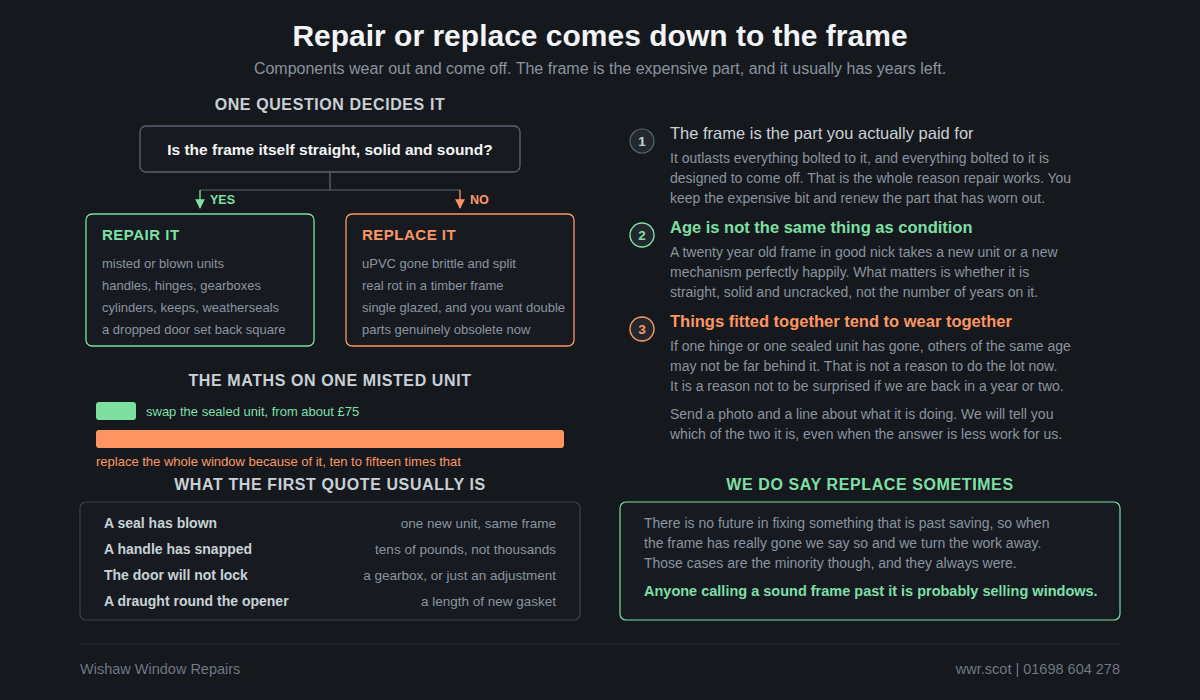
When new windows are actually the right call
There are five situations where we stop trying to save a window and tell people to replace it.
The frame itself has failed. uPVC does not rot, but it can crack, and a crack that runs through a corner weld is not repairable in any honest sense. Older frames that have gone brittle in strong sun will crack again next to wherever you patch them.
The glazing is single. If you still have single glazed units in a Scottish house, no repair changes the fact that you are heating the street. That is the one case where the energy argument stands up on its own.
The hardware is obsolete and the sizes have moved on. We hold a lot of parts and we can usually find something, but there are systems from the early nineties where the espagnolette, the stay and the keeps were all proprietary and none of it is made any more. When we cannot get parts for three windows in the same house, replacing them is cheaper than chasing them.
The window is the wrong shape for how you now use the room. A kitchen with a fixed pane where you want an opener, a bedroom with no fire escape opening, a bathroom with clear glass. Those are not faults. They are reasons.
You want them changed. That is allowed. Nobody has to justify wanting a nicer looking house to us.
If none of the five describes your windows, read repair or replace before you spend anything. It goes through the arithmetic properly.
The double glazing styles we fit
Most Scottish houses take one of five or six window styles, and the right one is usually decided by the building rather than by taste.
Casement windows are the default across Lanarkshire. A hinged opening sash in a frame, side hung or top hung. Simple, well proven, and the cheapest of the lot to keep going in twenty years time because the hardware is standard.
Tilt and turn windows do two things from one handle. Tilt inwards at the top for ventilation you can leave open safely, or swing the whole sash inwards for cleaning and for escape. Common in flats and in anything above the first floor.
Flush sash windows, also called flush fit windows, sit level with the outer frame instead of standing proud of it, which gives you the line of an old timber window without the maintenance. If your street is full of period stone frontages, this is usually the one that looks right.
Reversible windows rotate right round so the outside pane ends up facing into the room. In a tenement flat or a top floor bedroom where the outside of the glass is otherwise unreachable, they solve a problem nothing else solves.
Vertical sliding sash windows are the uPVC version of the traditional Scottish sash and case. The sashes slide up and down on balances rather than swinging out.
Bay windows, corner posts, curved heads and Georgian bar layouts are all doable in any of the above. Matching an existing bay is measuring work rather than a different product.
What uPVC actually means when you are comparing quotes
Two quotes for uPVC windows can be hundreds of pounds apart and both be honest, because uPVC is a material, not a specification. A few things account for most of the difference, and knowing them lets you compare like with like.
Chambers first. A profile is not solid plastic, it is a hollow extrusion divided internally into chambers, and more chambers means more still air and a better insulating frame. Five chambers is the sensible modern standard. If a quote does not say, ask.
Reinforcement second. Larger sashes and frames need galvanised steel or an equivalent stiffener inside the profile, and it is invisible once the window is in. It is also the easiest thing in the world to leave out on a cheap job, and you find out three winters later when a wide sash has bowed and stopped locking.
Hardware third. Hinges, friction stays, handles and locking gear are where the wear happens, and it is the part of the window you will be dealing with in a decade. Recognised brands with parts you can still buy are worth more than an extra chamber.
Colour last. Anything other than white is a foil laminated onto the profile, and coloured foils cost more and usually take longer to come. Anthracite grey outside with white inside has been the most requested combination round here for a few years now.
Glass, and what to ask for
The frame gets all the attention. The glass does most of the work.
A standard modern sealed unit is two panes with a warm edge spacer and argon between them, with a low emissivity coating on the inner face of the outer pane. That coating is the single biggest thing separating a good unit from a poor one, and you cannot see it.
The spacer bar round the edge matters too. A warm edge composite bar performs noticeably better than old aluminium at the point where most condensation forms. Whether the gas has gone is a question we get regularly and we have answered it in has my double glazing lost its gas. If you want to know what the window ratings on the sticker mean, window energy ratings explained covers it.
Triple glazing adds a third pane. It is not the automatic upgrade the adverts suggest, and we have written honestly about whether it is worth it in a house like yours.
Beyond that:
- Safety glass is not optional in doors, in side panels next to doors, and in any pane whose bottom edge sits low to the floor. Toughened or laminated, and there is a difference between the two worth understanding.
- Obscure glass for bathrooms comes in a range of patterns with different privacy levels. Changing the pattern does not mean changing the window.
- Acoustic laminated glass is the honest answer for traffic noise. Triple glazing is not.
- Georgian bars can be inside the unit, stuck to the surface, or a proper astragal. They look quite different from the pavement and they cost quite differently too.
- Trickle vents are worth having, and worth understanding before you decide you hate them.
Choosing a window company in Wishaw
You will not need much advice about us specifically, but you might find some about the process useful, because window buying has a reputation and it is largely earned.
A price that halves while the salesman is still sitting in your living room was never a real price. A discount that expires tonight is a technique, not an offer. Neither tells you anything about whether the windows are any good. What does tell you something is whether the person quoting has actually opened the window and looked at the hinge, whether they can name the profile system and the hardware, whether the quote is itemised, and whether they are willing to tell you that you do not need what you asked about.
Fitting matters more than the window itself. A well made window fitted badly will drop, drag, whistle and stop locking, and you will be phoning somebody about it inside three years. A sensibly specified window fitted properly will be forgotten about for two decades. That is not a small difference and it is the part of the job you cannot inspect afterwards, because it is all behind the trim.
Ask who is doing the work. A lot of quotes come from firms who sell and then subcontract the fitting, and the fitting is where jobs go wrong. With us there is no subcontractor, start to finish. We have gone into the wider question in choosing a window repair company, and you can read what our customers have said on our reviews page or see the work on our before and after gallery.
Who actually does the work
This is where we differ from most of the window companies in Lanarkshire, and it is the main reason people pick us.
The person who comes out to measure is the person who fits the windows. There is no salesman on commission, no surveyor who never sees the job again, and no subcontract fitting team who were booked last Tuesday and have never met us. Whatever gets agreed at the measuring stage is carried through to the fitting, because nobody new comes into it.
It also means we are not incentivised to sell you windows. We repair for a living, so if your existing frames are sound and it is the glass or the hardware that has failed, we will tell you that and quote the repair instead. Nobody here gets a better month for talking you into a full replacement, and our reviews reflect that fairly consistently.
What it costs
We do not publish window prices, and we are suspicious of anybody who does.
A window price is a function of size, style, glass specification, how many openers you want, the colour, whether there is a bay or a curved head involved, and what has to happen to the surrounding wall when the old one comes out. Any number quoted before somebody has measured is either a guess or a hook.
What we can tell you is how we quote. Somebody comes out and measures. There is no charge for that and no charge for the visit. You get a figure. The figure does not expire on Friday, it does not halve if you sign tonight, and there is nobody on commission in this business, because there is no sales team at all.
If replacement turns out to be the wrong answer for what you have got, we will tell you that at the measuring stage rather than after you have paid for it. Sealed unit replacements start from £75 for a hopper sized pane, the small opener above a window, and a lot of jobs that look like whole window jobs turn out to need only a new sealed unit. Our repair prices page covers what that figure includes.
Two things worth reading before you commit to anything. Window energy ratings explains what those A and A plus labels actually measure, which is less than the salesman implies. And double glazing guarantees covers what a twenty year guarantee is really worth and what to check before you sign one. On the security side, sash jammers are a cheap addition worth knowing about.
Scotland is not England
This catches people out, usually because they have read an English website.
FENSA does not operate in Scotland. Replacement windows here come under the Scottish Building Standards rather than the English building regulations, and the certification schemes that operate north of the border are different ones. The energy standards, the ventilation requirements and the rules on escape openings from bedrooms are all set in Scotland.
If your property is listed, or sits in a conservation area, the rules tighten considerably and uPVC may not be permitted at all. Your local authority is the one that confirms what applies to your address, and it is worth a phone call before you order anything. Our notes on the Scottish rules cover the general shape of it.
What fitting day looks like
People worry about the mess and the disruption more than anything else, so it is worth setting out plainly.
We work room by room rather than opening the whole house up at once, so you are never left with several holes in the wall at the same time. The old window comes out, the opening gets cleaned up and checked, the new frame goes in and is packed and levelled, then it is fixed, sealed and trimmed. Each window is finished before the next one starts.
The plaster around the reveal is the other thing people ask about. Done properly there is very little, but any window that was fitted before the current generation of trims can leave a line that wants filling and painting, and we would rather warn you than surprise you.
Before we arrive it helps if curtains, blinds and anything on the sills are down and out of the way, and if there is clear access outside. We put sheets down inside, and we take the old frames and glass away with us rather than leaving them in your garden.
How long it takes depends on how many and what they are going into. A single straightforward casement is a short job. A full house is usually a small number of days rather than a week. We will tell you the realistic figure when we quote rather than an optimistic one, because we would rather be right than sound fast.
Questions people ask before ordering
Do I have to do the whole house at once?
No, and plenty of people do not. Doing the front elevation first, or the worst two or three, then coming back to the rest later is completely reasonable. As long as the profile and colour are recorded, matching them up in a year or two is straightforward.
Can I keep the same style, or should I change it?
Either. Most people replace like for like because it suits the house, but it is a good moment to reconsider. If cleaning upstairs windows is the problem, reversible windows solve it. If ventilation is the problem, tilt and turn. If the frontage is the priority, flush sash. Worth five minutes of thought while the decision is open.
How long is the wait?
New windows are made to your measurements, so there is a manufacturing lead time between ordering and fitting. We will give you the current honest figure when we quote. Repairs are a different matter and most are done on the visit.
Will new windows stop my condensation?
Sometimes, and not always, and it is worth understanding before you spend. If the condensation is between the panes then yes, because that is a failed unit. If it is on the room side of the glass, that is humidity and ventilation, and new windows can occasionally make it worse by sealing the house up tighter. Our window condensation page explains which is which.
Do you do doors at the same time?
Yes, and doing them together usually makes sense for matching colours and for the disruption happening once. Our doors in Wishaw page covers that side.
New doors, in a customer’s words
Sean first had us replace a pane of glass, and then came back to us for new French doors.
“Price was a lot cheaper than other quotes I received and installation was really quick.”
Sean, Google review
Every one of our reviews is on Google, and there is a selection on our reviews page.
Where we work
Wishaw, Motherwell, Hamilton, Bellshill, Airdrie, Coatbridge, Larkhall, Carluke, Lanark, Shotts, Blantyre, Uddingston, Cambuslang, East Kilbride, the south side of Glasgow and out as far as Livingston. The full list is on our areas we cover page.
Getting a figure
Send photographs on WhatsApp if you want a rough idea before anybody comes out. A picture of the window from inside, one from outside, and a rough width and height is usually enough for us to tell you whether you are in repair territory or replacement territory.
Otherwise ring 01698 604 278, Monday to Friday, eight until five, or contact us here.
Before you replace anything, it is worth reading what is involved in double glazing repairs, because in most cases one component has failed rather than the whole window.
If a composite front door is what you have in mind, our composite doors page covers the Palladio range we fit most often.
Written by the team at Wishaw Window Repairs. Over thirty years repairing and replacing uPVC windows and doors across Lanarkshire.