
It’s a classic. The first proper warm spell of the year arrives, and suddenly your front or back door won’t lock. You lift the handle and it won’t go up, or it goes halfway and jams, or the whole door feels like it’s fighting you. Come the cool of the evening it works perfectly again, so you tell yourself you imagined it. Then it happens again the next hot afternoon.
You’re not imagining it, and there’s nothing wrong with you. Heat and uPVC doors just don’t get along, and it’s one of the most common summer callouts we get around Wishaw. Most of the time it’s fixable, and quite often you can sort it yourself in a couple of minutes. Here’s what’s happening and what to try.
Why heat stops the door locking
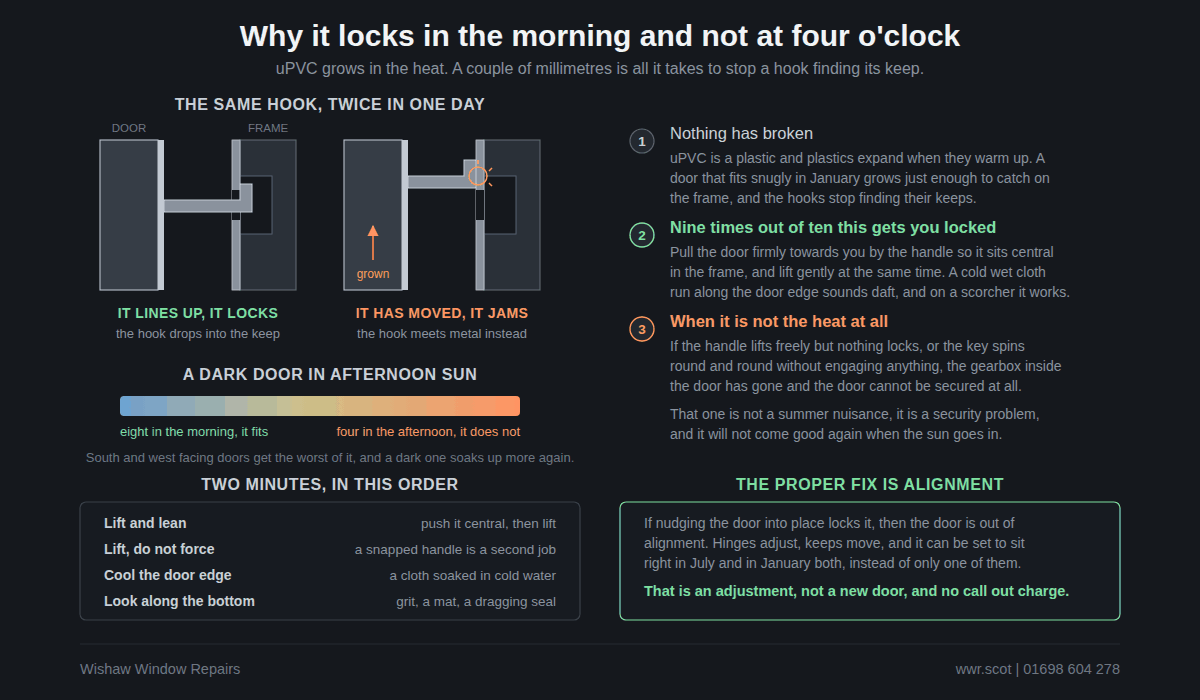
uPVC expands when it warms up. It’s a plastic, and on a hot day a door that fits snugly in winter can grow just enough to catch against the frame. When that happens, the locking points on the edge of the door (the hooks and rollers of the multipoint mechanism) no longer line up with the keeps they’re supposed to slot into on the frame. You lift the handle to throw those bolts, they hit metal instead of the gap they need, and the handle won’t complete its travel.
South and west-facing doors get the worst of it because they take the full afternoon sun. A dark-coloured door is worse again, since darker plastic soaks up more heat. None of this means the door is broken. It’s just moved a whisker out of alignment because it’s warm.
Try this first, before you call anyone
Nine times out of ten one of these gets you locked up:
- Lift and lean. Pull the door firmly towards you by the handle (or give it a gentle shoulder if it opens outwards away from you), so you’re pushing it back into proper alignment with the frame, and try lifting the handle at the same time. Getting the door central in its frame is often all it needs.
- Lift, don’t force. If the handle won’t lift, never wrench it. The plastic handle can snap and then you’ve a second problem. Ease it up gently while jiggling the door.
- Cool it down. If it’s a mechanism that only sticks in the heat, cooling the door edge can shrink it back enough to lock. A cloth soaked in cold water run along the frame edge sounds daft, but it buys you the locking you need on a scorcher.
- Check for the obvious. Make sure nothing’s fouling the bottom of the door: a dragging draught excluder, grit in the threshold, a mat pushed underneath.
If the door locks once you’ve nudged it into place, the underlying issue is alignment, and that’s a proper fix rather than a nightly wrestling match. The hinges can be adjusted and the keeps repositioned so the door sits right whatever the weather.
When it’s more than the heat
There’s an important difference between a door that’s stiff and a door whose mechanism has actually failed, and it’s worth knowing which you’ve got.
If the handle lifts freely but the door won’t stay locked, or the key spins round and round without engaging anything, the multipoint gearbox inside the door has likely packed in. That’s the part that drives all the locking points at once, and when it goes the door often can’t be locked at all, which is a security problem rather than just an annoyance. Don’t leave it. A failed gearbox can usually be replaced without touching the rest of the door, and it’s a lot cheaper than a new door.
Likewise, if the handle has gone floppy, or the key is getting harder and harder to turn over weeks rather than just on hot days, the cylinder or the mechanism is wearing out and will eventually leave you locked out (or unable to lock up). Better to catch it before it strands you on the doorstep.
A quick word on security
While we’re on the subject, if your door still has its original barrel from years back, it’s worth asking about an anti-snap cylinder. A lot of older uPVC doors were fitted with cylinders that can be snapped in seconds by anyone who knows the trick, and upgrading to a proper anti-snap one is an inexpensive job that makes a real difference to how secure your home is. Worth doing at the same time as any lock work.
Getting it looked at
A sticking or unlocking door is exactly the sort of thing we sort day in, day out. Hinge adjustments, new keeps, replacement gearboxes and cylinders, all done on your existing door with no need to replace it. We cover Wishaw and right across Lanarkshire, there’s no call-out charge, and if you’re not sure how serious it is, take a photo or a quick video of the door doing its thing and send it over on WhatsApp. We’ll tell you honestly whether it’s a two-minute adjustment or a part that needs replacing.
Give us a ring on 01698 604 278 and we’ll get you locking up properly again.
If it keeps happening once the weather cools down, the door needs adjusting properly, and that is a simple door repair.
How much movement are we actually talking about
People are often sceptical that heat alone can stop a door locking, so it is worth putting numbers on it.
uPVC expands roughly seven times more than steel for the same rise in temperature. A two metre door leaf sitting in direct afternoon sun can easily be twenty five or thirty degrees hotter than it was at breakfast, and that produces a couple of millimetres of growth across the height of the slab. On a dark coloured door it is more, because anthracite and black absorb considerably more heat than white.
Two millimetres does not sound like much until you remember what it has to do. The locking hooks have to drop into keeps with only a millimetre or two of clearance each side. Take that clearance away and the hook lands on the edge of the keep instead of in it, and the handle stops lifting.
Which is why this is almost never a door that has suddenly broken. It is a door that has been running with almost no clearance for a while, and the heat has taken away the last of it. That matters, because it tells you the underlying fix is to get the clearance back rather than to wait for autumn.
The winter version of the same fault
The opposite happens too and it confuses people even more, because a door that was fine all summer starts rattling and letting draughts through in January.
Cold shrinks the slab, the compression against the weather seal drops off, and you get a draught round a door that was perfectly tight three months earlier. If somebody adjusted the door in high summer to cure a sticking problem, that adjustment is often what causes the winter draught, because the door has been set up for its expanded size.
This is exactly why a proper adjustment is not just winding a hinge until the door shuts today. It is finding a setting that works at both ends of the year, which usually means adjusting the door and the keeps rather than either on its own. A door set up properly should lock without effort in February and in July.
Questions we get asked
Should I just wait until it cools down?
For tonight, yes, and it will very likely lock again by morning. As a plan for the summer, no. Every time you force the handle against a door that is binding you are loading the gearbox, and a gearbox that gets that treatment through a warm spell often fails in the autumn when the weather has nothing to do with it. The heat is the trigger, the forcing is the damage.
Would a lighter coloured door solve it?
It would reduce it, and it is worth knowing if you are choosing a new door for a south facing wall. A white door runs cooler than an anthracite one in the same position by a noticeable margin. But it is not the real answer for a door you already own, because a correctly set up dark door does not stick either. The colour makes the margin tighter, it does not create the problem.
Is it worse on composite doors?
Usually less bad, because the timber or foam core moves less than a hollow uPVC profile does. What composite doors bring instead is weight, so they are more prone to dropping on their hinges, which produces the same symptom for a different reason. Either way it is an adjustment rather than a replacement.
My patio doors do it too
Same physics, larger panels, and often a bigger effect because a sliding or bi-fold run has a lot more length to expand along. On sliders it usually shows up as the door getting heavy rather than refusing to lock. Our patio, French and sliding door repairs page covers that side.
Can I stop it happening next summer?
Yes, and this is the point of getting it looked at rather than waiting it out. Restoring the proper clearance, resetting the keeps and getting the compression right gives the door somewhere to expand into. A door set up correctly has enough margin to cope with a heatwave without anybody noticing. A door service covers exactly that, and the same visit sorts the seals so you do not get the winter draught either.
It sticks in the heat and it has also dropped
Very common, and they compound each other. A dropped door has already eaten most of its clearance, so it is the first one to bind when the temperature climbs. Sorting the drop usually cures the heat problem as a side effect. There is a walkthrough in adjusting a dropped uPVC door.
Related advice
- Doors in Wishaw: repairs, locks, panels and replacements
- How secure your door lock really is
- Adjusting a dropped door
- Why you have to lift the handle
See our door repair service page for what we do and where. You can also message us here.
You will find around fifty more guides like this one in our advice section.
Written by the team at Wishaw Window Repairs. Over thirty years repairing uPVC windows and doors across Lanarkshire.