
A patio door tells you it is in trouble long before it actually fails. It gets heavy. You find yourself putting a shoulder into it, or lifting the handle twice, or leaving it on the latch because locking it properly has turned into a fight. Hardly anybody rings us at that stage. They ring when it finally will not shut at all, and that is nearly always a wet Friday afternoon.
The good news is that the door itself is rarely the thing that has broken. Sliding doors, French doors and bi-folds all fail at their moving parts, and moving parts are wearing parts. Wheels, hinges, gaskets, shootbolts, gearboxes and glass units are all things we take out and put back in. The frame you already own usually has years left in it.
We repair patio, French, sliding and bi-fold doors across Wishaw, Motherwell and the wider Lanarkshire area. There is no call out charge, so having someone look at it costs you nothing until there is a job to do. We have more than a hundred five-star reviews on Google if you want to see what other customers made of us.
Sliding patio doors: it is nearly always the wheels
A sliding door hangs its entire weight on a handful of small wheels. That is the whole design. Sixty or eighty kilos of glass and frame, riding on four nylon or steel rollers that sit in a carriage in the bottom edge of the door, running along a track in the sill. When the door slides beautifully, those wheels are turning. When it does not, they have stopped turning and started dragging.
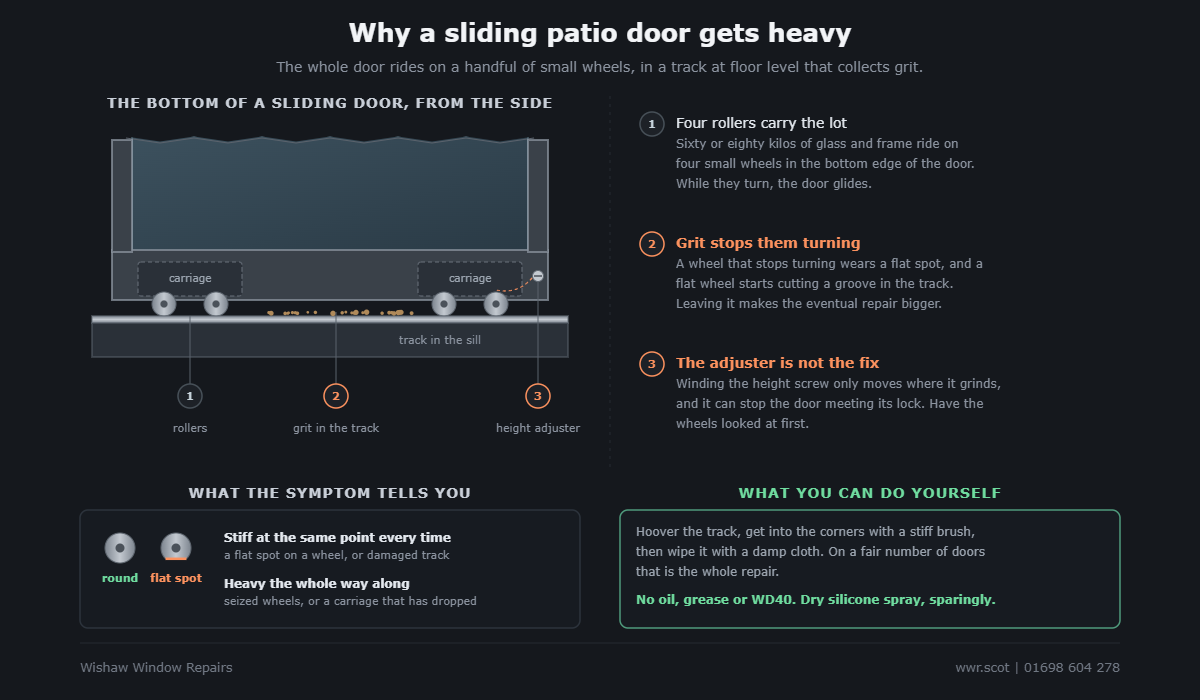
What stops them is grit. The bottom track is an open channel at floor level, sitting right where the garden is, so it collects sand, soil, bits of leaf and whatever the dog brings in. That debris packs into the track and jams the wheel. Once a wheel stops rotating it develops a flat spot, and from then on it is no longer a roller, it is a skid. Worse, the flat wheel starts machining a groove into the aluminium track, which is why leaving it makes the eventual repair bigger.
The symptom tells you a fair bit. If the door runs sweetly for the first foot and then goes stiff at the same point every time, you are either dropping into a damaged section of track or turning a flat spot on the wheel. If it is heavy along the whole run, the wheels have seized or the carriage has dropped so the door is sitting on the track rather than on the rollers.
There is one thing worth doing yourself before you phone anybody. Hoover the track out properly, get into the corners with a stiff brush, then wipe it with a damp cloth. On a fair number of doors that is the entire repair. What you should not do is put oil, grease or WD40 in there. It feels like the right instinct and it makes things worse, because the oil holds every bit of grit that lands in it and turns the track into grinding paste. If you want to use anything, use a dry silicone spray, sparingly.
Most sliding doors also have a height adjuster, a small screw behind a plastic cap in the vertical edge of the door, that raises and lowers the carriage. It is tempting to wind it. The trouble is that it only ever masks the real fault: if the wheel is flat, lifting the door just moves where it grinds. It also changes how the door meets the lock keep, so people who adjust the height to cure a sticking door frequently end up with one that will not lock. Have the wheels looked at first.
French doors and the leaf that drops
French doors work on a completely different principle and fail in a completely different way. You have two leaves. One is the master, carrying the handle and the multipoint lock. The other is the slave, held shut by shootbolts that fire into the frame at the top and the bottom, released by a lever on its inside edge. The master then locks into the edge of the slave. Everything about the door depends on those two leaves meeting each other squarely in the middle.
Each leaf hangs on hinges, and on uPVC doors those are usually flag hinges, adjustable in two or three directions with an allen key once you know which screw does what. That adjustability is the reason so many French doors that feel finished are actually twenty minutes of work.
Here is why they drop. The open leaf of a French door is a long lever with a lot of weight at the far end. Every time somebody leans on it, or the wind catches it and swings it hard, all of that load goes through the top hinge. Do that for a few years and the leaf rotates a couple of millimetres about the top fixing. It does not look like anything. But the bottom outer corner is the furthest point from the hinge, so a two millimetre rotation at the top becomes a noticeable drop down there, and that corner starts catching the threshold.
Look for a bright polished patch or a scuff on the threshold near the outer corner. That mark is the door telling you exactly what is wrong, and it means the fix is an adjustment rather than a new door.
The slave leaf gives itself away differently. When the leaves are out of line, the shootbolts stop meeting their keeps cleanly, and the lever gets harder and harder to throw. People push through it, because the door still shuts if you lean on it. What eventually happens is that the shootbolt rod bends or the drive shears, and now a job that was an adjustment needs a new mechanism. If that lever has started needing a firm shove, that is the moment to get someone out, not six months later.
Some French doors only bind in summer. uPVC expands in the heat, so a pair that clears comfortably in January can rub in the middle during a July heatwave. If it only happens in warm weather, an alignment adjustment usually gives the doors enough clearance to see them through the whole year.
Broken and misted glass in patio and French doors
Glass in a door is not the same as glass in a window, and this is the part where it matters that whoever does the work knows the rules. Any pane in a door, any pane in a side panel next to a door, and any pane whose bottom edge sits below 800mm from the floor has to be safety glass, either toughened or laminated. This is a building standards requirement, not a preference, and it exists because these are the panes people walk into and fall against. Every unit we fit into a door goes back as safety glass.
You can check what you have. Toughened glass carries a small etched stamp, usually in a bottom corner of the pane, giving the manufacturer and the standard it was made to. If a big pane of glass in your patio door has no mark anywhere on it, that is worth mentioning when you ring, because it may well be ordinary annealed glass that should never have been put there.
If your patio door glass has gone cloudy, hazy or has water sitting between the panes, the sealed unit has failed and the fix is a new unit rather than a new door. We have written up how that failure actually happens in our guide to misted double glazing, and the same thing applies to a door pane as to a window. The frame, the hinges, the lock and the handles all stay exactly where they are.
On price, sealed unit replacements start from £75, and that figure is for a hopper sized pane, the small opener above a window. A patio door pane is a much larger piece of glass and it has to be toughened, so it will be more than that. We do not publish a price list for door glass because there is no honest way to write one. The cost moves with the size, whether it is toughened or laminated, whether it is clear, obscure or has a low emissivity coating, and whether the unit can be carried through the house or has to go round the back. Big door units are heavy and awkward to handle, and that is part of it too.
When the door will not lock
Lift the handle on a modern patio or French door and you are driving a gearbox buried in the edge of the leaf. That gearbox pushes a steel rod up and down the door, and along that rod sit the hooks, rollers and deadbolts that swing out into keeps machined into the frame. Turning the key then locks the gearbox in that position. It is a good system and it is why these doors are hard to force, but it means a single small failure anywhere along the rod stops the whole door locking.
There are really only two faults, and you can tell which one you have in about ten seconds. Open the door so it is standing clear of the frame, and lift the handle. If it lifts smoothly and you watch all the hooks and bolts throw out along the edge, the mechanism is perfectly healthy and your problem is alignment: the door has moved and the hooks are no longer finding their keeps. That is a hinge and keep adjustment. If instead the handle is stiff with the door standing open, or it flops up with no resistance at all and nothing moves, something inside the gearbox has sheared and it needs replaced.
One thing to be firm about. If a door has locked itself with the mechanism jammed and you cannot get in, do not start levering at it or attacking the frame. We get called to doors where the forcing has cost several times what the original gearbox would have, and it turns a same day repair into a frame repair. Ring us and we will deal with it properly. There is more on this in our page on uPVC door repairs.
Patio and French doors are at the back of the house, out of sight of the street. If yours still has the cylinder it was fitted with, it is worth asking about an anti-snap cylinder at the same visit as any adjustment.
Draughts, and water appearing on the inside of the frame
Sliding doors and hinged doors keep the weather out in different ways, so they let it in differently too.
A slider seals with brush pile, a strip of dense bristle set into a groove in the frame and the door edge. Brush pile only works while the bristles are standing upright. After ten or fifteen years of the door being dragged across them they lie flat, and once they are flat the wind goes straight over the top. You can usually see it: run a finger along and the pile should push back at you. If it feels like a worn out toothbrush, that is your draught.
Hinged French doors seal on a rubber gasket that the closed door squashes flat. Rubber takes a set as it ages, going hard and staying compressed instead of springing back, and at that point the door is closing onto a strip of plastic that is no longer touching it. Both of these are cheap parts, and we cover the detail in our article on window seals and gaskets.
The one that catches people out is water. The bottom of any patio door frame has drainage slots cut through the outer face, because the frame is designed on the assumption that rain will get into the bottom channel and need somewhere to go. Those slots block with dirt and moss. Once they are blocked the channel fills up, and when it fills past the internal upstand the water comes over the inside edge and onto your floor. Nine times out of ten this gets reported to us as a failed seal, when the frame is simply full.
Clearing them takes a few minutes with a thin screwdriver and a bit of wire, and it is worth doing every autumn. If your patio door has started weeping on the inside after heavy rain, look at the drainage slots before you assume anything expensive.
Bi-fold doors
Bi-folds are a different animal again and they are less forgiving than either of the above. The leaves hang from carriages in a top track, or run on rollers in a bottom track depending on the system, and each leaf is hinged to the next. Because five or six panels have to fold and stack against each other, a small error anywhere is multiplied by the time it reaches the end of the run.
That means a bi-fold cannot be sorted with one adjustment the way a single French door often can. It needs setting up along its whole length, leaf by leaf, and rushing it produces a door that shuts but does not lock, or locks but drags on the floor. It takes longer, and we would rather tell you that in advance than turn up and pretend otherwise. The parts themselves, carriages, hinges and running gear, are still parts.
Is it worth repairing, or has it had its day?
Sometimes it has had its day, and we will tell you when that is the case. An aluminium slider from the seventies or eighties sitting in a rotted timber sub frame is often past sensible repair, and so is a uPVC door where the frame itself has gone brittle and chalky and starts cracking whenever a screw is driven into it.
But that is the frame, and the frame is almost never what failed. What failed was a wheel, a hinge, a gasket, a gearbox or a sealed unit, and every one of those is a wearing part that was always going to need replacing at some point in the door’s life. Replacing a whole patio door because its rollers are worn is like scrapping a car for a set of tyres.
You will not always hear that from a company whose business is selling new doors. If somebody has been out, glanced at a sticking patio door and quoted you for a full replacement without taking a cap off or opening the leaf to look at the mechanism, get a second opinion before you sign anything. We have gone into this properly in repair or replace. If it does turn out you need new, we fit replacement windows and doors as well, so we have no reason to steer you either way.
What a patio door repair costs
We do not charge a call out fee. You pay for the work done, and if there is nothing worth doing we will say so.
Beyond the £75 starting point for a hopper sized sealed unit, every job is quoted on its own, because every one genuinely is different. A wheel set for a slider, a hinge adjustment on a pair of French doors, a multipoint gearbox and a toughened glass unit are four completely different jobs with four different parts bills, and putting invented ranges on a web page would only mislead you. What we can do is look at it, tell you what it needs and what it will cost, and let you decide with no pressure and nothing owed.
The fastest route to a rough figure without anyone travelling is a photo. Send us a picture on WhatsApp showing the door, the area that is giving trouble and, if it is a lock or a hinge, a close up of the part with the door open. We can usually tell you what we are looking at from that. There is more general costing detail on our window repair prices page and in our article on uPVC door repair costs.
Patio doors, in a customer’s words
Stevie needed new glass in a patio door, and while Jim was there he adjusted the doors so they close properly again.
“Absolutely delighted with the glass repair on our patio doors… he left no mess and also adjusted the doors so they now close correctly…”
Stevie, Google review
Every one of our reviews is on Google, and there is a selection on our reviews page.
Getting yours looked at
We are a family run firm with over thirty years in the trade, working out of Wishaw and covering Motherwell, Hamilton, Bellshill, Coatbridge, Airdrie, East Kilbride and most of Lanarkshire. You can see the full list on our areas we cover page.
Ring 01698 604 278 between eight and five, Monday to Friday, and you will get one of us rather than a call centre. Or send a photo to WhatsApp and we will come back to you. If it is easier to write it down, the contact form reaches us just the same.
Patio and French doors are one part of the picture. For everything else we do on doors, including front and back doors, locks, panels and replacements, see our doors in Wishaw page.
Sticking patio doors do not fix themselves and they do get more expensive the longer they grind. It costs nothing to find out what is actually wrong with yours.
If you can, film the door doing whatever it is doing, whether that is sticking, dropping or refusing to lock, and send the video on WhatsApp. Seeing it move usually tells us straight away whether it is an adjustment or a part.