
You lift the handle and nothing happens. No resistance, no click, none of that solid clunk you get when the hooks shoot out of the edge of the door. On some doors the lever carries on turning right the way round, over and over, like a tap with nothing plumbed to it.
The lever has come adrift from the thing it is meant to be driving. Nine times out of ten that is a five minute diagnosis and a small part, so before anyone talks you into a new door, here is what is going on inside.
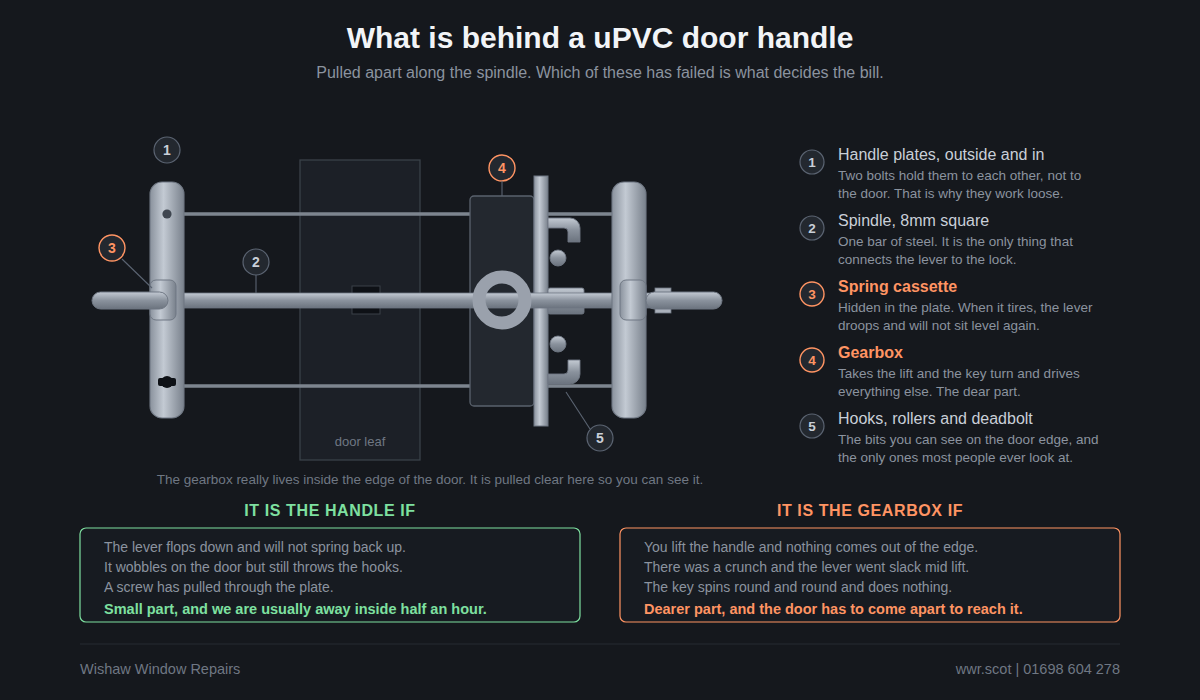
The square bar that does all the work
Take the inside handle off a uPVC door and you will find a short square steel bar running through the middle of it, usually 8mm across. That is the spindle. It passes from the outside handle, through the door and through the lock case buried in the door edge, and out into the inside handle. The two handles are not connected to each other except through that bar.
Inside the lock case, the multipoint gearbox has a square hole in it called the follower, and the spindle sits in that hole. Lift the handle, the spindle rotates, the follower rotates, and a set of cams and gears converts that turn into vertical travel along the locking strip, which pushes the hooks or rollers out into the keeps on the frame.
Everything your handle does, it does through that one bar.
The three faults, and they are the only three
A sheared spindle. Steel is strong but 8mm is not much, and all the twisting force concentrates where the bar enters the follower. On a door that has gone stiff, where you have been leaning on the handle to get it up, the bar eventually twists and snaps at that exact spot. You are left with one half of it still sitting in the follower and the other half turning uselessly in a handle.
A stripped handle. The square socket inside the handle rounds off. This is wear rather than a break, and it is far more common on cheap handles than good ones. The corners of the square hole get worn away until the spindle simply turns inside it without carrying it round.
A failed gearbox cam. Here the handle and spindle are both fine and the gearbox they drive has given up. A cam or a gear inside the case has broken, so the follower turns and nothing downstream of it moves. This is the dearest of the three and the one most often misdiagnosed as a handle problem.
How to work out which one you have without taking anything apart
Three questions will usually get you there.
Does it spin all the way round, repeatedly? A handle that is properly engaged cannot do a full 360, because the gearbox stops it. If yours goes round and round with nothing stopping it, the connection has failed before the gearbox: sheared spindle or stripped handle.
Does it spring back? Lift it and let go. If it drops with a definite thump, a return spring is still doing its job, which means something is still connected. If the lever stays wherever you leave it, floppy and dead, nothing is engaged at all.
Does the other side still work? This is the useful one. Try the handle on the opposite face of the door. If the inside handle lifts the mechanism normally and only the outside one spins, the spindle has sheared partway along and the inside half is still gripping the follower. That is the classic signature of a broken spindle. If both handles spin freely, suspicion moves to the follower or the gearbox itself.
Why it went in the first place
Two root causes come up again and again on doors round Wishaw and Motherwell.
The first is spindle length. Spindles come in a range of lengths to suit different door thicknesses and different handle backplates. Fit one that is slightly too short and it only just catches in the follower, a couple of millimetres of engagement instead of a proper seat. All the load bears on that tiny bit of contact and it chews the corners off the bar. Too long is no better, because the handles cannot be drawn fully home and you get the same partial engagement at the other end. A handle fitted with whatever spindle happened to be in the van will often work perfectly for a year and then start slipping.
The second is the handle itself. A lot of budget handles are die-cast zinc alloy, and zinc is softer than the hardened steel spindle running through it. Every lift is metal grinding on metal, with the softer one losing. A handle with a steel insert in the socket lasts a great deal longer, and the price difference is small.
Underneath both sits a stiff door. If the mechanism is fighting you, every operation puts far more twist through the spindle than was ever intended, and a handle that gets harder to lift over a period of weeks is telling you about alignment rather than about itself.
Can you still lock up, and how urgent is it?
Often you can, at least partly. If one handle still drives the gearbox, you can normally throw the hooks from that side, and plenty of people carry on for a few days locking up from the inside.
What matters is that on nearly all uPVC multipoint doors the hooks are engaged by lifting the handle, not by the key. The key only locks the mechanism once the handle has done its part. So a door where neither handle works has its hooks in, however many times you turn the key. It is on the latch and the deadbolt, no more than that.
A spinning handle on a door you can still shut and secure is annoying rather than an emergency. It will keep.
A door standing open is different, particularly if the hooks were thrown out before the handle failed. Hooks sticking proud of the door edge will not pass the frame, so the door physically cannot be pulled to, and you have an open doorway you cannot close. Say so when you ring, because we treat that differently.
What we check first
The first thing we do on arrival is take the handle off and look at the end of the spindle and the inside of the socket. Then we turn the follower directly with a test spindle. If the mechanism runs sweetly on the test bar, the gearbox is sound and you need a handle and a correctly sized spindle. If it does not, the gearbox is the fault, and that is still a repair rather than a new door.
No call out charge, and we cover Wishaw, Motherwell and the surrounding Lanarkshire towns. A photo of the handle from the side, plus one of any maker’s name stamped on the long metal faceplate in the door edge, tells us what to bring. Send them on WhatsApp, or the phone is 01698 604 278, Monday to Friday.
A spinning handle is usually a snapped spindle or a worn gearbox, and either way it is a straightforward door repair.
Getting through the night with a spinning handle
If the handle has gone in the evening and the door is your only way in and out, there are a couple of things worth knowing before you decide how urgent this is.
If the door is currently shut and locked and you are inside, you are secure. The mechanism holds where it is whether or not the handle turns. The problem is getting out and back in, not staying safe overnight.
If the door is shut but you could not throw the lock, it is on the latch only, which is not secure. Use another door if you have one, and treat it as worth sorting quickly rather than in a fortnight. If the door is your only external door, say that when you ring, because it changes how we schedule it.
What you should not do is keep working the handle hoping it will catch. On a broken spindle each attempt chews the remaining engagement, and on a failed spring cassette it does nothing at all. On a door where the gearbox is the real culprit, forcing it is what turns a part into a bigger part.
What the repair actually involves
For a spindle or a handle failure, it is a straightforward swap. Two screws through the handle plate, the old handle and spindle out, the new one in, and the door is working again. It is not a long job and it does not involve taking the door off or disturbing the glass.
The measurements matter, which is why a photograph in advance saves a second visit. Door handles are specified by the screw centres, usually 122mm or 92mm on a uPVC door, by the spindle length, and by the backset, which is the distance from the edge of the door to the centre of the spindle. Send a picture of the handle with a tape measure across it and we will bring the right thing.
Where it turns out to be the gearbox rather than the handle, the job is bigger but still very much a repair. The mechanism comes out of the edge of the door, the gearbox is replaced, and everything goes back. The slab, the frame and the glass are untouched. That is covered on our uPVC door repair page.
Questions we get asked
Can I just buy a handle and fit it myself?
If the fault really is the handle or the spindle, plenty of people do, and it is a reasonable job for anybody comfortable with a screwdriver. The catch is that a fair proportion of spinning handles are not the handle at all, so the risk is that you buy a part, fit it, and the problem is still there. Working out which of the three faults you have first, as set out above, is what saves the wasted money.
The handle works one way but not the other
That points at the spindle rather than the springs. A spindle that has sheared or rounded off often still catches in one direction where the remaining metal bites, and gives nothing in the other. It is a cheap part and a quick change.
It only does it when the weather is warm
Then the handle is probably fine and the door has expanded, so the hooks are meeting resistance and the handle feels like it is giving up. That is a different problem with a different fix, and it is covered in a uPVC door that will not lock in the heat.
Should I replace both sides?
Handles come as a pair joined by the spindle, so in practice yes, both sides get changed together. It is the same job and the same part. It also means the inside and outside match, which they will not if somebody has previously changed only one.
Is a spinning handle a security risk?
It can be, because it can leave a door that looks shut sitting on the latch with none of the multipoint hooks thrown. From outside there is no way to tell the difference. If you cannot get the hooks to engage, treat the door as unlocked and use another one until it is fixed. While we are there we will also tell you whether the cylinder is a snap resistant type, which is covered in uPVC door lock security.
How do I stop it happening again?
Spindles and springs mostly fail because the door has become stiff and people have been applying more force to compensate. So the real answer is to sort the stiffness rather than the handle. If the door has to be lifted or leaned on before it locks, deal with that, because it is the thing quietly destroying the hardware. Our advice on adjusting a dropped uPVC door covers the usual cause, and a door service deals with the lot in one visit.
Related advice
- Doors in Wishaw: repairs, locks, panels and replacements
- How secure your door lock really is
- A snapped door handle
- Why you have to lift the handle
See our door repair service page for what we do and where. If you would rather just ask, get in touch.
More like this: browse all fifty guides in our window and door advice section.
Written by the team at Wishaw Window Repairs. Over thirty years repairing uPVC windows and doors across Lanarkshire.