
A composite door is the one most people in Wishaw end up choosing for a front door now, and once you have stood next to one you can usually see why. It is thick, it is heavy, it shuts with a proper thud rather than a rattle, and it does not need painting every couple of summers. We fit them, we repair them, and we are honest about when you do not need one.
We are a family run business based in Wishaw. There is no sales team and no commission, so nobody here has a reason to talk you into a door you do not want. If your existing door can be put right for a fraction of the money, we will tell you that instead. Our doors in Wishaw page covers the full picture across every door type.
What a composite door actually is
The word composite means it is built from more than one material, and that is the whole idea. Inside there is a solid core, usually a dense timber laminate or a high density polyurethane foam, sometimes both. Around that core there is a glass reinforced plastic skin, the same family of material used for boat hulls, moulded to look like grained timber. The edges are capped, the slab is bonded together under pressure and the whole thing is hung in a uPVC or aluminium outer frame.
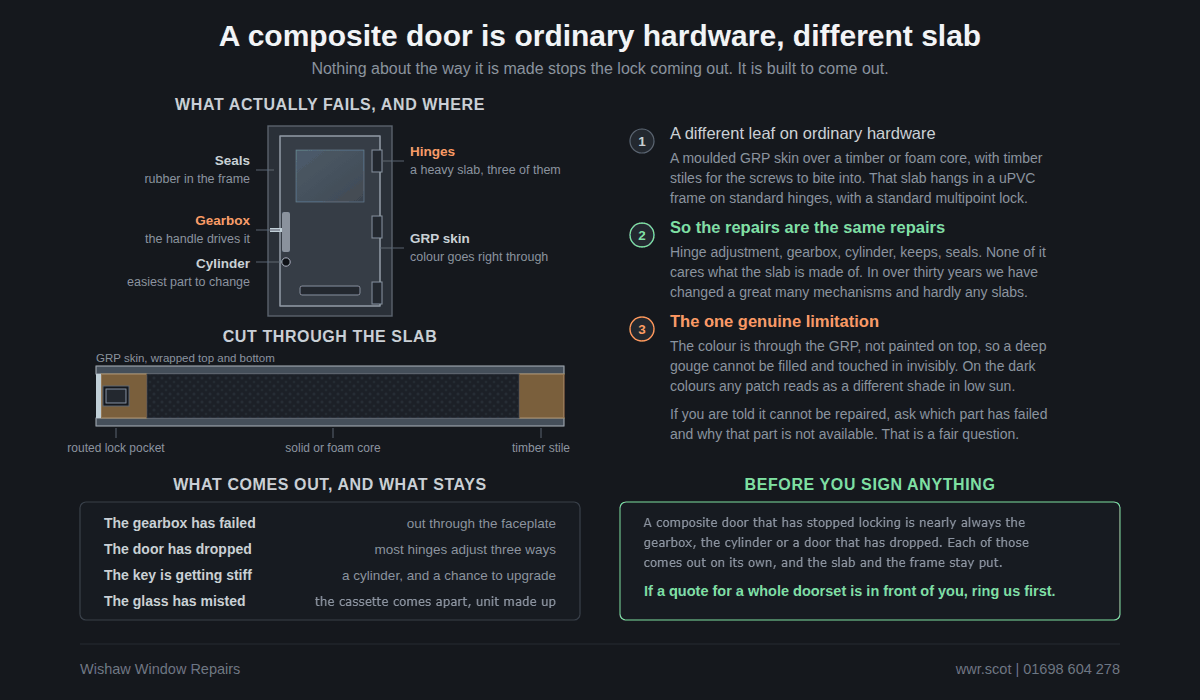
That build is why a composite slab is typically around 44mm thick and heavy enough that you notice it when you swing it. A uPVC door is a hollow multi chamber profile with insulation in the voids, which is a perfectly sound way to build a door and a lot lighter. The composite feels different because it is denser, and density is what gives you the sound deadening and a good part of the insulation.
The other half of the story is the finish. On a composite door the colour is moulded through the skin rather than stuck on top, so a knock or a scratch does not show white plastic underneath. On a coloured uPVC door the colour is a foil laminated onto the profile. Modern foils are tough and last well, but they are still a surface layer and they can be lifted at an edge if something catches them.
Composite or uPVC, honestly
A composite door costs more than a uPVC one. Anybody who tells you otherwise is selling something. The question is whether the difference is worth it on your particular opening, and the answer is not always yes.
Where composite earns its money is a front door on a busy road, a door that faces the weather square on, a door people see from the street, or a house where the front door is a big part of how the place looks. The heft, the noise reduction and the finish all show up every day in those situations.
Where a uPVC front or back door is the sensible answer is a back door onto a garden, a side door into a utility, a flat entrance that opens into a shared close, or any opening where budget is the deciding factor. A uPVC door with good hardware is secure, warm and weather tight. It will not feel like a composite door in the hand, but it will do the job for years.
The thing that matters more than either choice is the hardware. Hinges, the multipoint mechanism, the cylinder and the handle are the parts that wear out, and they are the parts you will be phoning somebody about in eight or ten years. A well specified uPVC door with a recognised mechanism will give you less trouble than an expensive composite slab hung on cheap hardware. Ask what is going in. If the answer is vague, ask again.
Security and locks
Composite doors are hard to get through by force, which is exactly why the people who break into houses do not usually try. They go for the cylinder instead, the barrel your key slots into, because on an older or cheaper door that cylinder can be snapped by hand in seconds with tools anybody can buy.
An anti snap cylinder to the current British standard is designed so that if it is attacked it breaks at a sacrificial line and leaves the locking cam still doing its job. Fitting one is a short job on most doors and it is the single cheapest thing you can do to make a door harder to get past. A quick check: if the cylinder sticks out more than two or three millimetres past the handle plate, it is giving somebody something to grip. There is a longer explanation on our uPVC door lock security page, and it applies to composite doors just the same.
Behind the cylinder sits the multipoint mechanism, the long strip up the closing edge that throws hooks, rollers or bolts into the frame when you lift the handle and turn the key. That is what actually holds the door shut. It is also the part with moving gears in it, and gearboxes do fail eventually. They usually warn you first, which is worth knowing about.
Glass, colours and the bits people choose
Most composite doors have glass in them somewhere, and any glass in a door has to be safety glass. That is building regulations rather than opinion, so it is toughened or laminated, never ordinary float. The same rule catches any pane whose bottom edge sits below 800mm off the floor, which includes most side panels. The differences between the two types are set out in toughened or laminated glass.
Glazing designs run from a single small square through to full length panes, with obscure patterns, leaded effects, bevels and colour available in most ranges. If the door is on a hallway that gets no other daylight, more glass is worth having. If it opens straight onto a pavement, less glass and an obscure pattern usually suits better. Our page on choosing obscure glass covers the privacy levels, and while it is written around bathrooms the patterns are the same ones.
Anthracite grey has been the colour everybody asks for these days, with black, dark green, dark blue and the various reds not far behind. Cream and white still sell steadily. Most ranges let you have a different colour outside from inside, which is handy when the street elevation wants dark and the hall wants white.
Handles, letterplates, knockers, numerals and hinges come in matching finishes, and getting them consistent makes more difference to how a door looks than people expect. Chrome, satin, black and gold are all standard.
The Palladio range we fit
Of the composite doors we supply, Palladio is the range we fit most often. It runs from plain contemporary slabs through to traditional panelled and glazed designs, in the colours people ask for round here, and matching side panels or a top light can be made up to suit the opening you already have.
A Palladio is built differently from the composite doors described further up this page, and there is no timber in it. Rather than a core with skins bonded on, the door is a 65mm reinforced fibreglass monocoque, meaning the outer shell itself carries the strength, filled with an insulating core that Palladio call PUREX0. That makes it noticeably thicker than the usual 44mm composite slab. Palladio quote a U value of 0.78 for a solid door and 0.98 for a glazed one, and lower is better.
If you have seen a Palladio door somewhere and liked it, tell us the style and colour and we will price it for your opening. Everything on this page about hardware, locks and fitting applies to a Palladio door just the same. The one difference is glass: if the glass in a Palladio door ever needs replacing, it has to be supplied by Palladio themselves rather than made up by our usual supplier.
Composite door repairs
A composite door that has gone wrong almost never needs replacing. The slab and the frame are the parts that last, and they are the expensive parts. What goes is the moving hardware, and every bit of that can be changed on its own.
The most common fault by a distance is a dropped door. Composite slabs are heavy, the hinges carry all of that weight, and over the years the door settles a few millimetres out of square. The symptom is that you have to lift or lean on the door before the key will turn. Nearly every composite hinge has adjustment built in for exactly this, and there is a walkthrough in adjusting a dropped uPVC door which applies to composite hinges too.
After that it is handles and locks. A snapped handle and a handle that spins loose are separate faults with separate fixes. A key that will not turn is usually a worn cylinder or a gearbox going. A key snapped off in the barrel can often be extracted intact if nobody has attacked it with pliers first. If you are locked out there is a page on what your actual options are.
Seasonal complaints turn up every year like clockwork. A door that will not lock in hot weather has expanded and needs adjusting, not replacing. A draughty front door is nearly always a perished seal or compression that has drifted out of setting, and both are cheap to sort. Our composite door repairs article goes through the lot in more detail, and the door repair page covers the service itself.
If the door is sound but the look has had its day, a replacement door panel is worth asking about before you price a whole new door. And if everything works but nothing feels right any more, a full door service resets the hinges, the keeps, the compression and the seals in one visit.
Composite is not the only route to a rear opening either. If what you actually want is the back of the house opening up, bi-fold doors and sliding patio doors do a job a single composite slab cannot.
Fitting, and why it matters more than the door
A very good door hung badly will drop, drag, whistle and stop locking, and no amount of quality in the slab saves it. Getting the frame plumb and square, packing it properly, sealing it correctly and setting the hinges and keeps so the compression is even along the whole length is the difference between a door you forget about and a door you keep phoning about.
A lot of larger firms sell the door and hand the fitting to whichever subcontractor is free that week. With us there is no subcontractor from the first look to the last adjustment, which is most of the reason the work stays right and most of the reason our reviews read the way they do. You can see the standard of finish on our before and after gallery.
What it costs
There is no call out fee. You pay for the work done.
Beyond that, a composite door is quoted on the job, because the variables are real ones. The size of the opening, whether the frame is staying or coming out, how much glass is in the slab and what pattern it is, the colour, the hardware you choose and whether there is a side panel or a fanlight all move the figure. Publishing a made up range would only mislead you and we would rather not. For sealed unit work, replacements start from £75 for a hopper sized pane, and that is the one starting price we do quote.
On the repair side, our door repair cost article explains what actually drives the price, and the repair prices page covers how we quote generally. We will come and look, tell you what it needs, tell you what that costs, and you decide with nothing owed either way.
Where we fit them
Wishaw first, then across Lanarkshire and out towards Glasgow: Motherwell, Hamilton, Bellshill, Coatbridge, Airdrie, Newmains, Shotts, Larkhall, Blantyre, Uddingston, Carluke, Lanark, East Kilbride, Cambuslang and Rutherglen among others. The full list with a page for each is on areas we cover.
Getting a price
Ring 01698 604 278 between eight and five, Monday to Friday, and you will speak to one of us rather than a call centre. If a photo is easier, send it on WhatsApp and we will come back to you. Or write it down on the contact form and it reaches us just the same.
Tell us roughly what you are after and we will tell you straight whether a new composite door is the right answer or whether the one you have got can be saved.