
The uPVC front and back door is still the most common door in Wishaw by a long way, and there is nothing wrong with that. It is warm, it is secure with the right hardware, it needs almost no looking after and it costs a good deal less than the alternatives. We fit them, we repair them, and most weeks we do more of the second than the first.
We are family run and based in Wishaw. Nobody here works on commission, so if your existing door only needs a part rather than replacing, that is what we will tell you. For the wider picture across every door type, our doors in Wishaw page pulls it all together.
What you are actually buying
A uPVC door is built from extruded plastic profile with hollow chambers running through it, reinforced internally with galvanised steel or aluminium and filled or baffled for insulation. The slab and the frame are made the same way. It is a light, stable, weatherproof way to build a door and it has been refined for forty years, so the modern ones are a very long way from the yellowing units people remember from the nineties.
The parts that vary, and the parts worth asking about, are the chamber count in the profile, whether the reinforcement is steel or aluminium, the quality of the multipoint mechanism and hinges, and whether the cylinder is anti snap. Those four things separate a door that gives you fifteen quiet years from one that starts playing up at year five. The colour and the glazing pattern are the bits people ask about first and the bits that matter least mechanically.
Compared with a composite door, a uPVC door is lighter and thinner, and it does not have the same solid feel or the same sound deadening. It is also considerably cheaper and it is perfectly capable of keeping the weather and the neighbourhood out. If you want the comparison set out properly, our composite doors page goes through it.
Front doors
A uPVC front door has to do a bit more than a back door. It faces the street, it takes the weather square on in most houses around here, and it is the door people judge the house by. So the things worth spending on are the hardware and the glazing.
Glazing options run from a solid panel with no glass at all, through a small square or a pair of oval lights, up to a half glazed or three quarter glazed slab. If your hall gets no other daylight, more glass makes a real difference to how the house feels. If the door opens straight onto a pavement, obscure glass in a smaller aperture usually suits better. Whatever you choose, the glass in a door has to be safety glass by regulation, which means toughened or laminated. The toughened or laminated page explains which is which and when each is the better call.
Colours are no longer just white. Foiled profiles come in anthracite grey, black, dark green, blue, red, cream and various woodgrains, and you can usually have a different colour outside from inside. The foil is a laminated surface layer, so it is tough but it is not through coloured the way a composite skin is. On a door that gets knocked about, that is worth knowing.
Back doors
Back doors get a harder life than front doors and a smaller budget, which is the wrong way round if you think about it. They get slammed, they get used with wet hands and full arms, they take whatever the weather throws at that side of the house and quite often they are the door the dog goes through twenty times a day.
uPVC is the right material for that job. What we would say is do not skimp on the mechanism, because a back door works its lock far harder than a front door does. A decent multipoint and a proper hinge set are the difference between a door that keeps going and one that starts needing a shove within a couple of years.
If your back door is a set of French or patio doors rather than a single leaf, those have their own parts and their own faults, and they are covered on our patio, French and sliding door repairs page. Bi-fold doors have their own page too.
Security
The multipoint mechanism running up the closing edge is what secures a uPVC door. Lifting the handle engages hooks, rollers or deadbolts along the length of the door, and turning the key locks them there. That spreads the load along the frame instead of concentrating it at one point, which is why these doors are difficult to lever open.
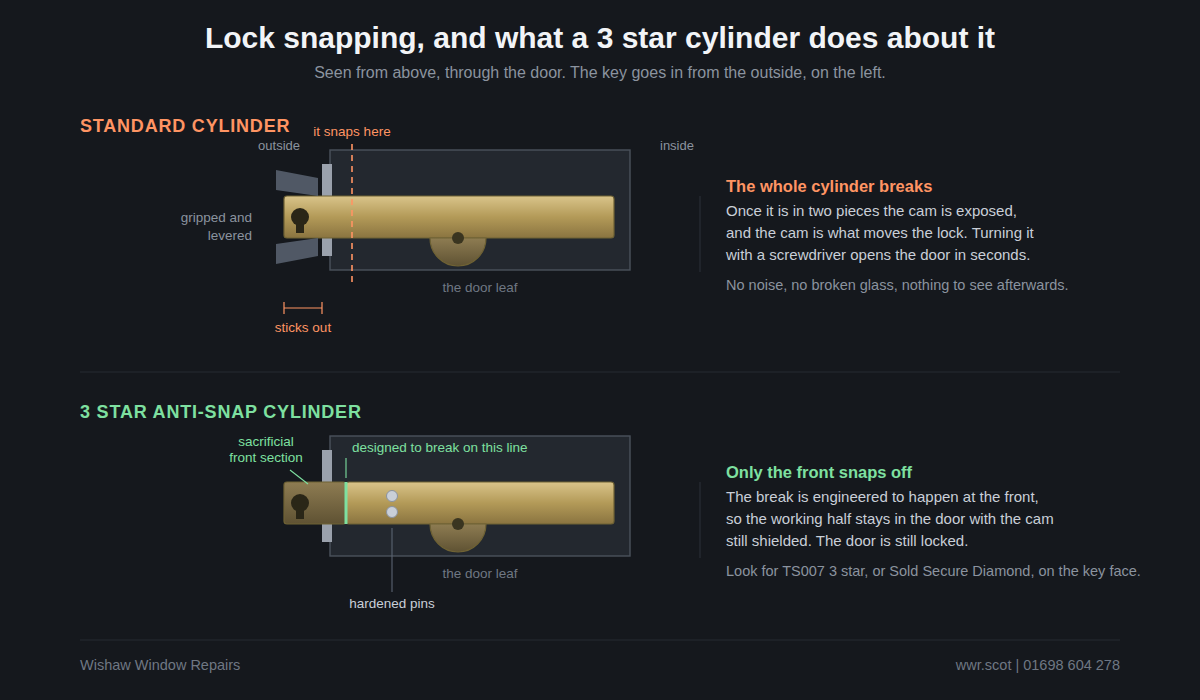
Which is precisely why the weak point is the cylinder. An older or cheap cylinder can be snapped in seconds by somebody who has watched a two minute video, and no amount of hooks in the frame helps once the barrel is gone. An anti snap cylinder to the current British standard breaks at a designed sacrificial point and leaves the cam intact. It is a short job and it is the best value security upgrade there is. Our uPVC door lock security page goes into the detail, including how to check whether yours sticks out too far.
The faults we see most
Almost every uPVC door problem is a hardware problem, and hardware can be changed without touching the slab or the frame. That is the single most useful thing to know before you ring anybody, because it means the phrase you will hear from some firms about needing a whole new door is very often not true.
A dropped door is the classic. The hinges carry the weight, the door settles out of square by a few millimetres and the keeps stop lining up, so you find yourself lifting or leaning on it before the key turns. Nearly all uPVC hinges adjust, and there is a step by step in adjusting a dropped uPVC door.
Handles come next. A snapped handle and a handle spinning loose are different faults with different causes, and neither one means the lock has failed. Getting the right replacement comes down to measuring the screw centres and the spindle, which is easy once you know to check.
Then the lock itself. A key that will not turn is usually a worn cylinder or a gearbox on the way out. A door that will not lock without lifting the handle is actually behaving exactly as designed, which surprises a lot of people. A key snapped in the barrel can often be extracted without wrecking the cylinder if nobody has been at it with pliers. And if you are locked out, there is a page on what your realistic options are.
Two faults arrive with the seasons. A door that will not lock in hot weather has expanded and wants adjusting rather than replacing. A draughty door in winter is nearly always a perished weather seal or compression that has drifted, and both are inexpensive to sort out. Our uPVC door repair page covers the service, and a full door service deals with the lot in one visit when a door has been neglected for a while.
If the door works fine but looks tired or the panel has been damaged, a replacement door panel gives you a new looking door while the frame, hinges and lock stay exactly where they are. It is one of the better value jobs we do and plenty of people do not realise it is possible.
Misted glass in a door
Glass in a door mists for the same reason a window does. The seal around the double glazed unit fails, moisture gets between the panes and no amount of cleaning will touch it because the condensation is on the inside faces. The fix is a new sealed unit dropped into the existing door, which stays exactly where it is. There is more in misted double glazing and on our glass unit replacement page.
What it costs
There is no call out fee. You pay for the work done.
Sealed unit replacements start from £75, and that figure is for a hopper sized pane. Everything else is quoted on the job, because every job is genuinely different. A cylinder, a gearbox, a hinge set, a handle, a replacement panel and a complete new door on a new frame are six different pieces of work with six different parts bills, and putting invented ranges on a page would only set you up for a surprise.
What moves the number is which part has failed, whether the mechanism is a current pattern or something discontinued, the size and type of any glass, and whether the frame is staying put. Our uPVC door repair cost article explains it properly, and the repair prices page covers how we quote in general.
The quickest route to a rough figure without anybody travelling is a photograph. Send a picture of the whole door plus a close up of whatever is misbehaving, and the make stamped on the edge of the lock if you can see it, and we can usually tell you what we are looking at.
Door repairs, in a customer’s words
Eddie’s door had become difficult to lock. He phoned in the morning and Jim was there that afternoon.
“My double glazed door was difficult to lock. After adjustments to hinges, and the locking mechanisms, it now works like new.”
Eddie, Google review
Every one of our reviews is on Google, and there is a selection on our reviews page.
Where we work
Wishaw is home, and from there we cover Motherwell, Hamilton, Bellshill, Coatbridge, Airdrie, Newmains, Shotts, Larkhall, Blantyre, Uddingston, Carluke, Lanark, East Kilbride, Cambuslang, Rutherglen and out towards Glasgow. The full list with a page for each is on areas we cover.
Getting a price
Ring 01698 604 278 between eight and five, Monday to Friday, and one of us will answer rather than a call centre. Send a photo on WhatsApp if that suits better, or use the contact form and it reaches us the same way. You can see the sort of work we turn out in the before and after gallery and what people made of it on our reviews page.