
We fit triple glazing. We are also going to tell you, before you read another word, that for most houses in this part of Scotland it is not the upgrade the adverts make it out to be, and that the money is usually better spent elsewhere.
That is an odd thing for the firm selling it to say. Read on and decide for yourself.
What the third pane actually does
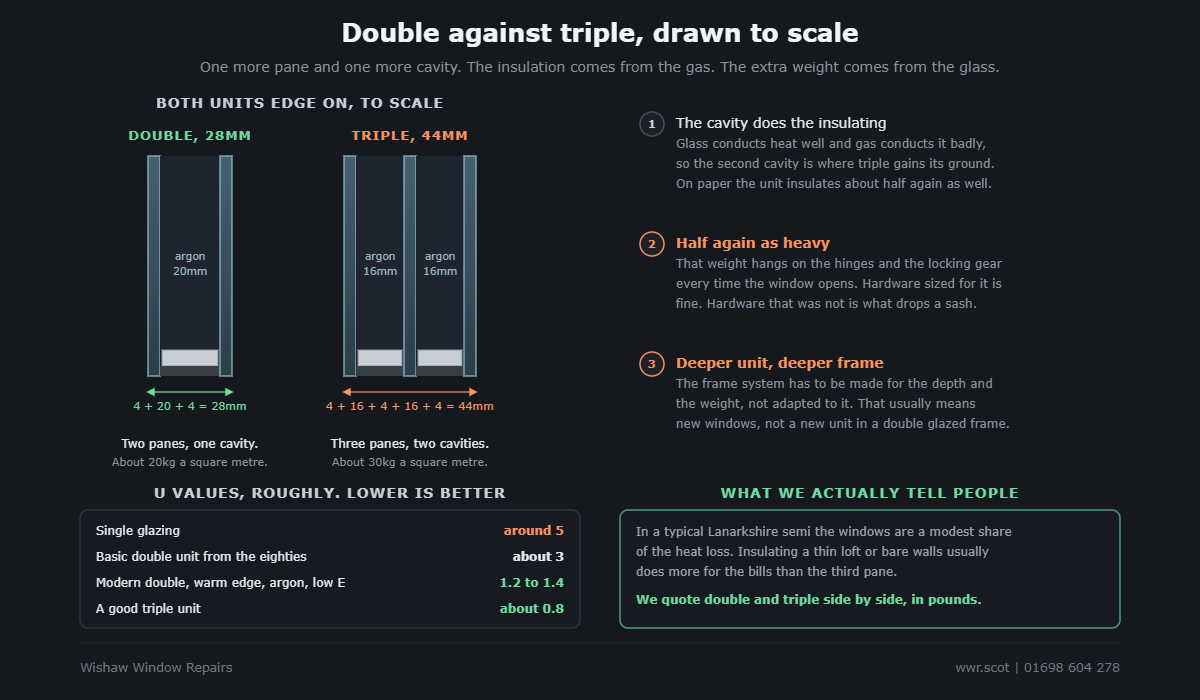
A sealed unit works by trapping gas in a cavity. Glass conducts heat well, gas conducts it badly, so the insulation comes from the cavity rather than from the glass.
Add a third pane and you get a second cavity, so on paper the whole unit insulates roughly half again as well. The number quoted is the U value, which is heat lost per square metre for each degree of difference between inside and out. Lower is better.
A single glazed window is somewhere around 5. A basic double glazed unit from the eighties, maybe 3. A modern double glazed unit with a warm edge spacer, argon fill and a low emissivity coating comes in around 1.2 to 1.4. A good triple glazed unit gets to about 0.8.
So triple is better. The question is what that improvement is worth in a real house, and the answer depends almost entirely on what the rest of the house is doing.
The reason we are lukewarm about it
Your walls, your roof, your floor and your doors are all losing heat too, and in a typical Lanarkshire semi the windows are a modest share of the total. Improving a modest share by a third moves the overall figure by a small amount.
Meanwhile the third pane brings things with it.
Weight. A triple unit is roughly half again as heavy as a double. That load goes through the hinges and the locking gear every time the window is opened. Hardware sized properly for it is fine. Hardware that was not is what drops a sash in six years.
Frame depth. Deeper units need deeper frames, which means a slightly narrower glass area in the same hole in the wall. In a small window that is noticeable.
Cost. More glass, more spacer, more gas, heavier hardware, harder to handle on site.
Solar gain. Three panes with coatings let less free heat in from the sun as well as less heat out. On a south facing room in a Scottish winter that is not entirely a gain.
If your walls are uninsulated and your loft has a hundred millimetres in it, insulating those will do far more for your bills than the difference between a good double glazed unit and a triple one. We would rather you spent the money there and came back to us later.
When we do recommend it
There are real cases, and they are not the ones the salesman leads with.
A well insulated house. Once the walls and loft are properly done, the windows become the weak point and upgrading them genuinely moves the needle. Triple glazing makes most sense last, not first.
Very exposed elevations. A gable end taking the weather off open ground, a house on a hill, a flat above the treeline. Cold radiating off a large area of glass is what people actually feel, and a third pane raises the inner surface temperature and stops the draught sensation near the window.
Rooms you sit next to the glass in. A dining table in a bay, a desk under a window, a conservatory style extension. Same reasoning. What improves is comfort at the glass rather than the annual bill.
Condensation on the inside face. Warmer inner glass is harder to condense on. If a bedroom runs with water on the panes every morning, triple can help, though ventilation is usually the bigger part of the answer.
New build and deep retrofit. Where the whole fabric is being brought up to a modern standard together, triple is the sensible specification and the extra cost is proportionally small.
What it will not do
It will not fix noise. This is the most common misunderstanding and it costs people a lot of money.
Sound is not blocked by adding another identical pane. It is blocked by mass, by asymmetry and by damping. A double glazed unit with one leaf of acoustic laminated glass, with the two panes deliberately different thicknesses, will outperform a symmetrical triple unit on traffic noise every time, and costs less. If noise is your problem, ask us for that instead.
It will not make an old draughty frame perform. The unit is only part of the window. If air is coming past a perished gasket, the glass specification is irrelevant.
And it will not pay for itself quickly. Nobody who is honest about the arithmetic claims otherwise.
If you want it, we will fit it properly
Assuming you have read all of the above and still want triple, there are things that matter.
The frame system has to be rated for the weight and depth, not adapted for it. The hardware has to be specified for the heavier sash, particularly the friction stays and the hinges. Both cavities should be argon filled with warm edge spacers, and there should be low emissivity coatings on two faces rather than one. Safety glass rules apply exactly as they do to double glazing, and there is a real difference between toughened and laminated.
We will quote you double and triple side by side on the same job so you can see the actual difference in pounds rather than in percentages. Prices depend on size, style, glass specification and how many openers you want, so we measure before quoting, and there is no charge for the visit.
Existing triple glazed units
If you already have triple glazing and a unit has misted, the repair is the same idea as any other failed unit. The glass comes out, a new unit goes in, the frame stays. It is heavier and a bit more awkward, and it costs more than the £75 our standard sealed unit replacements start from, but it is a fraction of a new window. See misted double glazing for why it happens.
Triple glazing and condensation
This comes up more than anything else, and the answer depends entirely on which side of the glass the water is on.
Condensation on the room side of the glass is caused by warm damp air meeting a cold surface. Triple glazing raises the inner pane temperature, so it does genuinely reduce it. What it does not do is remove the moisture from the house. If the underlying problem is drying washing indoors, a bathroom without extraction or a kitchen without a working hood, triple glazing will move the condensation somewhere else rather than get rid of it. Usually to the coldest remaining surface, which might be a wall.
Condensation on the outside face is the opposite situation, and it is a sign the window is working well. The outer pane is staying cold because so little heat is escaping through it, so dew forms on it on a clear morning exactly as it does on a car windscreen. It is more common on triple glazing than on double, it clears as the sun comes up, and it is not a fault. People do ring us about it though, so it is worth saying plainly.
Condensation between the panes is the only one that is actually a fault. It means a seal has failed and the unit needs replacing, and no amount of glazing specification prevents it forever. There is a full explanation of all three on our window condensation page.
What it costs
There is no call out fee. You pay for the work done.
Triple glazed units cost more than double glazed ones, and the frames often have to be deeper to take them, so the difference is not only in the glass. How much more depends on the size of the openings, how many you are doing, the specification and whether the frames are being replaced too. That is why we quote each job rather than publishing a range, because a range on a web page is a number somebody will hold us to on a job we have not seen.
Sealed unit replacements start from £75 for a hopper sized pane, and that is the one starting price we publish. Our repair prices page sets out how we quote generally, including what you never pay for.
Our position on the money has not changed: on most Lanarkshire houses, the same budget spent on getting the fitting right, on decent hardware and on sorting the draughts elsewhere in the house will do more for comfort than the third pane will. If after all that you still want triple, we will fit it and we will fit it properly.
Questions we get asked
Will triple glazing cut my heating bill?
A little, and less than the brochures suggest. The step from single to double glazing is enormous. The step from a good modern double glazed unit to a triple glazed one is much smaller, because you have already captured most of the available saving. In a house that still has draughty doors, a cold loft or gaps round the frames, those are where the heat is actually going.
Is it better for noise?
Not as much as people expect, and sometimes not at all. Noise reduction comes mainly from having panes of different thicknesses and a wide cavity, not from having three of them. A well specified acoustic double glazed unit with an asymmetric pane arrangement will usually beat a standard triple glazed one. If noise is your actual problem, say so when you ring, because the answer is a specification question rather than a pane count question.
Will it make the room darker?
Slightly. Every pane and every low emissivity coating takes a small amount of light, and three panes take more than two. On a bright room facing south you will not notice. On a small north facing room that is already dim, it is worth thinking about before you commit.
Can you put triple glazed units into my existing frames?
Sometimes, and often not. A triple glazed unit is thicker and considerably heavier than a double glazed one, so the frame has to have the rebate depth to take it and the hinges have to be rated for the weight. Forcing one into a frame that was never designed for it is how you end up with dropped sashes and hardware failing early. We will measure and tell you honestly which position you are in. If anyone offers to drop triple units into your existing frames, ask them to show you the rebate depth first.
One of my triple glazed units has misted. Can it be replaced?
Yes. A failed triple glazed unit is replaced the same way as a double glazed one, with the frame and sash staying exactly where they are. It is heavier and more awkward to handle, but the job is the same. See misted double glazing and our glass unit replacement page.
Do I need it to meet building regulations?
No. Replacement windows in Scotland have to meet a required standard, and a good modern double glazed unit meets it comfortably. Triple glazing is a choice rather than a requirement for ordinary replacement work. If you want the detail, our advice piece on window rules in Scotland covers what actually applies.
Where we fit it
Wishaw is home, and from there we work across Motherwell, Hamilton, Bellshill, Coatbridge, Airdrie, Newmains, Shotts, Larkhall, Blantyre, Uddingston, Carluke, Lanark, East Kilbride, Cambuslang, Rutherglen and out towards Glasgow. Every area has a page of its own on areas we cover.
Other options
The replacement windows page covers glass specification generally and how we quote. Styles are on the casement, tilt and turn, flush sash and reversible pages.
Ask before you commit
If somebody has quoted you for triple glazing and you want a second opinion on whether it is the right spend, ring us. We will give you an honest answer even where the honest answer is that you do not need us.
01698 604 278, Monday to Friday, eight until five, or contact us here.
Glazing is only one part of the decision. Our windows in Wishaw page covers the styles, the frame specification and the rest of the glass choices alongside it.
Written by the team at Wishaw Window Repairs. Over thirty years repairing and replacing uPVC windows and doors across Lanarkshire.