
A reversible window rotates. Release the catch, swing the sash in, keep going, and the pane that was facing the weather ends up facing into the room. You clean the outside of the glass standing on your own carpet.
For a top floor flat, a stairwell window, or anything above a roof or an extension where a ladder is not going anywhere, that is not a convenience. It is the only safe way the window is ever going to get cleaned.
How the rotation works
The sash hangs on two pivot hinges, one on each upright, set part way up rather than at the top or bottom. Because the pivot point is inboard of the frame, the sash can swing through and past itself instead of fouling the reveal.
Getting to that position is a two stage business on purpose. In normal use the window opens a limited amount on the pivots, held by a friction mechanism, and a restrictor stops it going further. To reverse it fully you release that restrictor deliberately, usually with a catch on the side of the sash, and then rotate it right round. Some systems then have a safety catch that locks the sash in the reversed position so it cannot swing back onto your fingers while you are cleaning.
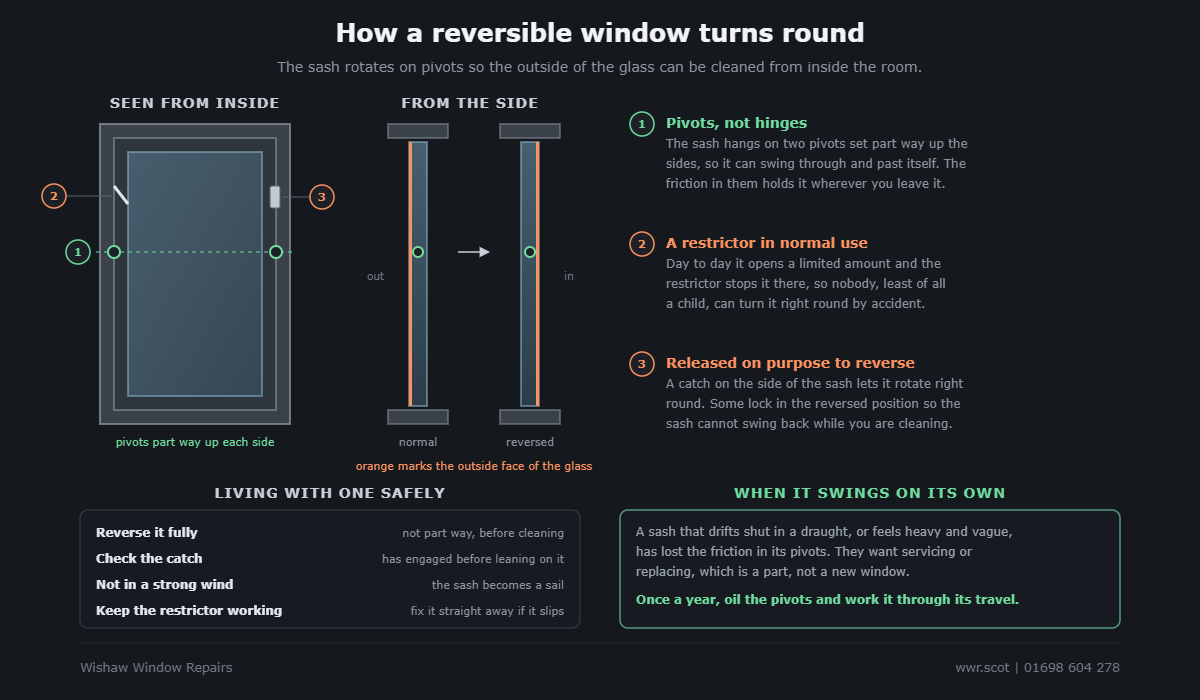
The friction in the pivots is what holds the sash wherever you leave it. When a reversible window starts swinging shut on its own in a draught, or feels heavy and vague, that friction has gone and the pivots want servicing or replacing.
Where they are the right answer
High level windows of any kind. Second floor and above. Flats where there is no safe standing outside. Stairwell and landing windows over a rear extension roof. Bedrooms in dormer conversions. Anywhere the outside of the glass has not been touched since it was fitted.
They are also good on wide openings, because the pivot hardware carries weight better than a friction stay does.
The trade offs
They come into the room, so the same caveats as tilt and turn apply. Curtains, blinds and anything on the sill have to be clear before you can reverse the sash.
You need a bit of floor space to stand in while the window is rotated. In a narrow bathroom that can be tight.
They cost more than a plain casement.
And they are not a style choice. Nobody looking at the outside of your house can tell a reversible window from a casement, which is the point. You fit one because of what is on the other side of the glass, not because of how it looks.
Living with one safely
Reverse it fully before you start cleaning, not part way. A sash left half rotated is on the wrong side of the friction and can move.
Check that the reversed position catch has actually engaged before you lean on the glass.
Do not reverse a window in a strong wind. The sash becomes a sail and the pivots are not designed to take a gust broadside.
Keep the restrictor working. It is there so that nobody, particularly a child, can put the window into full rotation by accident. If yours has stopped holding, that is a repair worth doing straight away rather than at the same time as everything else. The same reasoning is behind window restrictors generally.
Once a year, oil the pivots and the friction slides and work the sash through its full travel a few times.
Repairing rather than replacing
A lot of the reversible windows around Wishaw and Motherwell went into flats and housing stock in the eighties and nineties, and quite a few of them still work perfectly. What tends to fail is the hardware rather than the frame.
Pivot hinges wear and the sash starts to drop or bind. Restrictors snap. The reversing catch seizes. Friction slides polish smooth and stop holding. All of those are parts, and all of them come out with the frame staying exactly where it is.
Reversible hardware is more specialised than casement hardware, and some of the older systems are genuinely obsolete, which is why several firms will not take the work on. We usually can. If we cannot get the part, we will tell you that plainly rather than string you along.
Start at our window repair page, or send a photograph of the hinge on the edge of the open sash, which is what tells us what system you have.
Reversible or tilt and turn
These two get compared constantly, because both are sold on the same promise of cleaning the outside from indoors. They go about it very differently and they suit different houses.
A reversible window spins the whole sash through roughly 180 degrees on a pair of pivots, so the outside face ends up indoors. You clean it standing in the room, at normal height, with both hands free. That is the whole point of them and nothing else does it as completely.
A tilt and turn window does two separate things instead. Handle at ninety degrees and it tilts inward at the top for ventilation you can leave unattended. Handle at one eighty and it swings fully inward like a door, which gives you access to the outside face but eats a large amount of room space while it is open. It is the better choice where secure background ventilation matters, and the worse choice in a small bedroom with furniture under the window.
The short version: reversible for upper floors where cleaning is the problem, tilt and turn where ventilation and a wide opening matter more than floor space. If you are weighing up the full range, our double glazing in Wishaw page sets all the styles against each other.
What it costs
There is no call out fee. You pay for the work done.
Beyond that, reversible windows are quoted on the job. The size of the opening, how many you are doing, the glass specification, the colour and whether the existing frames are coming out all move the figure, and a made up range on a web page would only mislead you. For glass work, sealed unit replacements start from £75 for a hopper sized pane, which is the one starting price we publish.
Worth knowing on the repair side: reversible hardware is more expensive than standard friction hinges, because the pivot gear is doing more work and there is more of it. It is still a small fraction of the cost of a new window. Our repair prices page sets out how we quote.
Questions we get asked
Can an old reversible window still be repaired?
Usually yes. The pivot gear, the friction stays, the safety catch, the handle and the seals are all separate replaceable parts, and the frame and sash normally outlast every one of them. The honest exception is a very old or obscure pivot system where the gear is no longer manufactured and nothing modern will retrofit. We can tell you which you have got from a photograph of the hardware.
Are they safe with children in the house?
They are, provided the safety catch is working and used. Every reversible window has a catch that holds the sash in the cleaning position and stops it rotating unexpectedly, and most have a restrictor that limits the initial opening. Both of those are parts that wear, and a catch that no longer holds is worth reporting rather than living with. If yours does not click firmly into place, get it looked at.
Do they need anything special doing to them?
Very little, but they do not like being ignored. Keep the pivot points clean and give them a light lubricant once or twice a year, not a heavy grease that collects dust. Wipe the seals rather than letting grit sit against them. And rotate the window occasionally even if you are not cleaning it, because hardware that never moves stiffens up.
The window has got stiff to turn. Is that serious?
Caught early, no. Stiffness is usually dry pivots or a sash that has settled slightly out of square, and both are adjustments. Left alone it wears the gear, and worn gear is a part rather than an adjustment. As with most window and door hardware, the cheap moment to deal with it is when it starts feeling wrong, not when it stops working.
Can I put reversible windows into an older house?
Yes, and upper floor flats and tenement properties are exactly where they earn their keep. The one thing to check first is whether the property is listed or in a conservation area, because that can restrict what you are allowed to fit. If you are in that position, our flush sash windows page covers the styles that usually get approved.
Where we fit them
Wishaw is home, and we work out across Motherwell, Hamilton, Bellshill, Coatbridge, Airdrie, Newmains, Shotts, Larkhall, Blantyre, Uddingston, Carluke, Lanark, East Kilbride, Cambuslang, Rutherglen and towards Glasgow. Every area has a page of its own on areas we cover.
Other styles
Casement for the standard outward opening window, tilt and turn for two modes from one handle, flush sash for period frontages, vertical sliding sash for the traditional Scottish sash and case look. How we quote replacements is on the replacement windows page.
Ask us
If you are not sure what you have got, photograph the window open, from inside, with the edge of the sash showing. That one picture usually answers it.
WhatsApp it across, or ring 01698 604 278 between eight and five, Monday to Friday. Contact us here.
If you are still weighing one style against another, our windows in Wishaw page puts every style we fit side by side and explains what the frame and glass specification actually change.
Written by the team at Wishaw Window Repairs. Over thirty years repairing and replacing uPVC windows and doors across Lanarkshire.