
On an ordinary uPVC casement the opening sash stands proud of the outer frame by a centimetre or so. You can see the step from the pavement and it is the detail that makes a plastic window look like a plastic window.
A flush sash sits level with the frame instead, the way a joiner made timber windows before any of this existed. From the street you see one flat plane of frame with a fine shadow line where the sash meets it.
That is the entire difference, and on the right building it matters a great deal.
You will see them advertised as flush fit windows as often as flush sash, and some firms call them flush casement windows. They are the same thing: a sash that finishes level with the frame instead of standing proud of it.
Which houses want them
Stone frontages. Anything Victorian or Edwardian. Cottages and converted steadings. Streets where the neighbours still have timber and yours would stick out. Conservation areas, where the planning department will be looking at the sightline whether or not uPVC is permitted at all.
Also, increasingly, new build. A lot of developers have gone flush across the board because it photographs better.
If your house is a nineteen sixties semi with wide windows and a bay, a standard casement will look correct and a flush sash will cost you more for a difference nobody notices. We will say so.
How they are built
The sash and frame are designed as a matched pair rather than the sash being a smaller version of the frame. That means a different profile system, not a modification of a standard one, which is the honest reason they cost more.
The gasket arrangement changes too. On a standard casement the sash presses onto a seal in the frame rebate. On a flush design the seal has to work in a tighter, shallower joint, so the quality of the gasket and the accuracy of the manufacture matter more. A well made flush window seals every bit as well as a standard one. A badly made one whistles.
Hardware is conventional. Friction stays, espagnolette locking, standard handles. Which means that in fifteen years, when something wears out, we can get parts.
Finishes
This is where flush sash earns its keep. The point of the style is to look like painted or stained timber, and the foils have got good.
White for a painted look. Cream and heritage off whites for older properties. Anthracite grey, which has been the default for a decade now. Chartwell green, sage and duck egg for cottage frontages. Oak and rosewood woodgrains where you want to read as timber rather than as paint.
Two points worth knowing. Foiled finishes are available on one side or both, and white inside with colour outside is both cheaper and usually what people want. And a dark foil on a south facing elevation runs hot, which over many years is what ages a frame, so the substrate quality behind the foil matters more on a dark window than a white one.
Astragal bars and glazing detail
If you are chasing a period look, the bar detail does as much work as the flush sightline.
Bars inside the sealed unit are the cheapest and look it, because there is no shadow. Surface applied bars on both faces with a spacer between them inside the unit are the usual compromise and read convincingly from the pavement. A true astragal, where the sash is genuinely divided into separate panes, is the real thing, costs the most, and is the only one that will satisfy a fussy conservation officer.
There is more on matching existing glazing detail in our note on Georgian bars and leaded glass.
Planning and listed buildings
If the property is listed, or in a conservation area, do not order anything until you have spoken to the council. In some areas uPVC is refused outright regardless of how good the sightline is. In others a flush sash in the right colour with the right bar detail is acceptable where a standard casement would not be.
Scotland runs on its own building standards and its own consents rather than the English system, and your local authority is the only reliable source for what applies to your address. Our notes on the Scottish window rules cover the general position.
Where consent is going to be a problem, secondary glazing is sometimes the route that keeps everybody happy.
What we would tell you on the doorstep
Flush sash is worth paying for when the building deserves it and when you can see the frontage from the road. It is not worth paying for at the back of the house where nobody looks, and there is no rule saying every window has to match. Plenty of jobs we do are flush at the front and standard casement at the back, and the money goes where it shows.
That is not the advice a salesman on commission gives. There is nobody on commission here.
Flush sash or a standard casement
Both are casement windows. The difference is entirely in where the opening sash sits when it is closed, and it is worth understanding because it is the whole reason for the price gap.
On a standard casement window the sash closes onto the face of the frame and stands proud of it by roughly fifteen millimetres. You can see the step from across the street. It is a perfectly good window and it is what most houses in Lanarkshire have.
On a flush sash the frame is rebated so the sash drops into it and finishes dead level with the outer face. There is no step, no shadow line and no proud edge, which is exactly how a well made timber window looked before uPVC arrived. From the pavement it reads as a joinery window rather than a plastic one.
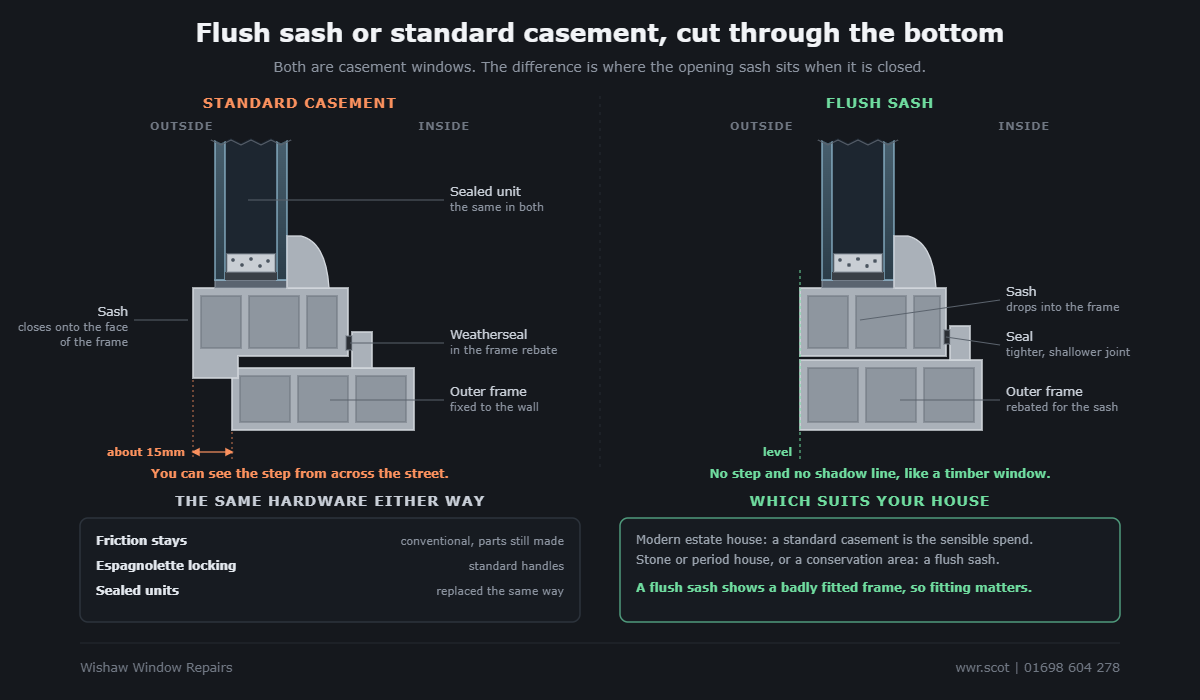
That extra machining, the deeper frame and the tighter tolerances are what you are paying for, and they are also why a flush sash has to be fitted well. A standard casement will forgive a frame that is a millimetre or two out of square. A flush sash will show it, because the eye picks up an uneven reveal immediately when everything else is level.
Our honest position: if the house is a modern estate property and nobody is going to look twice, a standard casement is the sensible spend. If it is a stone or period property, a house in a conservation area, or simply somewhere the frontage matters to you, the flush sash is worth the difference and you will notice it every time you pull up outside. The full range is set out on our uPVC windows in Wishaw page.
Questions we get asked
Do flush sash windows cost a lot more?
They cost more than a standard casement, but the gap is smaller than most people assume, and on a small number of windows it is often not the deciding factor. Every job is quoted individually, because the size of the openings, how many you are doing, the finish, the glass and whether there are astragal bars all move the figure. There is no call out fee, and nothing is owed for coming out to measure and price it.
Will they pass in a conservation area?
Often, and they are usually the uPVC style with the best chance of it, particularly in a woodgrain finish with the right glazing detail. What we will not do is promise you an approval, because that decision belongs to the local planning department and it varies. Check with them before you order, and if the property is listed, assume you need consent until somebody tells you otherwise.
Can I have flush sash on the front only?
Yes, and plenty of people do exactly that. The front elevation is what the street sees and what you see coming home, so spending there and fitting standard casements to the back is a reasonable way to split a budget. As long as the colour and the glazing match, nobody will ever notice.
Do they need more looking after?
No more than any other uPVC window. Wipe the seals rather than letting grit build against them, keep the hinges clean and give them a light lubricant once or twice a year, and clear the drainage slots along the bottom of the frame occasionally. That last one matters slightly more on a flush sash, because the rebate is deeper.
Can flush sash windows be repaired?
Yes, and the same way as any other casement. Hinges, handles, locks, gaskets and sealed units are all separate replaceable parts. If a flush sash starts catching on the frame it is nearly always hinges that have worn or a sash that has settled, and both are adjustments rather than a new window. Our window repair page covers the service.
The glass has misted. Does the whole window come out?
No. A misted pane means the sealed unit has failed, and the unit is replaced while the frame and sash stay exactly where they are. There is more in misted double glazing and on our glass unit replacement page.
Where we fit them
Wishaw is home, and from there we work across Motherwell, Hamilton, Bellshill, Coatbridge, Airdrie, Newmains, Shotts, Larkhall, Blantyre, Uddingston, Carluke, Lanark, East Kilbride, Cambuslang, Rutherglen and out towards Glasgow. Every area has a page of its own on areas we cover.
Other styles
Tilt and turn for inward opening and cleaning from inside, reversible for full rotation, vertical sliding sash for the traditional up and down Scottish sash, or the replacement windows page for how we quote.
Getting a figure
Send a photograph of the frontage on WhatsApp and we can tell you fairly quickly whether flush is the right call for your building. Or ring 01698 604 278, Monday to Friday, eight until five. Contact details here.
If you are comparing this against the other options, our windows in Wishaw page sets out every style we fit in one place, with what to look for in a quote.
Written by the team at Wishaw Window Repairs. Over thirty years repairing and replacing uPVC windows and doors across Lanarkshire.