
Look down almost any street in Wishaw or Motherwell and the windows you are looking at are casements. A frame, one or more hinged sashes, and a handle. It is the plainest window design there is and there is a reason it has outlasted everything fashionable that has come along since.
We fit them, and we spend most of our working lives repairing them, which is a useful thing to know about the firm putting yours in.
What makes a window a casement
A casement sash is hinged along one edge and swings outwards. That is the whole definition.
Side hung means the hinges are on the left or right upright and the sash opens like a door. Top hung means the hinges run along the top and the sash lifts out from the bottom, which is what you want above a path or a driveway where a side hung sash would swing into somebody walking past.
Most windows are a mixture. A large fixed pane, a side hung opener beside it, a top hung vent above. The fixed panes are the cheap part, which is why a window with three openers costs noticeably more than the same window with one.
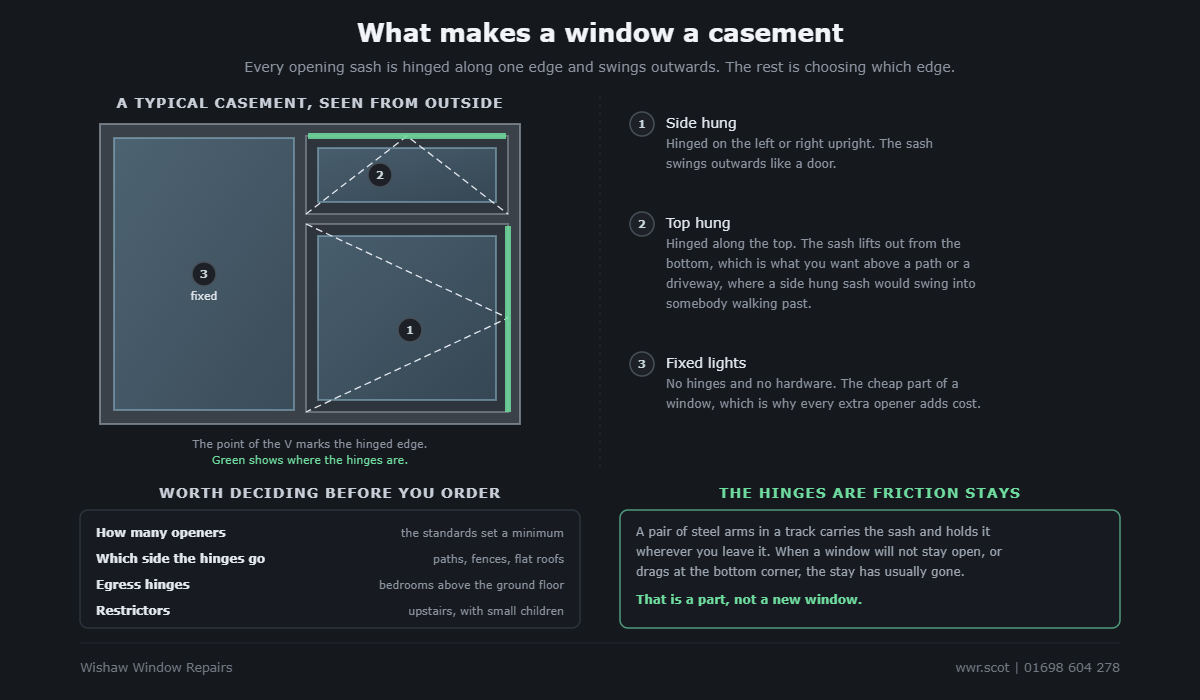
The hinges themselves are friction stays, not simple butt hinges. A friction stay is a pair of steel arms in a track that both carries the sash and holds it wherever you leave it. When a window will not stay open in a breeze, or drags on the frame at the bottom corner, the stay is nearly always what has gone, and it is a part rather than a window.
Why we recommend them for most houses
Standard hardware. In fifteen years time when a handle snaps or a stay wears out, a casement takes parts that everybody carries. That is not true of every style, and it is the difference between a twenty minute repair and a hunt through obsolete catalogues.
They suit the buildings. Post war semis, ex council terraces, seventies estates and most new build in Lanarkshire were all designed around casement openings. Putting something else in often means the proportions stop looking right.
They are the cheapest option per square metre, in the frame and in the glass.
And they seal well. A casement compresses against its gasket all the way round when you turn the handle, which is a genuinely good way of keeping weather out on an exposed elevation.
The things worth deciding before you order
How many openers. More openers means more ventilation and more cost. The building standards set a minimum for habitable rooms, and bedrooms have escape opening requirements on top of that, so this is not purely a preference. We will tell you the minimum and you can decide what you want above it.
Where the hinges go. Think about which way the sash swings before it is made, not after. Over a path, next to a fence, above a flat roof, or somewhere you will want to clean from inside are all reasons to change the hinge side.
Egress hinges. These let the sash open right back so it clears the frame for escape. In bedrooms above ground floor they matter.
Restrictors. If there are small children in the house, opening restrictors on upstairs windows are worth fitting at the outset. We have written about window restrictors and child safety separately.
Colour. White is the cheapest. Anthracite grey outside with white inside has been the popular choice for several years now. Woodgrain foils are available and hold up better than people expect. Bear in mind a dark foil on a south facing elevation runs hotter, and heat is what ages a frame.
Trickle vents. Small controllable vents in the head of the frame. They are there to stop the house getting airtight enough to grow condensation, and they are usually required on a replacement. There is more on what they do if you have been told to close them up.
Glass
Whatever style of window you choose, the glass specification is doing most of the work. A double glazed unit with a warm edge spacer, argon fill and a low emissivity coating is the sensible standard.
Doors, side panels and any low level glazing need safety glass. Bathrooms usually want obscure. If you are near a busy road, acoustic laminated is the option that actually helps.
More on all of that is on our replacement windows page.
We repair them too
This is the part most window companies do not offer, and it is the reason we exist.
A casement that has dropped, sticks, whistles in the wind or has misted up is very rarely a window that needs replacing. Stays, gaskets, handles, locking mechanisms and sealed units are all separate parts and all of them come out without the frame moving.
If you are here because of a fault rather than a plan, start with our window repair page, or with the advice on draughty and stiff windows and windows that will not stay open. It is quite possible you do not need us at all.
Other styles
If a plain casement is not what you had in mind, tilt and turn gives you inward opening and easy cleaning, flush sash gives you the period timber line, and reversible windows rotate fully for high level cleaning.
Getting a price
Sizes, opener count, colour and glass all move the number, so we measure before we quote. There is no charge for coming out and no charge for saying you do not need it.
Ring 01698 604 278 between eight and five, Monday to Friday, or send photographs on WhatsApp. Our contact details are here.
Casements are the starting point for most houses here. Our windows in Wishaw page covers the alternatives and what changes when you move away from the standard.
Casements are one style among several. Our guide to uPVC windows in Wishaw compares them all, and if yours are sound but the glass has gone, double glazing repairs is usually the cheaper answer.
Written by the team at Wishaw Window Repairs. Over thirty years repairing and replacing uPVC windows and doors across Lanarkshire.