
Two complaints, one part to blame most of the time.
The first is the window that won’t hold itself open. You push it out on a warm day, let go, and it swings shut on you, or creeps closed inch by inch until it’s resting against the frame. The second is the window that’s visibly gone out of shape: the gap along the top is wider than the gap along the bottom, or a corner of the opener catches on the frame and you have to lift it to get it shut.
Both usually come back to the hinges. And both are repairs, not replacements.
The part doing the work
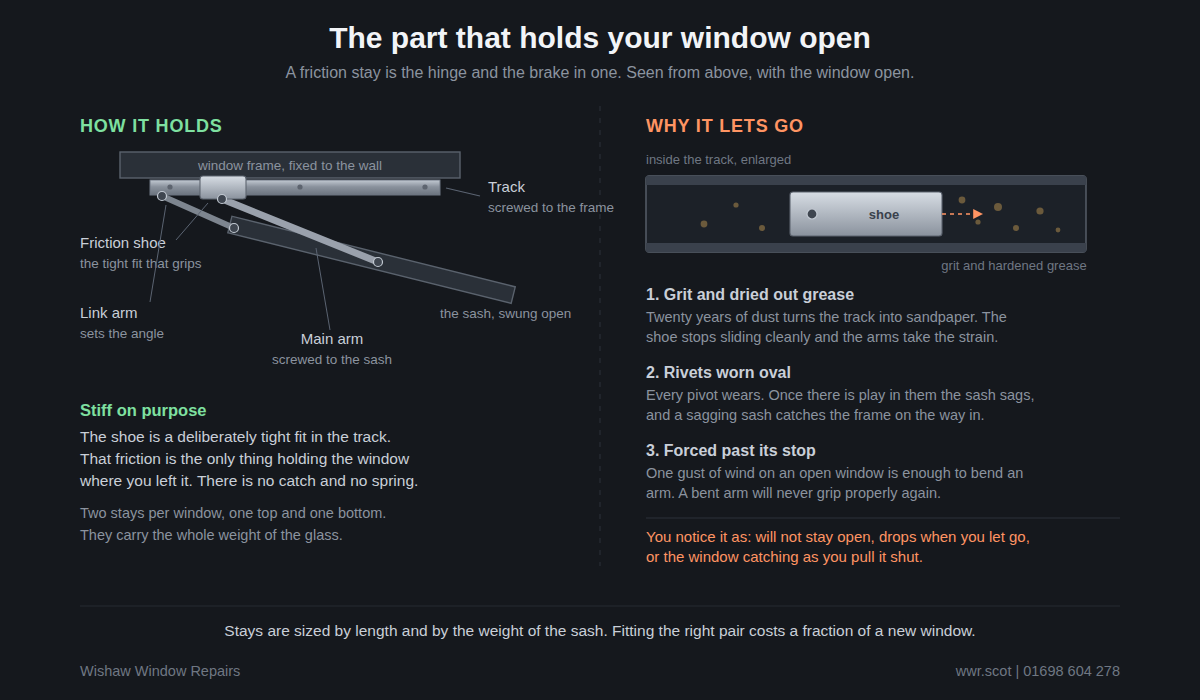
A uPVC opening window doesn’t hang on ordinary hinges like a door. It sits on a pair of friction hinges, sometimes called friction stays. They’re the metal arms you can see running along the top and bottom of the opener when the window is open. They do two jobs at once: they carry the weight of the sash, and they grip just enough to hold it wherever you leave it, whether that’s an inch open or wide out.
That grip is the friction part of the name. It comes from a bit of deliberate stiffness built into the arm. Once that stiffness goes, or the arm wears loose in its track, the window stops holding its position and starts drifting shut on its own.
So why won’t it stay open?
Usually because the friction has worn out of the stay after years of opening and closing. Sometimes it’s because someone has oiled it. That sounds counterintuitive, and it catches people out: a squeaky hinge feels like it wants oil, but pour lubricant into a friction stay and you’ve just removed the very friction that was holding the window up. There’s a difference between lubricating the moving pivots and drowning the whole thing.
If the window is heavy, a large opener or a thick unit of glass, the stays have a harder life and tend to give up sooner. Same if the window is on an exposed elevation catching the wind, where it gets pulled and knocked about more than a sheltered one.
Either way, the answer is a new pair of stays, matched to the size and weight of that opener. It’s a quick swap on the existing frame. You get a window that holds where you put it and, as a bonus, usually feels smoother to open than it has in years.
And why has it dropped?
A dropped sash is the same family of fault a stage further on. When the stays wear, the sash stops being held square in the opening and starts to sag under its own weight. What you see is uneven gaps around the edge, a corner that fouls the frame, a window that needs a shove or a lift to close, or a draught that’s appeared along the top edge where the seal no longer meets.
If it’s caught early, sometimes it’s just a matter of adjustment: the hinge positions and the keeps are tweaked to bring the sash back square. If the stays themselves have worn or bent, they’re replaced. Neither job involves touching the glass or the frame.
What not to do while you’re waiting
Don’t prop it open with something heavy. A window resting on a worn stay with a book or a brick holding it out is putting strain in exactly the wrong direction, and a stay that’s already tired can let go with the window swinging in the wind. Every year we see openers that have been damaged, or hinges torn out entirely, because a gust caught a propped window.
And don’t force a dropped sash shut by shouldering it. That’s how you end up cracking a corner weld or snapping a handle, and then a small job becomes a couple of jobs.
One thing that’s often not the hinges
Occasionally a window that won’t stay open is actually a window with a broken restrictor or a jammed child-safety stay, which limits how far it can travel and can make the whole thing feel wrong. And occasionally what looks like a dropped sash is actually a bit of grit or old sealant in the way, stopping the window seating properly. Both are worth a look before assuming the worst, and both are easy fixes.
Getting it sorted
Friction stays are one of the most common parts we carry, because worn hinges are behind a huge proportion of the window problems we get called out to around Wishaw and Lanarkshire. It’s an inexpensive part and a short visit.
If you can, open the window and take a photo of the hinge arm along the top or bottom edge, and one of the window shut from the outside so we can see the gaps. Send those over on WhatsApp and we can usually tell you what’s needed before we arrive, and bring the right stays with us. There’s no call-out charge either way.
Call us on 01698 604 278 and we’ll get it hanging square and holding where you leave it.
Friction stays wear out on nearly every window eventually, and swapping them is routine window repair work.
Checking it yourself before you ring
Five minutes with the window open will tell you most of what we would want to know, and it costs nothing.
Open the window fully and look along the top and bottom edges of the sash where it meets the frame. You are looking for the friction stays, the flat scissor arms with a slider running in a track. Both should look the same as each other. If one is bent, if the arm has come out of its track, or if the rivet where the arms cross has visible play in it, that is your answer.
Next, with the window open about halfway, take the weight off it with one hand and see whether it feels lighter than it should. A stay in good order provides real resistance. If the sash swings freely as soon as you let go, the friction has gone entirely rather than just weakened.
Then look at the screws. Stays are held by small screws into the frame and into the sash, and on an older window one or two of those have often worked loose or stripped. A stay that is only half fixed cannot do its job no matter how good the stay is.
Finally, photograph both stays with the window open. That single photo usually tells us the make, the size and whether it is the stay or the fixings, which means we arrive with the right part.
The friction screw, and why it is not always the answer
Many friction stays have a small adjustment screw on the arm that sets how much resistance the stay provides. Tightening it is the first thing people try, and sometimes it genuinely is the fix, particularly on a window that has simply loosened over years of use.
Two cautions though. It only works if the stay is otherwise sound. Winding the friction up on a stay that is worn or bent puts more load on a part that is already failing, and the usual result is that it lasts another few weeks and then goes properly.
And overtightening makes the window heavy to open, which is how people end up snapping handles. If you have wound the screw up and the window is now stiff but still will not hold, back it off and accept that the stay needs changing.
Questions we get asked
Is it dangerous to leave it?
It is worth dealing with rather than living with, particularly upstairs. A sash that swings unchecked in a gust can slam hard enough to crack the glass or damage the frame, and on an upper floor a stay that fails completely can let the sash drop outward. If the window is above a path or a doorway, treat it as a priority rather than a nuisance.
Can one stay be replaced or does it need the pair?
Always the pair, and anybody telling you otherwise is cutting a corner. The two stays share the load and control the geometry between them. Fitting a new one against a worn one puts the sash slightly out of square and the new stay takes a beating it was not designed for.
Will the same thing happen to the other windows?
Often, eventually. Stays in a house are usually the same age and specification, and they wear at roughly the same rate depending on how much each window gets used. The ones that go first are normally the biggest and heaviest sashes and the ones opened most. If several are already feeling loose, doing them together saves repeat visits.
Does this mean I need a new window?
No, and this is one of the clearest cases of that. Friction stays are a bolt on part costing a fraction of a window. The frame, the sash and the glass are all untouched by the job. If someone has quoted you a replacement window for a sash that will not stay open, get another opinion.
The window is also stiff to lock. Same problem?
Related, usually. A sash that has dropped on worn stays no longer lines its locking cams up with the keeps, so it goes stiff to lock at the same time as it stops staying open. That is good news in a way, because replacing the stays fixes both at once. Our uPVC window repair page covers the locking side.
Can I just prop it open?
As a very short term measure indoors, on a ground floor, in still weather, people do. It is not a fix and it is not safe in wind, because a propped sash that catches a gust puts the whole load onto whatever is propping it. Do not do it upstairs at all.
Related advice
See our window repair service page for what we do and where. If you would rather just ask, get in touch.
There are around fifty more plain English guides in our advice section.
Written by the team at Wishaw Window Repairs. Over thirty years repairing uPVC windows and doors across Lanarkshire.