
Window handles are small, cheap and almost never the reason a window needs replacing. They’re also the part people most often think they can’t get any more, particularly on windows that are a good few years old, which is why we see so many houses with one window nobody opens.
You can nearly always get the part. Here’s how to work out what’s actually wrong.
Start by working out where the resistance is
Everything depends on one question: is the handle broken, or is the handle struggling against something else?
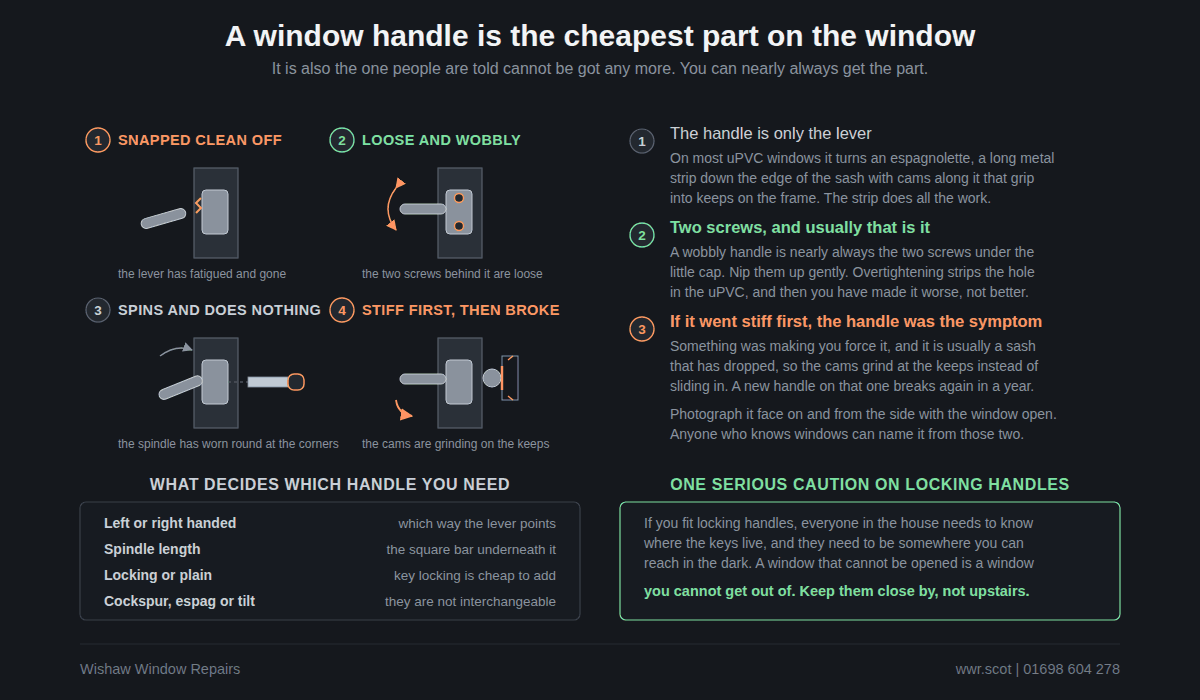
The handle drives a mechanism hidden inside the window frame. On most uPVC windows that’s an espagnolette, a long metal strip running down the edge of the opening sash with cams or mushroom-shaped studs along it. Turn the handle and those studs rotate to grip into keeps on the outer frame, pulling the window tight shut. The handle is just the lever. The mechanism does the work.
So when a handle fails, it’s either the lever that’s gone, or the mechanism behind it that’s gone and taken the lever with it. Different jobs, and it’s worth knowing which before anyone starts.
The four ways they fail
Snapped clean off. The lever has broken, often at the base where it’s thinnest, or the little casting inside has cracked. Handles are usually die-cast metal or metal with a plastic coating, and after a decade or two of being turned they simply fatigue. Nothing else is necessarily wrong. A new handle goes on and you’re done.
Loose and wobbly. Nine times out of ten, the two screws holding it to the sash have worked loose. They’re usually under a small plastic cap or behind the handle itself when you swing it round. Nipping them up carefully is one of the very few window repairs genuinely worth trying yourself. Be gentle, because overtightening into uPVC strips the hole and then you’ve made it worse. If it’s still loose after tightening, the screw holes have gone or the handle casting has cracked internally, and it needs replacing.
Spins freely and does nothing. The connection between the handle and the mechanism has gone. On window handles that’s usually the spindle, the small square bar underneath the handle that pokes into the mechanism, either worn round at the corners or sheared. Sometimes it’s the drive slot inside the mechanism that’s worn instead. A new handle with the right spindle length normally sorts it, but the mechanism gets checked at the same time.
Stiff for months, then failed. This one matters most. If the handle has been getting progressively harder to turn and has now broken, the handle was the symptom, not the cause. Something else was making you force it: the mechanism is stiff or seizing, or more often the sash has dropped slightly so the cams are grinding against the keeps instead of sliding into them. Fit a new handle onto that and it’ll break again, probably within a year. The mechanism and the alignment need sorting alongside the handle.
Which way does yours go?
Worth knowing before ordering anything, because handles are handed and sized.
They come left or right handed, and the height of the base varies (that’s the spindle length, which has to match your window’s mechanism depth). There are also several distinct families of handle: cockspur handles on older windows with a curved arm that hooks over a wedge on the frame, espagnolette handles on most modern ones, tilt and turn handles that do two jobs, and locking versions with a key. They aren’t interchangeable.
You don’t need to identify all that yourself. But if you photograph the handle from the side as well as face on, with the window open so the mechanism edge is visible, anyone who knows windows can tell in seconds what you’ve got, and turn up with the right part first time.
The key question people ask
Yes, key-locking handles are worth having on ground floor windows and anything reachable from a flat roof or an extension, and no, they aren’t expensive. They’re also worth thinking about if you’ve got young children, since a locked handle stops a window being opened.
One caution, and it’s a serious one. If you fit locking handles, everyone in the house needs to know where the keys are kept, and they need to be somewhere you can reach in the dark. A window that can’t be opened is a window you can’t escape through. Keep them close by, not in a drawer upstairs.
When it’s a bit more than the handle
A few things that show up alongside a handle problem and are worth having looked at in the same visit rather than paying for a second one.
If the window has to be pulled or lifted to get the handle round, the sash has dropped and the friction hinges are worn. If the window rattles once shut even with the handle turned, the keeps need adjusting or the seals have gone. If the handle turns fully but the window still feels loose, the mechanism isn’t engaging properly. All of those are small parts and small adjustments, and all of them wear handles out early if left.
Getting it done
Window handles are one of the cheapest, quickest repairs there is, and it’s mildly infuriating how many people are told they need a new window because of one. We keep a wide range of handles, spindles, espagnolette mechanisms and hinges on the van, and we cover Wishaw and all across Lanarkshire.
Send a photo of the handle on WhatsApp, ideally one face on and one from the side with the window open, and say what it’s doing. We’ll tell you what it needs. No call-out charge, and no interest in selling you a window you don’t need.
Call us on 01698 604 278.
A handle change is about as small as a uPVC window repair gets, and we carry most of the common patterns in the van.
Measuring up for a replacement
If you are buying a handle yourself, this is the part that catches everybody out. uPVC window handles are not a standard part, and the one hanging on the peg in the DIY shed will fit roughly half the windows in the country.
Three measurements decide it. The spindle is the square bar that drops down into the mechanism, and the length matters because too short and it will not engage, too long and it fouls. Common lengths run from around 30mm up to 55mm, and some handles come with a stepped or adjustable spindle that covers a range.
The screw centres are the distance between the two fixing screws, measured centre to centre. 43mm is the commonest by a distance, with 40mm and 50mm turning up regularly. Get this wrong and you are drilling new holes in a window frame, which nobody wants.
The handing is whether the handle is left, right or universal. A lot of modern handles are non handed and will do either side, which saves an argument, but plenty of older patterns are specific.
Photograph the old handle beside a tape measure before you go anywhere. If you send that photo to us we can usually identify the pattern from it, which is quicker than you standing in an aisle guessing.
Cockspur, espag and the difference
Two families of handle cover almost every uPVC window, and knowing which you have saves a wasted trip.
An espagnolette handle, usually shortened to espag, has a square spindle that drives a long gearing strip running round the sash. Turn it and cams engage into keeps at several points. This is what most windows made since the mid nineties have, and it is the one where a broken handle and a broken mechanism can feel identical from the outside.
A cockspur handle is the older type, with a curved claw on the handle itself that hooks over a wedge block on the frame. There is no gearing behind it. If yours is a cockspur, the good news is that when the handle fails it really is just the handle, because there is nothing else to fail. The measurement that matters on these is the step height, the distance from the backplate to the claw, usually 21mm or 26mm.
If you are not sure which you are looking at, open the window and look at the edge of the sash. A strip of metal with mushroom shaped cams along it means espag. A bare edge with a single claw catching a block on the frame means cockspur.
Questions we get asked
The handle turns but the window will not open
The handle is doing its job and the mechanism behind it is not. Usually a cam that has sheared or gearing that has jammed part way. Do not force it, because forcing it while it is jammed is what turns one broken cam into a whole strip. It is a replaceable part rather than a new window.
Can I still lock the window with a broken handle?
Often not properly, and that is the reason not to leave it. On an espag window the handle is what drives the locking cams, so a handle that spins freely means the window is shut but not locked, even though it looks closed from inside. If it is a ground floor or accessible window, treat that as worth sorting quickly.
Mine has a key. Do I need one that locks?
If it had one, replace like for like. Some home insurance policies specify key locking window handles on accessible windows, and swapping to a non locking handle could matter at claim time. It also stops a window being opened from inside through a broken pane, which is the original reason for them.
Should I replace all the handles at once?
Not necessarily, but it is worth thinking about. Handles from the same house are usually the same age and the same pattern, so when one goes on metal fatigue the others are often not far behind. If two have already gone, doing the rest in one visit usually works out better than four separate calls.
The screws just spin and will not tighten
The screw has stripped its thread in the sash, which happens on windows that have been overtightened at some point. It is fixable, usually with a longer screw reaching fresh material or a repair insert, and it does not mean the sash is ruined. It does mean you should stop turning, because each attempt makes the hole bigger.
How do I stop the next one snapping?
Most handles break because the window has got stiff and people apply more force to compensate. So the honest answer is that the handle is often the symptom. If a window is heavy to operate, get the hinges and gearing looked at rather than leaning on the handle harder, and lubricate the moving parts along the sash edge once or twice a year. That is covered in our window service page.
Related advice
See our window repair service page for what we do and where. Our contact details are here.
Stuck on something else? Our window and door advice section covers around fifty of the faults we see most.
Written by the team at Wishaw Window Repairs. Over thirty years repairing uPVC windows and doors across Lanarkshire.