
A tilt and turn window does two separate things from one handle, and once you have lived with one it is hard to go back. Handle horizontal and the sash swings inwards like a door. Handle straight up and the same sash tilts in at the top, leaving a gap at the head for air while the bottom and sides stay locked shut.
We fit them and we repair them, and there are a few things worth knowing before you decide they are what you want.
How the two modes work
Everything happens through one gearbox in the sash and a chain of rods running round all four edges.
With the handle down, cams on those rods sit behind keeps on the frame and the sash is locked all the way round. Turn the handle horizontal and every cam clears its keep at once, so the sash is free on its side hinges and swings into the room.
Turn the handle all the way up and something cleverer happens. The bottom hinge stays engaged and the top side pivot releases, so the sash hangs from the bottom and leans in at the head. The side rods stay locked. That is why a tilted window is still reasonably secure and why you can leave one open when you go out in a way you would never leave a casement.
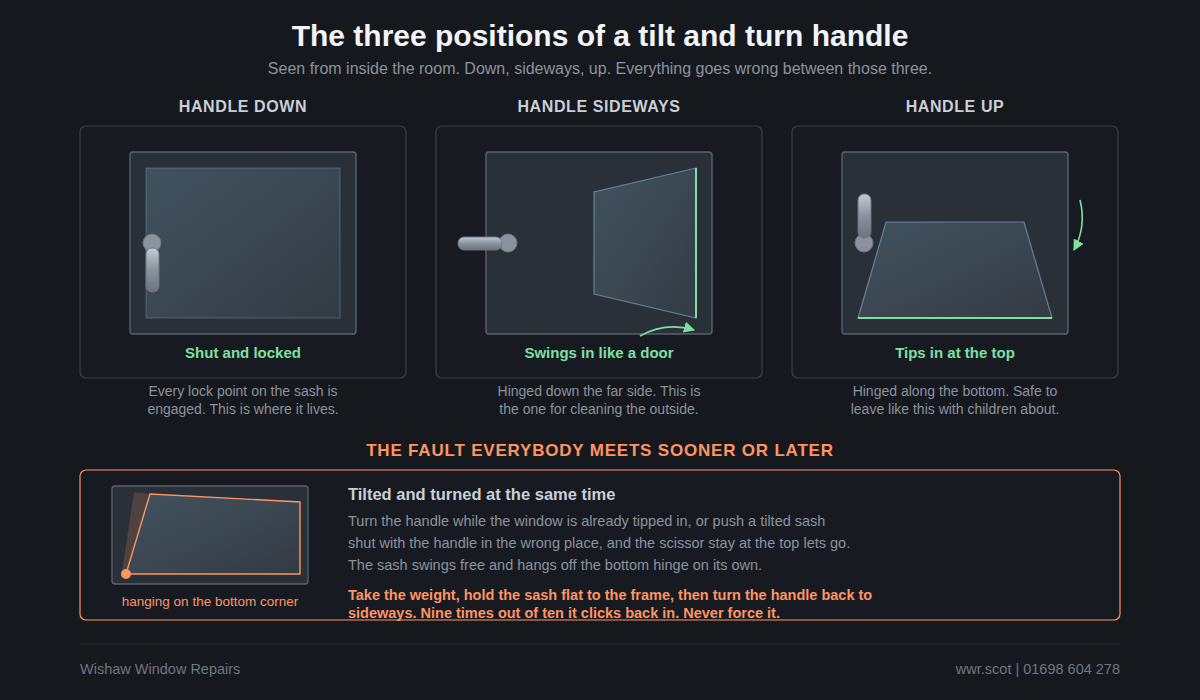
The mechanism that decides which of the two it does is a switch inside the gear. When that switch gets confused, usually because somebody has turned the handle while the sash was already open, the window tries to do both at once and hangs off one corner. It looks alarming and it is almost always recoverable. There is a full explanation on our tilt and turn window problems page.
What they are genuinely good at
Cleaning from inside. The whole outer face of the glass comes into the room. In a first floor flat, or anywhere a ladder is not sensible, that is the argument that ends the discussion.
Ventilation you can leave. Tilted, the opening is at the top, out of reach from outside, too narrow to climb through and pointing rain away from the gap. Good for a bathroom, good for a bedroom in summer, good for a house where somebody smokes.
Large sashes. Tilt and turn hardware carries far more weight than a friction stay will. If you want a single opening pane a metre and a half wide, this is the way to get it.
Escape. In full turn mode the opening is the size of the sash, which makes meeting escape requirements in bedrooms straightforward.
Nothing swings outside. Over a path, a driveway, a balcony or a busy pavement, an inward opening window is the neighbourly choice.
What they are not good at
They open into the room. That is the whole trade off, and it is the reason most people rule them out. Curtains have to be tied back or hung well clear. Roman blinds and vertical blinds are awkward. A windowsill full of ornaments becomes a windowsill full of nothing.
They cost more than an equivalent casement, in the hardware more than the frame.
And the mechanism has more in it. More parts is more to go wrong eventually, though in practice a well made tilt and turn gear that gets oiled once a year lasts a very long time.
Where they make sense in a Lanarkshire house
Flats above ground level, particularly anything where the outside of the glass cannot be reached safely. Bathrooms and en suites. Kitchens where the window sits over a worktop and you want the ventilation without the opener flapping about outside. Bedrooms where escape width is tight. And any elevation facing directly onto a footpath.
For a standard semi with a garden in front of every window and blinds already fitted, a casement is usually still the better answer. We will say that rather than sell you the dearer thing.
Looking after one
Two jobs, once a year, and they last decades.
Put a drop of light oil on every moving point you can see on the edge of the sash when it is open, work the handle a few times, and wipe the excess. Then check the gasket for the flattened, shiny patches that mean it has taken a set and stopped sealing.
Never turn the handle while the sash is open. That is the single most common cause of a tilt and turn ending up hanging by one corner.
If yours is already stuck, do not force it. Forcing a jammed gear turns a repairable part into a scrap sash.
Repairs
We repair tilt and turn windows across Lanarkshire, including on systems other companies have refused to touch. Gearboxes, corner drives, tilt arms, restrictors, handles, gaskets and sealed units are all replaceable in the frame.
Start with the window repair page if something has gone wrong, or ring us and describe it.
Tilt and turn or a standard casement
Most windows around Wishaw are casements: hinged at the side or the top, opening outward on friction stays. They are cheap, simple, reliable and there is nothing wrong with them. So it is worth being clear about what the extra money on a tilt and turn actually buys you.
The tilt position is the real difference. A casement is either shut or it is swinging out into the weather, which means on a windy night or when you are going out, it is shut. A tilt and turn opens a few inches at the top, drawing air in without letting rain across the sill and without giving anybody an opening to climb through. That is a genuinely useful thing in a bedroom, a bathroom or a kitchen.
The turn position is the second difference and it is a mixed blessing. A fully inward opening sash gives you the whole outside face to clean and a large clear opening, which is why they are often specified as a means of escape. It also swings a heavy glazed panel into the middle of your room, so it needs floor space and it needs nothing on the sill.
Against that, a tilt and turn is heavier, the hardware is more complex, and it costs more to buy and more to repair. If what you want is simply to clean an upstairs window from inside without giving up floor space, a reversible window does that job better. If you want the cheapest sound window that does the basics, a casement is still the answer. Our new windows in Wishaw page sets the full range side by side.
Safety, restrictors and upper floors
Because a tilt and turn opens fully inward, it is worth thinking about who else is in the house. The tilt position is inherently safe: the gap is at the top, it is small, and a child cannot get through it. The turn position is a wide open window with nothing in front of it.
Two things help. Most tilt and turn handles can be fitted with a key lock, so the window cannot be moved from tilt to turn without the key. And restrictors can be fitted to limit the turn opening. If you have young children upstairs, ask for one or both when you order, because retro fitting is fiddlier than specifying it up front.
The other point worth knowing is the handle sequence. Handle down is locked, handle horizontal is turn, handle up is tilt. Forcing the handle while the sash is in the wrong position is the single commonest way people damage the gearing, and it is why a window that has been fought with sometimes ends up in both modes at once. If that has happened to yours, do not force it further, ring us.
What it costs
There is no call out fee. You pay for the work done.
New tilt and turn windows are quoted on the job. The size of the opening, how many you are having, the glass specification, the colour, the hardware and whether the existing frames are coming out all change the number, and publishing an invented range would only mislead you. Sealed unit replacements start from £75 for a hopper sized pane, which is the one starting price we do publish.
On repairs, be aware that tilt and turn gearing costs more than casement hardware because there is a great deal more of it running round the whole sash. It is still far cheaper than a new window, and most faults come down to one component rather than the whole set. Our repair prices page explains how we quote.
Questions we get asked
My window is stuck in the tilt position
This is the classic tilt and turn fault and it is almost always a scissor stay or a corner drive that has jumped out of sequence, usually after the handle was turned while the sash was open. Do not force it and do not hang off the top of the sash. It is a repair, not a replacement, and it is a good deal easier to put right before anything gets bent.
The handle will not go all the way round
Either the sash has dropped slightly so the locking cams are catching on the keeps, or the gearing is worn. Both are fixable. As with any window or door, the cheap moment to deal with stiffness is when it first appears, because forcing worn gearing is what turns an adjustment into a parts bill.
Can you get parts for older tilt and turns?
Usually. Most tilt and turn gearing comes from a handful of European manufacturers and the common patterns are still supported. Send us a photograph of the hardware along the edge of the sash with the window open and we can normally identify it. Where a pattern really has been discontinued there is often a modern equivalent that retrofits.
Are they better for condensation?
They can genuinely help, and it is one of the better reasons to have them. Condensation on the inside of the glass is a ventilation and humidity problem rather than a window fault, and the tilt position lets you ventilate a bedroom or bathroom overnight without leaving the house open. There is a full explanation on our window condensation page.
Do they need much looking after?
A little, and it pays back. Keep the gearing along the sash edge clean, give the moving points a light lubricant once or twice a year rather than a heavy grease, and wipe the seals instead of letting grit sit against them. Operate both modes occasionally even if you normally only use one, because hardware that never moves seizes.
Tilt and turn repairs, in our customers’ words
Karen’s bathroom window had a damaged tilt and turn mechanism, and it was fixed the same day she got in touch.
“We had a damaged tilt and turn mechanism on one of our bathroom windows. I had sent a message earlier today. Not only did Jim reply promptly, but he had availability to fix the window on the same day.”
Karen, Google review
Pete’s windows were old enough that the original parts are no longer available, so Jim found an updated mechanism and adapted it to fit.
“So he managed to get some new updated mechanism, and with a few alterations fitted them and both my tilt and open windows work perfect!”
Pete, Google review
Every one of our reviews is on Google, and there is a selection on our reviews page.
Where we fit them
Wishaw first, then across Motherwell, Hamilton, Bellshill, Coatbridge, Airdrie, Newmains, Shotts, Larkhall, Blantyre, Uddingston, Carluke, Lanark, East Kilbride, Cambuslang, Rutherglen and out towards Glasgow. Every area has a page of its own on areas we cover.
Other styles
Flush sash for a period frontage, reversible for full rotation and high level cleaning, vertical sliding sash for the traditional Scottish look, or the full replacement window page for how the quoting works.
Talk to us
Photographs on WhatsApp are the quickest way to get an opinion, especially if the window is already misbehaving. Otherwise ring 01698 604 278, Monday to Friday, eight until five, or message us here.
For how this compares with the other styles we fit, and what separates one uPVC quote from another, see our windows in Wishaw page.
Written by the team at Wishaw Window Repairs. Over thirty years repairing and replacing uPVC windows and doors across Lanarkshire.