
The sash and case window is the Scottish window. Two sashes in a box frame, one sliding up past the other, counterbalanced so a heavy sheet of glass moves with one finger. Every tenement, every terrace of any age, every stone villa in Lanarkshire was built with them.
The trouble is that timber sash and case windows want painting, and the cords rot, and after a hundred and twenty years a lot of them have been painted shut, ripped out, or replaced with something that looks nothing like what was there.
A uPVC vertical slider is the modern version. It moves the way the original moved, it reads correctly from the pavement, and it does not want painting every five years.
How they work
The sashes run in a track and are held by spiral balances rather than by weights on a cord. A spiral balance is a spring in a tube, tensioned to match the weight of the sash it carries. That is what lets the window stay wherever you push it.
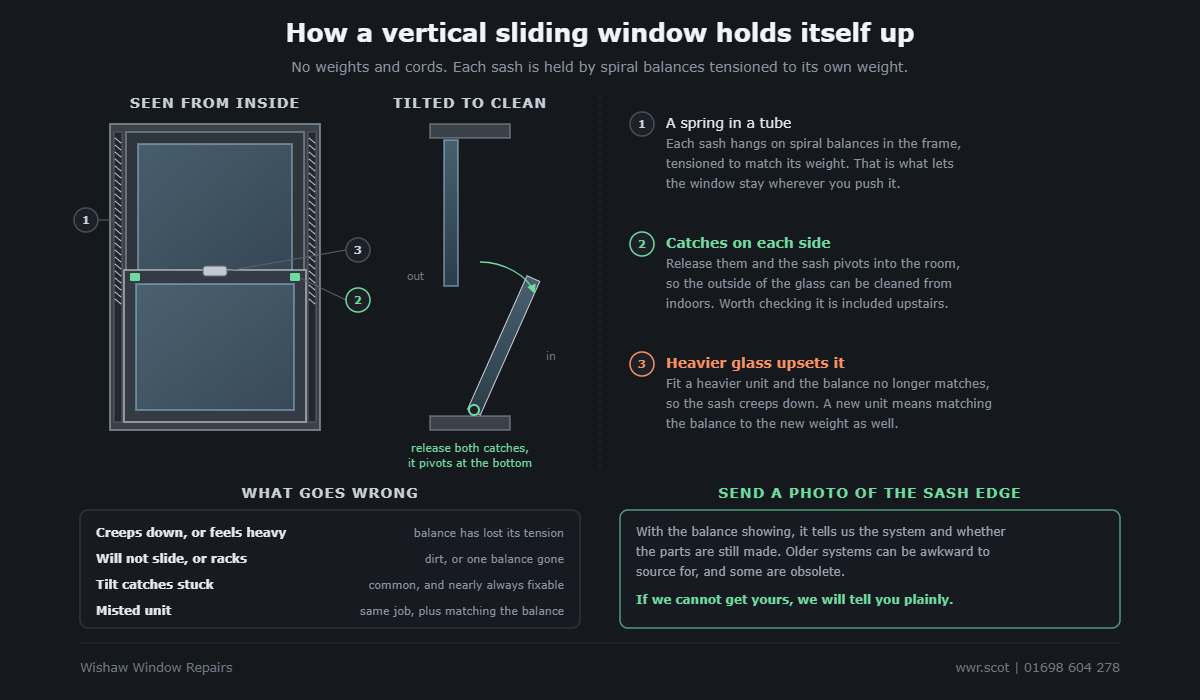
Because the balance is tuned to the sash, a vertical slider is not a window you can casually change the glass in without thinking. Put a heavier unit in and the balance no longer matches, and the sash starts creeping down on its own. That is worth knowing before somebody sells you a glass upgrade.
Most modern sliders tilt inwards as well. Release a catch on each side and the sash pivots into the room so the outside face can be cleaned from indoors. On anything above a ground floor that is the feature that matters most, and it is worth checking it is included rather than assuming.
Getting the look right
This is where vertical sliders are either very good or very disappointing, and the difference is in the detail rather than in the frame.
Run through horns. The small projections at the bottom corners of the upper sash on an original timber window. Without them the window reads as modern. With them it reads as a sash window from across the street. They are usually an option rather than standard.
Astragal or glazing bars. Traditional Scottish sashes were often six panes over six, or two over two, and the layout matters more than people expect. Bars inside the sealed unit look flat. Bars applied to both faces with a spacer between them inside the unit look right from the pavement. A genuine divided sash costs the most and is the only one that will satisfy a conservation officer.
Deep bottom rail. The bottom rail on an original is noticeably deeper than the others. A slider that has all four rails the same width looks wrong even to somebody who could not tell you why.
Colour. White is fine on a rendered or painted frontage. On sandstone, a cream, a heritage off white or a woodgrain foil usually sits better. We would look at the building before advising.
Where the rules bite
Sash and case windows are concentrated in exactly the buildings where the council takes an interest.
If the property is listed, or in a conservation area, uPVC may not be permitted at all, and where it is permitted there will usually be conditions on the sightline, the bar detail and the colour. Scotland runs its own building standards and its own consents, so English guidance you have read online may not apply. Our notes on the Scottish window rules cover the general position, but your local authority is the only reliable source for your address.
Where consent looks difficult, secondary glazing behind the original timber is often the answer that keeps everybody happy, and we will say so rather than sell you something you cannot fit.
Repairs, which is usually where we come in
Most people who ring us about a vertical slider are not buying a new one. They have got one that has stopped behaving.
Balances lose their tension and the sash creeps down or feels like lifting a paving slab. That is a part, matched to the weight of the sash, and it comes out with the frame staying put.
The sash will not slide, or slides in one direction only. Usually dirt in the track, sometimes a balance on one side gone and the other still working, which racks the sash.
The tilt catches will not release, or release on one side. Common, and almost always fixable.
Locks, keeps, restrictors and the little brush seals in the tracks all wear and all replace individually.
And a misted sealed unit in a vertical slider is the same job it is in any other window, with the extra step of getting the sash out and the balance matched to the new weight. Sealed unit replacements start from £75 and slider units sit above that because of the handling.
Older systems can be awkward to source for, and some are genuinely obsolete. We hold a lot of parts and we will tell you plainly if yours is one we cannot get, rather than string it out. Start at our window repair page, or send a photograph of the sash edge with the balance showing.
Other styles
If the building does not actually need a sash window, flush sash casements give you a period line for less money, casement windows are the standard across Lanarkshire, tilt and turn opens inwards for cleaning and escape, and reversible windows rotate right round. How we quote is on the replacement windows page.
Ask us
Send a photograph of the frontage and a close up of one window on WhatsApp, and we can usually tell you what you have got, whether it can be repaired, and whether a slider is the right thing for the building.
Or ring 01698 604 278, Monday to Friday, eight until five, or contact us here.
If sash and case is not the only option you are considering, our windows in Wishaw page compares every style we fit and explains what to look for in a uPVC quote.
Written by the team at Wishaw Window Repairs. Over thirty years repairing and replacing uPVC windows and doors across Lanarkshire.