
It usually starts in a corner. A scatter of small black or grey dots along the bottom edge of a pane, or a dirty looking tidemark curving up one side, sometimes with a greenish cast to it in a north facing room. You go at it with a cloth and nothing changes. You do the outside as well, in case it’s on there. Still nothing.
That’s because it isn’t on the inside face and it isn’t on the outside face. It’s in the gap in the middle, between the two panes, and there is no cloth on earth that gets in there.
How anything got in there in the first place
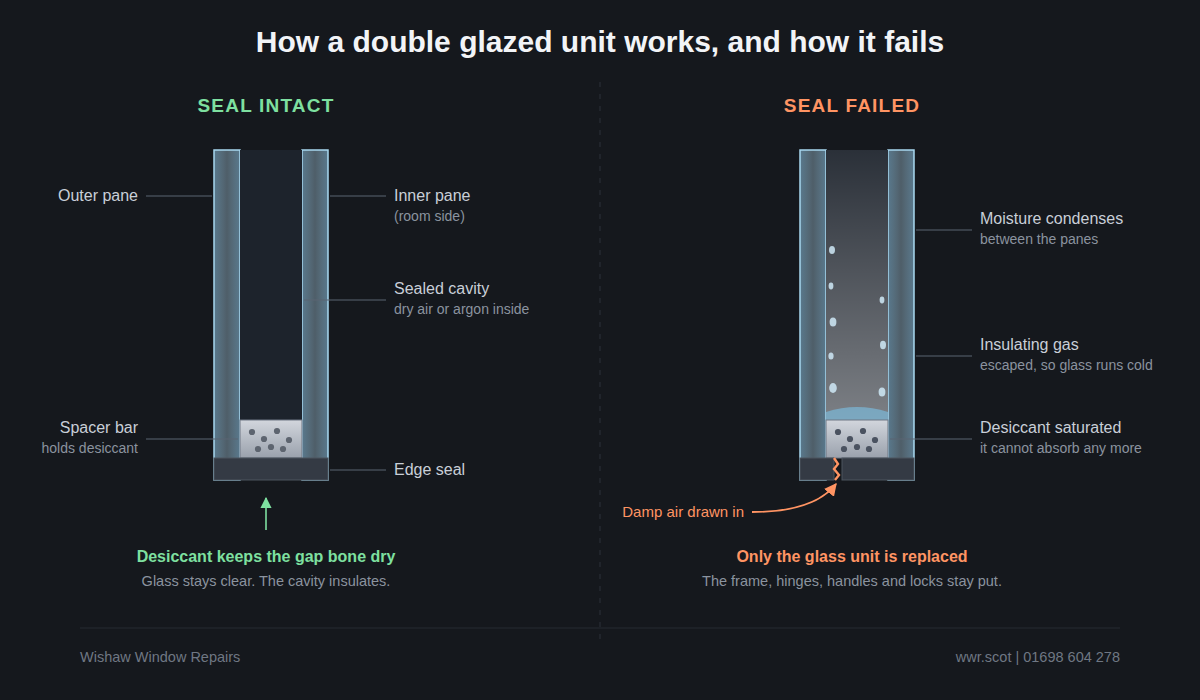
A sealed unit is two sheets of glass held apart by a spacer bar round the edge, with the whole perimeter sealed so nothing passes in or out. Inside that hollow spacer bar sits a drying agent, desiccant, which mops up the small amount of moisture present when the unit was made and keeps the cavity bone dry for years.
When the edge seal fails, that arrangement stops working. Warm damp air gets drawn in and out of the cavity every time the glass heats up and cools down, and the desiccant fills up and gives in. From then on the gap holds water. On a cold morning you see it as fog. In the afternoon the sun drives it off and the glass looks fine again, and it condenses out once more that night.
Spotting is what happens when that has been going on for a long while. A cavity that has been wet and drying, wet and drying, for a couple of years is not a sterile place any more. Airborne spores came in with the damp air, they found moisture and a bit of warmth, and they’ve settled and grown on the glass and on the spacer.
Mould, mineral, or a bit of both
Not everything you’re looking at is alive.
Water carries dissolved minerals, and every time a film of water evaporates off the inside of the glass it leaves behind whatever it was carrying. Do that a few thousand times and you get a hard white or grey haze, usually strongest along the bottom where the water pools, sometimes in a rippled tidemark that records where the water level sat.
Actual mould looks different. It’s darker, often properly black, and it grows in discrete blotches and speckles rather than an even film. It tends to start at the bottom edge and creep up, and it will often be worse at the corners where the water lingers longest.
Plenty of blown units have both. The mineral haze goes down first, the mould takes hold on top of it. Either way the diagnosis is the same, and so is the fix.
Is it a health risk?
No, and I’d rather say that plainly than have anyone lying awake about it.
The mould is inside a sealed cavity. That cavity is not connected to the air in your room. Even a failed unit is failed at the perimeter, not open like a window, and there’s no airflow carrying anything from the gap into the bedroom. Nobody is breathing it in.
What it does tell you is that the seal went a long time ago. Speckling is a late stage symptom. If you’ve got it, that unit has been damp for years, the insulating gas that was in the gap is long gone, and the pane has been performing more like single glazing than double for a good while. It isn’t hurting your health. It is costing you a bit on the heating and it looks dreadful.
Why nobody can clean it
People ask, quite reasonably, whether we can take the unit out and open it up.
We can take it out. Opening it is where it falls apart. The panes are bonded to the spacer with sealant that isn’t designed to come apart and go back together, and once you’ve cut a unit open you’ve got two loose sheets of glass, a bent spacer bar and a saturated desiccant. Even with both inner faces cleaned perfectly you’d have to rebuild the edge seal to a standard that keeps damp out for a decade, and that’s a factory process in controlled conditions.
The drill and dry kits online are worse. They put a hole through a pane that’s holding the weather out, they don’t repair the seal that failed, and on toughened glass you risk the whole pane going. The fog is back within weeks because nothing has been fixed.
You can’t clean a sealed cavity. You replace it.
Mould round the frame is something else entirely
Worth separating these two, because they get muddled constantly and the answers have nothing in common.
If the black is on the uPVC frame itself, in the corners of the rubber gasket, on the plaster reveal at the side of the window, or on the wall above the sill, that is not a failed unit. That’s condensation forming on the room side of the glass and frame, running down, and sitting somewhere it can grow. You can wipe it off, which is the giveaway. It comes back because the underlying condition hasn’t changed.
That one is about moisture in the room and how much ventilation you’re giving it. Trickle vents shut, an extractor that isn’t shifting much, washing drying on the radiators, a room that’s cold most of the day and warm at night. Different problem, different fix, and replacing the glass won’t touch it.
The test is simple. If a cloth removes it, it’s a room ventilation issue. If a cloth does nothing, it’s inside the unit.
What we’d do about it
Replace the sealed unit and leave the frame where it is. We measure the failed unit, note the glass spec so the new one matches the rest of the window, and make one up to size. The old one comes out, the new one goes in, the beads go back on. No plaster, no mess, no redecorating, and the hinges, handles and locks are untouched because there’s nothing wrong with them.
Misted and blown unit replacements start from £75, and a spotted unit is the same job as an ordinary misted one. It just looks worse.
If you’ve got speckling in a pane anywhere around Wishaw or Motherwell, take a photo with the light behind you so the marks show up, send it over on WhatsApp, and we’ll tell you what you’re looking at. Or ring 01698 604 278 and describe it. There’s no call out charge either way.
If the frame is holding damp as well, that is worth looking at, and it comes under ordinary uPVC window repair.
Related advice
- Why double glazing mists up
- Condensation on the inside of the glass
- What it costs to fix a misted window
- Seals and gaskets
See our glass unit replacement page for what we do and where. There are before and after photographs of jobs like this in the gallery. If you would rather just ask, get in touch.
You will find around fifty more guides like this one in our advice section.
Written by the team at Wishaw Window Repairs. Over thirty years repairing uPVC windows and doors across Lanarkshire.