
It’s the first thing everybody wants to know and the last thing most companies will tell you. Ring around about a misted window and you’ll get a lot of “we’d need to send someone out” before anyone mentions a number.
Fair enough up to a point, because glass is made to measure and nobody can price a window they haven’t seen. But you’re entitled to know roughly what you’re walking into before you invite anyone round, so here’s an honest explanation of what drives the price and where it lands.
The short answer
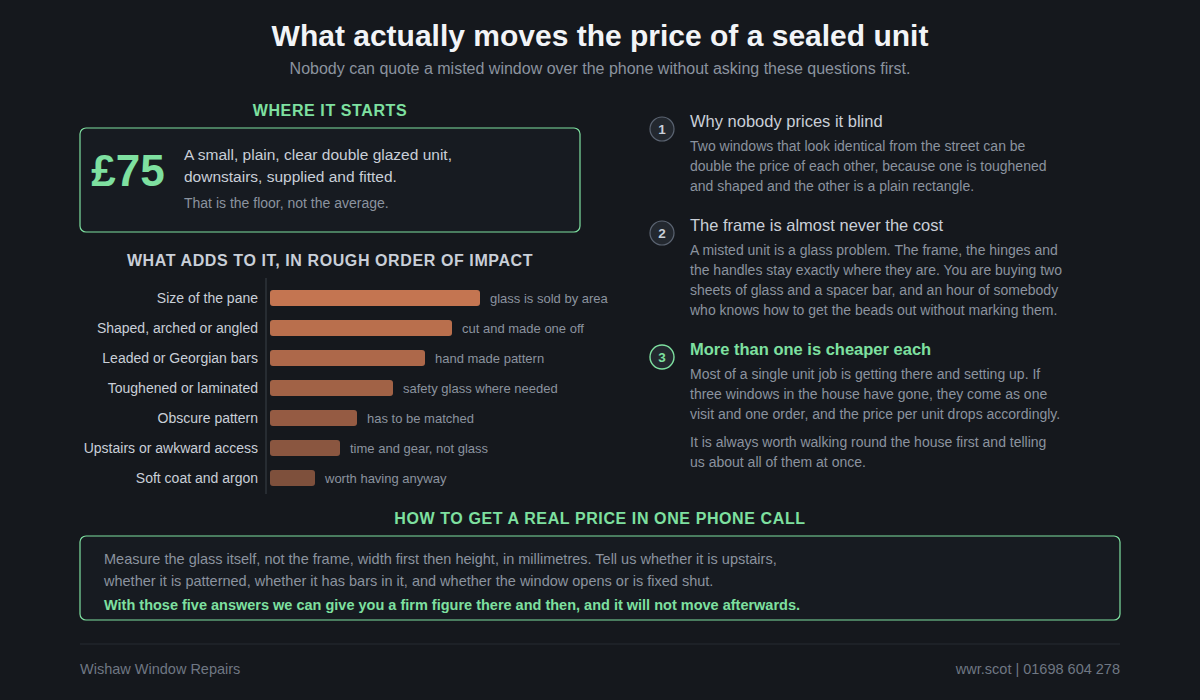
Replacing a failed sealed unit in an existing uPVC frame starts from £75.
That’s the figure for a typical, straightforward, average-sized pane of clear double glazing in a sound frame. Everything above that is quoted on request, because it depends on the size of the pane, the type of glass and the type of work involved, and those vary from window to window. We would rather price your actual window than publish a list that turns out not to apply to it.
What is worth knowing is the scale of it. This is a job priced in tens of pounds for most windows, not thousands. Replacing the whole window instead, when only the glass has failed, can easily be ten or fifteen times the cost of replacing the glass.
What actually moves the price
Six things, roughly in order of how much difference they make.
Size. Glass is priced by area, so a small bathroom pane and a big living room picture window are not remotely the same job. This is the single biggest factor, and it’s why nobody can quote firmly without a measurement.
How many. If several units have gone, which is common because units fitted at the same time tend to fail around the same time, the price per window comes down. One visit, one delivery, one lot of setting up.
The type of glass. Clear glass is the baseline. Obscured or patterned glass for bathrooms costs a bit more, and the pattern has to be matched. Toughened safety glass, which is required in doors, side panels and low-level glazing, costs more than standard. So does laminated.
Decorative detail. Georgian bars inside the unit, or leaded designs, add to the cost because the unit is more work to make and the pattern has to line up with the windows around it.
Energy specification. Modern units use a low emissivity coating and an argon-filled cavity to keep heat in. It’s worth having, especially as you’re replacing the glass anyway, and it’s a modest addition rather than a big one.
Access. Ground floor is straightforward. Anything needing ladders or working at height, or a very heavy unit that needs two people to lift safely, takes longer and is priced accordingly.
What doesn’t change the price
Worth saying, because people worry about these.
The age of the window doesn’t matter, as long as the frame is sound. A twenty-year-old frame in good condition takes a new unit just as happily as a five-year-old one.
There’s no call-out charge with us, so getting someone out to look and measure doesn’t cost you anything, whether you go ahead or not.
And the frame, handles, hinges and locks aren’t part of the job unless something is separately wrong with them. You’re paying for glass and fitting, not for a window.
Why “from” prices need reading carefully
A quick word of caution about shopping around online. A very low headline price usually refers to the smallest possible pane of the most basic glass, and it may not include fitting, VAT, or removing and disposing of the old unit. Some prices are quoted per square metre, which is fine but means very little until you’ve measured your window.
When you get a price from anybody, it’s worth asking three questions: does that include fitting, does it include taking the old unit away, and is that the final figure including VAT. A straight answer to all three tells you more about who you’re dealing with than the number itself does.
How to get a real figure quickly
The fastest route is a photo and a measurement.
Measure the pane of glass itself, not the whole window, in millimetres if you can. Width and height. Then take a photo of the window from far enough back that we can see the style, whether there are bars or a pattern, and where it sits in the house.
Send both over on WhatsApp and we can usually give you a realistic figure the same day, before anyone comes out. We’ll still measure properly before ordering, because the glass has to be right, but you’ll know what you’re dealing with in advance.
Is it worth it?
For nearly everyone, yes, and not just for the look of it. A blown unit has lost the insulating gas from the cavity, so it’s running colder than it should be, which means a colder room and more condensation on that pane through the winter. You’re paying for that in heating whether you fix it or not.
Set the cost of a new sealed unit against a full window replacement and it’s not a close call. Set it against another few winters of looking at a foggy pane and it’s not a close call either.
Ready when you are
We’re a family-run firm and we’ve been replacing misted units around Wishaw and Lanarkshire for over thirty years. No call-out charge, no hard sell, and a straight price before we start.
Send a photo on WhatsApp or call us on 01698 604 278.
The price does not change with the distance we travel, so a job in Hamilton costs the same as one two streets from the yard.
If the frame or the hardware needs attention at the same time, that is priced separately as window repair work.
Related advice
See our glass unit replacement page for what we do and where. There are before and after photographs of jobs like this in the gallery. Our contact details are here.
There are around fifty more plain English guides in our advice section.
Written by the team at Wishaw Window Repairs. Over thirty years repairing uPVC windows and doors across Lanarkshire.