
A call from a house in Wishaw a while back. One blown unit in a front bay, leaded pattern, and the owner had already been quoted for all three windows because she’d been told a single leaded unit couldn’t be matched. It could. We took one photograph, ordered off the back of it, and the new unit went in looking like the two either side of it.
Matching decorative glass isn’t difficult. The catch is that nearly everything which can go wrong is decided before the unit is ever made, so the looking and the measuring have to happen at the start rather than on the day of fitting.
What a real leaded light actually is
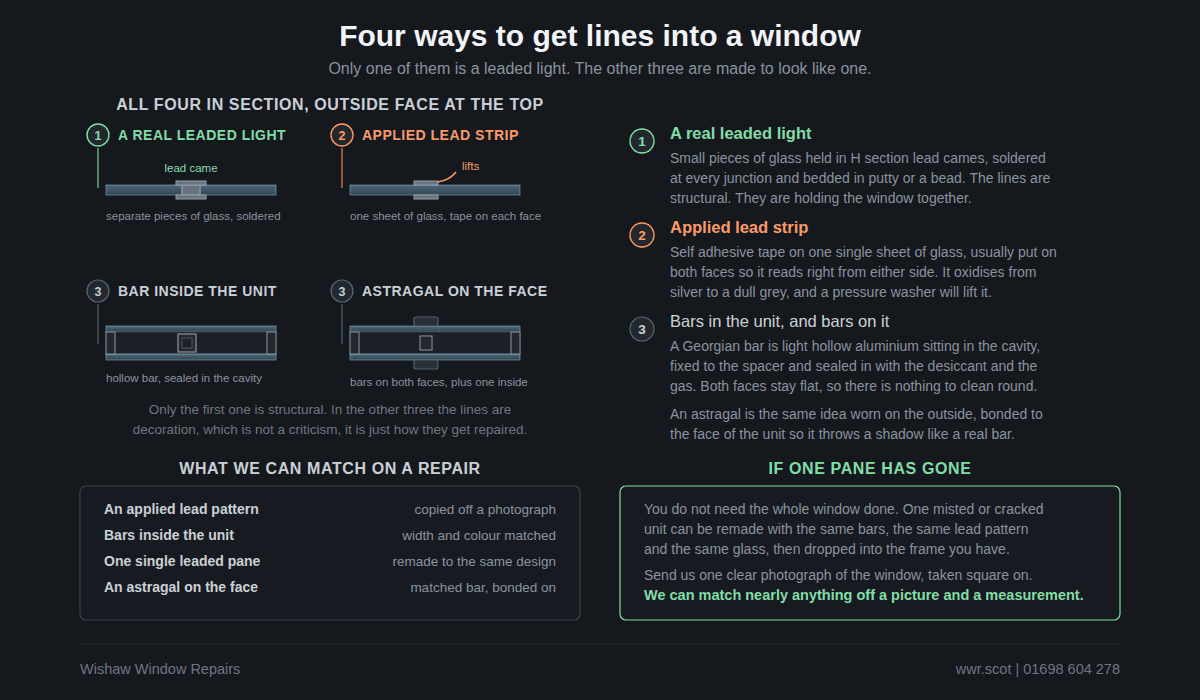
A genuine leaded light isn’t one sheet of glass. It’s a lot of small pieces, each cut to shape, held in strips of lead called cames. The came is H shaped in section, so a piece of glass slots into the channel on either side, and every junction where the cames meet is soldered. The finished panel is then bedded into the frame with putty or a bead.
The lines in a real leaded light are structural. They’re what’s holding the glass together. That’s the whole difference.
You’ll still find them in older timber and steel windows around Lanarkshire, and occasionally sealed inside a modern double glazed unit, where the leaded panel is encapsulated between two sheets of float glass to keep the weather off it. That’s a specialist item and it’s priced like one.
If your windows are uPVC, you almost certainly haven’t got one.
Applied lead, which is what most houses have
What you’ve most likely got is applied lead strip. A single sheet of glass with self adhesive lead tape stuck to the outer face in a diamond or rectangular pattern, and usually a matching strip on the inner face so the lines line up and it reads properly from inside the room as well as from the street. Some patterns have coloured film bonded in behind the lead for the stained glass effect.
From the pavement it looks like leaded glass. Run a fingernail across it and you can feel it sitting proud of the surface.
Applied lead oxidises from bright silver to a dull grey, which most people prefer anyway, and it can be lifted at a corner by a careless window cleaner or a pressure washer. It can also be applied to a new unit, so an unusual pattern isn’t lost when the glass fails.
Georgian bars, inside the cavity and on the face
Two completely different things share the name and people mix them up constantly.
The common one is a Georgian bar inside the sealed unit. It’s a light hollow aluminium bar that sits in the cavity between the two panes of glass, fixed to the spacer bar around the edge, dividing the view into squares or rectangles. The glass itself is two continuous sheets, so both faces are flat and there’s nothing to clean around. It’s sealed in there with the desiccant and the cavity gas, which is the part that matters later on.
The other is an astragal bar, which sits on the surface. It’s bonded to the outside face of the glass, usually with a matching bar on the inside face and often a slim bar in the cavity too so the line runs all the way through. Astragal is far more convincing close up, because a real timber sash has bars on the surface casting a shadow, which a bar floating in a cavity never quite does. The trade off is a raised profile to clean around, and a hard enough knock will take one off.
While we’re here: a faint tick or rattle from a window with bars inside the unit is normal. The bar assembly needs a working clearance in the cavity so nothing binds when the glass flexes in the wind or everything expands on a hot afternoon. A slammed door or a lorry going past and you’ll sometimes hear the bar touch a pane. It isn’t a broken seal and there’s nothing to fix.
Get the spacing and the width wrong and the whole front looks off
This is where matched replacements are won and lost.
Nobody standing on the pavement can tell you what’s wrong with a window whose bars are a few millimetres out. They just know something is. If the rest of the bay has six panes and the new one has eight, or the new bar is a shade wider than its neighbours, the eye picks it up even though the brain doesn’t.
So the bars get measured off the window next door rather than guessed. Centre to centre on an existing bar, the number of panes across and down, the width of the bar itself, and whether the top row is a different depth from the rest, which it very often is.
Colour is the other one. Bars come in white, gold and black. Gold on white frames turns up all over houses of a certain vintage, black is what most people choose now, and a single gold bar next to white ones is obvious from across the road. Check yours in daylight rather than through net curtains, because aged gold in a shaded room reads as white.
One thing there’s no way around: a bar inside a sealed unit cannot be added afterwards. It’s inside a hermetically sealed cavity. Adding one means making a new unit, so it’s a decision taken at order stage, not a change of mind a fortnight later. Applied lead and surface astragal can be added to existing glass. Anything in the cavity can’t.
The photograph that saves a wasted trip
Stand outside, square on to the window, a few feet back, and get the whole opener in the picture with the bars running level. Daylight, no flash. Then one close up of a bar with a tape measure held against it.
That’s it. A shot taken at an angle from below the sill distorts the spacing, and a shot through the glass from inside shows you the reflection of the room and very little else. Two photographs, sixty seconds, and the pattern can be read off them properly.
Getting yours matched
If you’ve a blown unit in a leaded or Georgian window and you’ve been told the whole set has to go to keep them looking right, that’s worth a second opinion before you spend the money. We’ve been replacing decorative units around Wishaw and Motherwell for over thirty years and it’s rare that a pattern genuinely can’t be matched.
Send the photo over on WhatsApp, or ring us on 01698 604 278 and we’ll tell you what we’d need to see.
If the frame or the hardware needs attention as well as the glass, that falls under our general window repair work.
Related advice
See our glass unit replacement page for what we do and where. There are before and after photographs of jobs like this in the gallery. Photographs on WhatsApp are the quickest route to an answer. Contact us here.
Stuck on something else? Our window and door advice section covers around fifty of the faults we see most.
Written by the team at Wishaw Window Repairs. Over thirty years repairing uPVC windows and doors across Lanarkshire.