Obscure glass is glass with a texture rolled into one face while it’s still soft, so it scrambles light without blocking it. The bathroom stays bright and nobody outside can make out what’s happening in it. It isn’t frosted, it isn’t a film, and it isn’t sprayed on. The pattern goes right into the surface of the glass and it can’t wear off, peel or be scrubbed away.
Which is why, when someone wants theirs changed, the answer is always a new pane rather than a treatment applied to the old one.
The privacy scale, 1 to 5
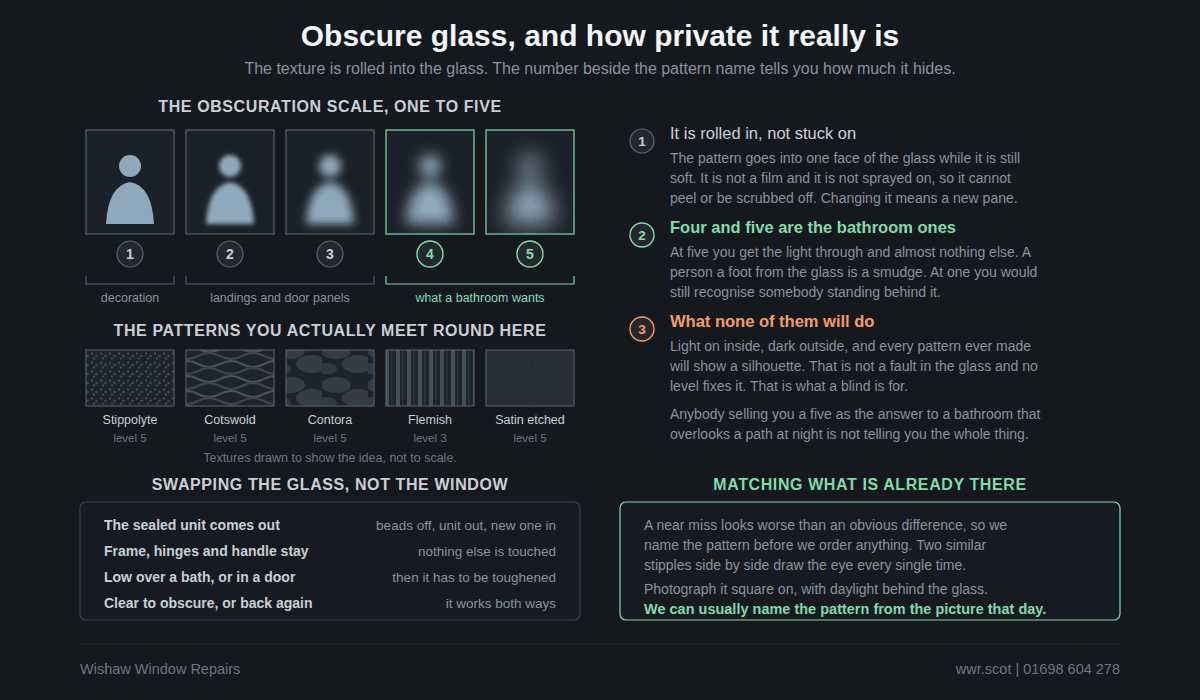
Every obscure pattern carries an obscuration rating from 1 to 5. It’s an industry scale and it’s the single most useful thing to understand before you choose.
Level 1 is barely obscure at all. A light texture that softens the view and distorts it slightly. You’d still recognise a person standing behind it. It’s decoration, not privacy.
Levels 2 and 3 are the middle ground. You’ll see shapes, colours and movement, and know somebody is in the room, but not who or what they’re doing. Fine for a landing or a door side panel.
Levels 4 and 5 are what a bathroom wants. At 5 you get light through and almost nothing else. A person a foot from the glass is an indistinct smudge. Most of the heavier patterns sit here, and it’s what we fit in bathrooms unless someone asks otherwise.
One thing that trips people up. No obscure glass at any level stops a silhouette when the bathroom light is on at night and it’s dark outside. That’s true of every pattern made, and it’s what blinds are for.
The patterns you’ll actually meet round here
Patterns are manufacturer designs with names, not generic textures, and the same handful turns up again and again in Scottish housing stock.
Stippolyte is the one most people picture. A fine random stipple, like the surface of hammered metal, level 5, and it went into an enormous number of bathrooms from the eighties onwards.
Cotswold is a coarse rippled bark texture, also level 5, and it’s probably the most fitted obscure pattern in Britain over the last thirty years.
Contora is a soft cloudy swirl, another 5, common in newer replacement windows.
Flemish is the old fashioned one, vertical rippled reeding with a Victorian look, and it sits lower on the scale at around 3. It shows up in tenement stair windows and in period properties, and people either love it or want it gone.
Satin or acid etched glass is the flat, even, sandblasted looking finish with no pattern at all. It’s a different process, it looks modern and plain, and it’s what people usually ask for when they want the bathroom to look less like 1987.
Then there’s a long tail of others: Everglade, Autumn, Charcoal Sticks, Chantilly, Minster, Pelerine, Digital. Even an unusual one is usually identifiable.
Why the name matters is simple. If your bathroom window has three panes and only one has blown, or you’re changing one window in a run where the whole side of the house is glazed the same, a near miss looks worse than an obvious difference. Two similar but not identical stipples side by side draw the eye every time. So we identify the existing pattern and match it.
Some patterns have been discontinued. Where that’s the case we’ll tell you the closest current equivalent, and whether it’s near enough to sit beside the original or whether you’re better doing the pair together so they match each other.
Bathrooms, doors and safety glass
Here’s the part that isn’t about looks.
Where glazing is in a door, in a panel beside a door, or set low in a wall, the glass has to be safety glass, meaning toughened or laminated. That’s not a preference. It’s a requirement, because those are the positions where somebody can fall or walk into the pane, and ordinary annealed glass breaks into large sharp pieces where toughened crumbles into small blunt ones.
Bathrooms throw this up more than most rooms. Bathroom windows often sit low over a bath, and bathroom doors are frequently glazed. A wet floor, a slippery bath edge and somebody moving about is exactly the scenario the rule is written for.
Every common obscure pattern is available toughened, so it doesn’t limit your choice. It’s specified when the unit is ordered, and toughened glass can’t be cut afterwards, so the sizes have to be right first time. In Scotland this sits under the Scottish Building Standards rather than the English regulations, and the certification schemes here are different to what you’ll read on English sites. FENSA doesn’t operate in Scotland at all. A like for like glass swap in an existing frame needs nothing arranged, but if you’re altering an opening your local building standards department is the place to confirm what applies.
If you’re unsure whether your bathroom glass needs to be toughened, tell us how high the bottom of the glass is off the floor and we’ll tell you.
Going from clear to obscure without touching the frame
Usually asked by somebody who’s bought a house where a previous owner put clear glass in a bathroom, or whose neighbour has just built an extension with a landing window looking straight in.
You don’t need a new window. The sealed unit is a separate item held in the frame by beads, and swapping it for one with an obscure outer pane is a straightforward exchange. Frame, hinges, handle, trickle vent and sill all stay as they are. It works the other way too, and plenty of people take obscure glass out of a dark landing and put clear in for a fraction of what a new window costs.
One practical point. The pattern normally goes on the inner face of the outer pane, so the texture is protected inside the sealed cavity and the outside stays flat and easy to clean.
Finding out what you’ve got
A photo does it. Stand square to the window, get in reasonably close so the texture fills the frame, and take it with daylight behind the glass so the pattern shows in relief rather than flat. If there’s an etched stamp in a corner of the pane, photograph that as well, because it names the manufacturer and tells us whether it’s toughened.
Send it over on WhatsApp and we’ll usually name the pattern from the picture and give you a rough figure the same day. Sealed unit replacements start from £75 and obscure glass isn’t a premium item, so it’s rarely the expensive job people expect.
Or ring us on 01698 604 278 between eight and five, Monday to Friday, and we’ll talk through the options. We’re out around Wishaw and Lanarkshire most days and there’s no charge for coming to measure.
If the window itself is stiff, draughty or hard to close, that is a separate uPVC window repair and worth sorting while the glass is being done.
Related advice
See our glass unit replacement page for what we do and where. Ring 01698 604 278 or contact us here.
There are around fifty more plain English guides in our advice section.
Written by the team at Wishaw Window Repairs. Over thirty years repairing uPVC windows and doors across Lanarkshire.