
A salesman at the kitchen table with a folder tells you your windows have lost their argon and the whole lot needs replacing. It’s a good line. It sounds technical, it points at something invisible, and it can’t be argued with in the moment.
So let’s take it apart. What the gas does, whether yours has gone, and whether it would matter if it had.
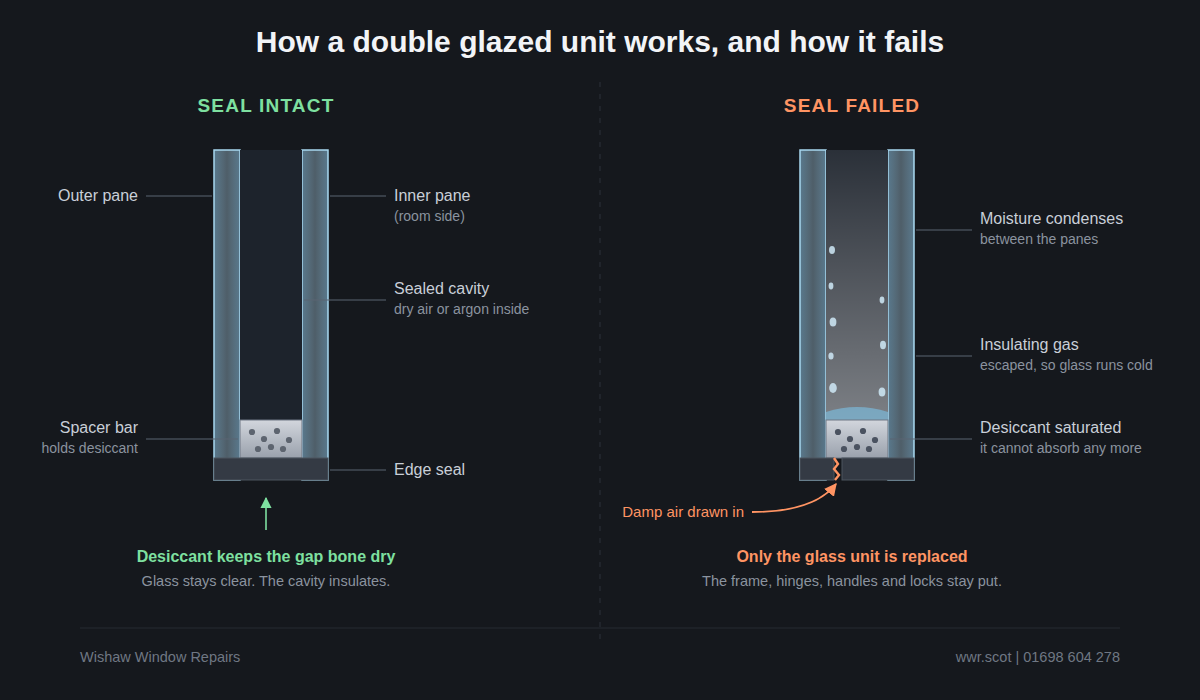
What the argon is doing in there
The cavity between the two panes of a sealed unit isn’t empty and it isn’t a vacuum. It’s filled with argon, an inert gas, for two reasons.
The first is that argon conducts heat less readily than air. The second, and the one doing more of the work, is that it’s denser and moves more sluggishly. Heat crosses that cavity mostly by convection. The pane on the warm side heats the gas touching it, that gas rises, tracks across the top, cools against the outer pane, sinks, and comes back along the bottom. A loop turning quietly inside your window all winter, ferrying heat out of the house.
A denser, slower gas makes that loop harder to start and slower once it’s going. It’s the same reason the cavity is a particular width. Too narrow and the panes conduct straight across, too wide and the gas circulates freely.
That’s the whole trick. It isn’t a large effect, which is a point we’ll come back to.
It leaks. That’s expected.
No sealed unit holds its gas forever. The edge seal is a barrier, not a vault, and gas molecules work their way through it very slowly. The standards governing sealed unit manufacture allow a small annual loss rate and units are tested against it. A properly built unit gives up its argon over decades, the performance drifting down so gradually that nobody has ever noticed it happening in their own house.
That’s not a failure. That’s the design.
A failure is the edge seal breaking down, at which point you don’t have a slow drift, you have a hole. The gas goes, damp air comes in, the desiccant in the spacer bar soaks up what it can until it’s saturated, and then moisture starts condensing between the panes. Slow permeation and a blown seal are not the same event, and it’s worth being clear which one is being described to you.
You can’t see it, and there’s no home test
Here’s the part the man with the folder tends to skip.
Argon is colourless, odourless and invisible. A unit full of argon and a unit full of air look identical. There’s no way to tell by looking, no way to tell by touch, and nothing you can do at your own window that will answer the question.
Gas fill can be measured. There are instruments that do it, firing a spark across the cavity and reading the light the gas gives off. They’re a factory tool, and nobody is carrying one round the houses of Lanarkshire in the back of a van. If someone pronounces on your argon without an instrument in his hand, he’s guessing, and guessing in a direction that suits him.
What can be seen is a unit that has actually failed. Misting between the panes, and a pane that feels notably colder to the back of the hand than the same glass elsewhere on the same wall. Sometimes panes that visibly bow inward, though be careful with that one, because a cold snap drops the cavity pressure and pulls the panes together on perfectly sound units.
And if a unit has misted, the argon left long ago. There’s no version of events where the seal has let water vapour in but the gas is still sitting politely inside.
The coating does more work than the gas does
The inner pane of a modern sealed unit carries a low emissivity coating on the face pointing into the cavity. A microscopically thin layer of metal oxide, invisible in normal use, whose job is to reflect long wave heat radiation. Warmth coming off your radiators, your walls and you hits that coating and bounces back into the room instead of passing out through the glass.
It contributes considerably more to the performance of a modern unit than the argon does. Take the gas out of a unit with a good coating and it’s still a decent window. Take the coating out and it’s a much worse one, gas or no gas.
You can check for one yourself in a minute, and it’s the closest thing to a home test that exists. Wait until dark, turn the room lights off and hold a lit match up close to the window at a slight angle. You’ll see a row of reflections, one from each glass surface. If one is a different colour from the rest, usually duller or with a coppery cast, that’s the coating. All the same colour and you’ve got an older uncoated unit.
That tells you nothing about the argon. It tells you something far more useful about how the window is performing.
When “you’ve lost your gas” is a sales line
Treat it as a warning sign when someone diagnoses gas loss in a unit that’s clear and dry and showing no other symptom, then goes straight from that to replacing every window in the house.
They can’t know, because they haven’t measured. Even if they were right, slow permeation in a sound unit is a small effect nobody feels. And the fix for a tired sealed unit is a new sealed unit into the frame you’ve already got, not new frames and certainly not the whole house.
Ask how it was measured and what the reading was. The answer, or the lack of one, tells you what the quote is worth.
Questions we get asked
Can argon be topped up in an existing unit?
No. It’s a sealed manufactured item with no port to fill it through. Anyone offering to re-gas your windows in situ is selling you something that isn’t a thing.
My unit is twenty years old and clear. Should I replace it for the gas?
Not on its own. If it’s clear, dry and the frame is sound, it’s still working.
Does a misted unit cost me money as well as looking bad?
Yes, though less than people fear. The gas has gone and the moisture attacks the coating, so it’s a colder pane than it should be. It’s still two sheets of glass, so it isn’t a disaster.
What to do about it
A misted window is a real fault with a straightforward fix, and it’s the glass unit that gets replaced rather than the window. Replacements start from £75, usually well under an hour a window and no mess left behind. A clear window that somebody has told you has failed anyway is worth a second opinion before you sign anything.
Photos over WhatsApp are the quickest way to get a rough figure out of us, or ring 01698 604 278 between eight and five, Monday to Friday.
Whatever the glass turns out to be doing, the frame and the gear around it are worth checking at the same time, and that is what our uPVC window repair service covers.
Related advice
- Why double glazing mists up
- Whether triple glazing is worth it
- Window energy ratings
- What a guarantee actually covers
See our glass unit replacement page for what we do and where. There are before and after photographs of jobs like this in the gallery. Our contact details are here.
More like this: browse all fifty guides in our window and door advice section.
Written by the team at Wishaw Window Repairs. Over thirty years repairing uPVC windows and doors across Lanarkshire.