
We went out to a house in Clarkston a couple of summers back where the lady was convinced her neighbour’s boy had put a stone through the kitchen window. Nobody had seen anything, there was no mark on the glass, and nothing had turned up in the sink or the garden.
It was a thermal crack. Started at the edge of the pane behind the frame, ran in a slow curve towards the middle, and it happened at about four in the afternoon on the first properly hot day of the year with nobody in the room.
Glass does this. Not often, but often enough that we see a few every year, and it catches people out because there’s no cause you can point at.
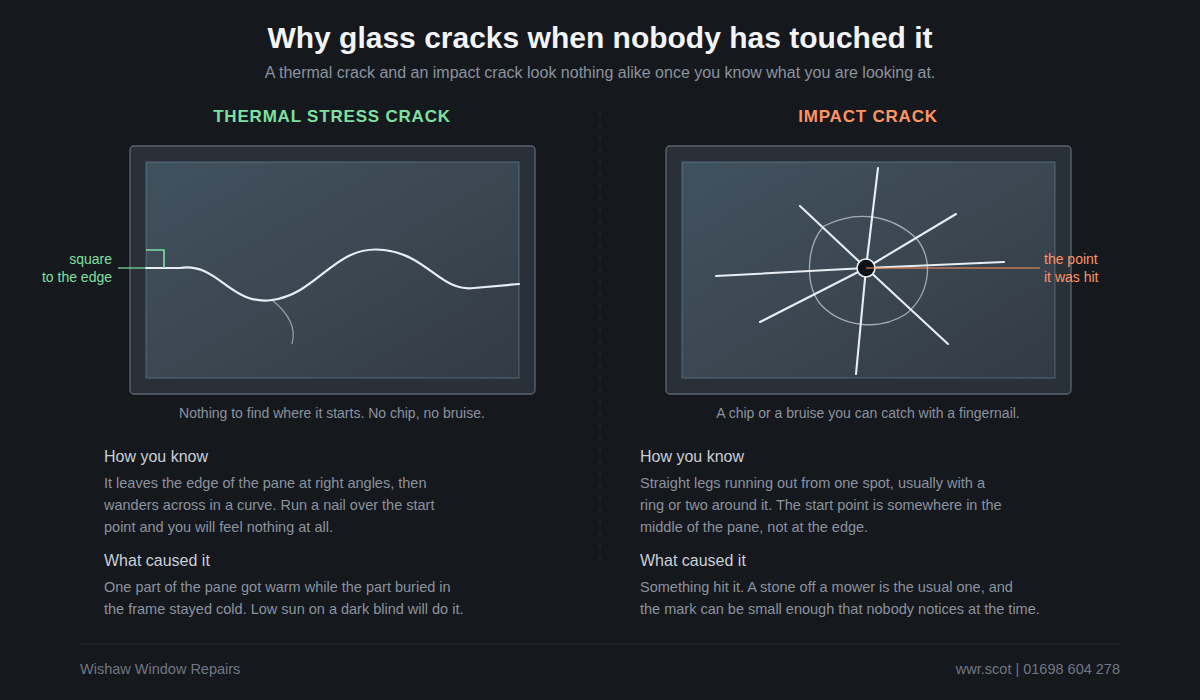
What thermal stress does
Glass expands when it’s heated. Not by much, but by a definite amount, in proportion to how hot that bit of glass has got.
Now look at how a pane sits in a window. The middle is out in the open taking full sun. The outer inch or so, all the way round, is tucked inside the frame rebate, in shade, against a plastic frame and a rubber gasket that are themselves sitting on a cool wall. On a bright day the exposed centre runs a good deal warmer than that buried edge.
So the centre tries to grow and the edge doesn’t. The edge ends up holding the middle back, and that puts the perimeter of the glass into tension. Tension is what glass hates. It’ll take enormous compression and very little pulling.
Once the tension passes what the edge can bear, the glass relieves it the only way it can. The crack starts at the weakest point on that edge, nearly always a tiny nick or rough spot left from cutting, and it travels.
That’s it. No impact, no defect in the frame, no fault of yours.
Telling a thermal crack from an impact crack
You can read it off the glass in about ten seconds.
A thermal crack starts at the edge of the pane and leaves it at roughly ninety degrees, straight out into the glass for the first inch or two. Then it wanders, curving gently, sometimes forking once, looking organic, a bit like a river on a map. No chip, no crater, no white bruise anywhere along it.
An impact crack has an origin. There’ll be a point somewhere, often a small chip or a bright bruised spot the size of a match head, with cracks radiating away from it like spokes, frequently with a rough ring or two crossing them. Run a fingernail over the origin and you’ll feel it.
So: crack meets the edge square on, no damage at that spot, it’s thermal.
What makes it more likely
The pattern is always the same: something making one area of the glass much hotter than the area next to it, or than the edge.
Dark blinds pulled down close to the glass. Sun comes in, the blind absorbs it, gets hot, and radiates that heat straight back into the pane it’s sitting an inch from. The glass behind the blind cooks while the edges stay cool in the frame.
Furniture pushed hard against the window. A dark headboard, a wardrobe, a big sofa back, anything trapping a pocket of hot still air against the glass. Posters and cardboard taped over a pane do the same.
Stick on solar films. This one catches a lot of people. They work by absorbing solar energy rather than letting it through, so the glass they’re stuck to runs considerably hotter than bare glass would. Applied to a pane that wasn’t specified for it, they’re a well known cause of thermal breakage.
Partial shade falling across a window. A tree, a downpipe, a neighbour’s gable, anything leaving half a pane baking and half of it cold. The line between the two is where the stress concentrates.
Toughened glass, and the rare one that goes to pieces on its own
Toughened glass very rarely cracks thermally. Toughening puts the outer surfaces into compression, which is a lot of extra resistance to a crack starting, and it takes far more temperature difference to break it. If your cracked pane is annealed, which ordinary float glass is, that fits the pattern.
There is one odd failure that only affects toughened glass, worth knowing exists so you’re not baffled by it.
During manufacture, minute specks of nickel sulphide can end up trapped inside the glass. The furnace changes their crystal form, and over the following years some slowly change back and swell as they do. If one sits in the tension zone at the core of a toughened pane, that expansion can eventually be enough to set the whole thing off. The pane shatters into the usual small blunt fragments, no warning, nobody near it.
It’s rare, it’s a manufacturing inclusion rather than anything anybody did to the window, and there’s no test for it at home. But it explains the panes that let go in the middle of the night with the house asleep.
The ones to sort quickly
A cracked pane in an upstairs bedroom that isn’t going anywhere can generally wait a few days. Two situations shouldn’t.
The first is a crack in a door, in a side panel next to a door, or in glazing that comes down low in the wall, roughly knee height or below. Those positions fall under safety glazing requirements in the Scottish Building Standards, and they’re glazed in toughened or laminated glass precisely because they’re where somebody can fall or walk into them. A cracked pane there has lost the strength it’s meant to provide, and it must go back as the correct safety glass, not ordinary float because it’s cheaper. Your local authority building standards department can confirm the detail for your opening.
The second is any crack that’s moving, opening up, or where a piece has gone loose. If you can hear it tick as the sun comes round, or a section stands proud of the rest, it’s on its way out.
Meanwhile don’t lean on it and don’t slam that window or door. If a piece comes away, thick gloves, and wrap it in stiff card or box it before it goes near a bin bag. Anything upstairs, on a stair, or needing a ladder, leave it for someone who does it every day.
A few things people ask
Is it my fault? No. Thermal cracking is a consequence of how glass behaves in a frame, and a nickel sulphide inclusion happened in a furnace long before the window reached your house.
Will the crack spread? Often, yes, slowly, with each hot day, cold night and slammed door. It doesn’t tend to stop where it is.
Can it be repaired rather than replaced? Not on a sealed unit. Resin filling is a windscreen technique for laminated automotive glass and it doesn’t apply here.
Does the whole window come out? No. Only the sealed unit. The frame, hinges, handle and locks stay exactly where they are.
Will it happen again? Not usually. Where there’s an obvious contributing factor, a blind hard against the glass or a film stuck on, we’ll say so and it’s easily changed.
Getting the pane replaced
We measure the opening, match the glass spec including toughened where the position calls for it, and make up a new unit to size. Replacements start from £75 depending on size and glass type, and there’s no call out charge for coming to look.
Photograph the whole window, then take a second shot close in on where the crack meets the edge of the glass. That second one usually tells us what caused it. Send them over on WhatsApp or ring 01698 604 278, Monday to Friday.
However it happened, the fix is the same, a made to measure glass unit replacement into the frame you already have.
Related advice
You can also message us here.
More like this: browse all fifty guides in our window and door advice section.
Written by the team at Wishaw Window Repairs. Over thirty years repairing uPVC windows and doors across Lanarkshire.