
Both are safety glass. Both are legal in the places the standards call critical locations. They behave in completely different ways when they break, though, and that difference is the whole reason for choosing one over the other.
The short version: toughened breaks safely, laminated holds together. If what you’re worried about is somebody falling into it, either will do. If what you’re worried about is somebody climbing through it, or glass coming down from above your head, it’s laminated.
How toughened glass is made
Toughened glass starts as an ordinary sheet of float glass. It’s cut to final size, the edges are worked, any holes are drilled, and then it goes through a furnace at around six hundred degrees until it’s on the point of going soft. It comes out and gets blasted with cold air on both faces.
The surfaces cool and set first. The middle is still hot, and as it cools afterwards it tries to shrink, pulling the already solid outer faces inward. You end up with a sheet whose surfaces are locked in compression and whose core is in tension, permanently, fighting each other. Glass breaks when a surface flaw opens up under tension, so a surface already squeezed tight is much harder to start a crack in. That’s the strength, and it’s four to five times what the same sheet of ordinary glass would take.
When it does go, all that stored energy comes out at once and the pane disintegrates into small blunt granules rather than shards. That’s the safety part, and it’s why it goes in doors, shower screens and car side windows.
Two things follow from how it’s made. First, toughened glass cannot be cut, drilled or edge ground after manufacture. Every hole and every millimetre of size has to be right before it goes in the furnace, because putting a cutter to a toughened pane afterwards releases the stress and it explodes on the bench. If you’ve got a toughened unit that’s an inch too big, it’s scrap, not a five minute trim.
Second, it fails all at once. There’s no cracked but still standing stage with toughened. One second it’s a window, the next it’s a pile of granules on the carpet.
How laminated glass differs
Laminated is two sheets of glass with a plastic interlayer bonded between them, pressed together under heat and pressure until the whole sandwich behaves as one pane. The interlayer is usually a tough clear plastic and it’s what does the work.
Hit it hard enough and the glass cracks. But the pieces stay stuck to the interlayer, so the pane stays in the frame, still keeping the weather out, still filling the hole in your wall. You get the spidered windscreen look rather than a heap on the floor.
For security that matters enormously. A toughened pane can be broken and stepped through in seconds. A laminated pane has to be broken and then cut or beaten through the interlayer, which takes time and makes a great deal of noise, and time and noise are exactly what an opportunist hasn’t got. Laminated is also the answer for anything overhead, a conservatory roof, a canopy, a rooflight, because glass that stays in its frame when it breaks is not glass landing on somebody’s head. It cuts more ultraviolet too, and it’s better on noise than a plain pane of the same thickness because the interlayer damps the vibration instead of passing it through.
Where safety glass is required
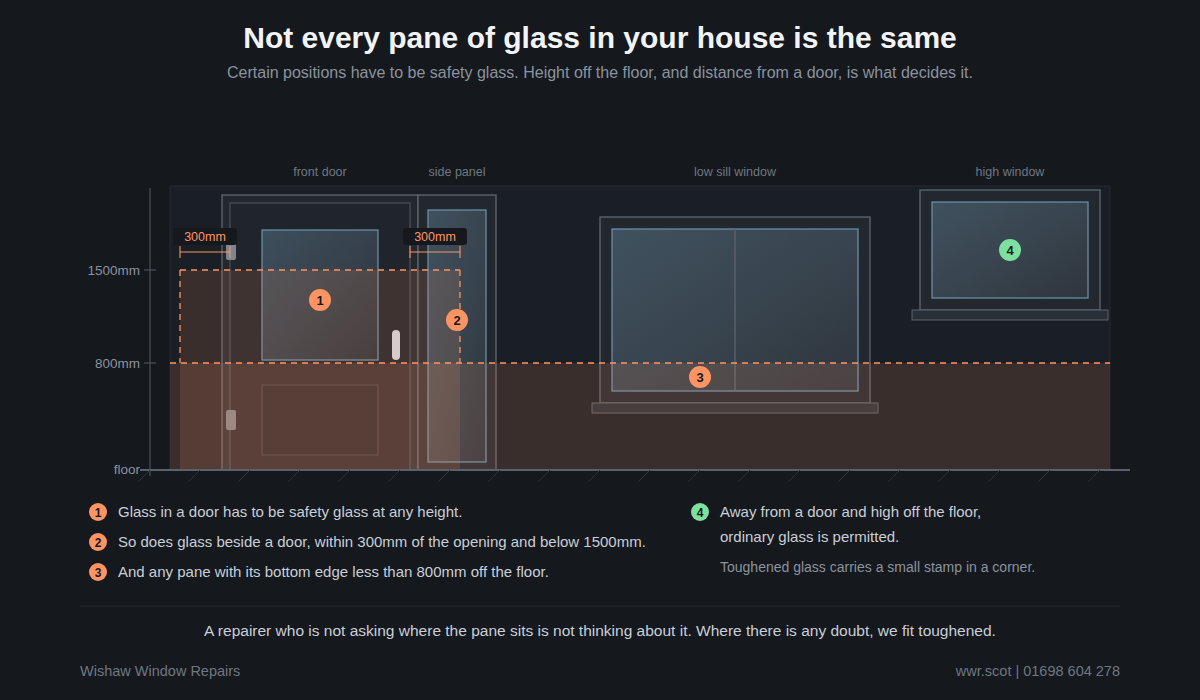
The building standards describe certain positions as critical locations, and glazing in them has to be safety glass. In plain terms there are three of them:
- Any glass in a door. Full height glazing, a small vision panel, a fanlight in the leaf, it doesn’t matter. Glass in a door leaf up to 1500mm from the floor is a critical location.
- Glass beside a door, within 300mm of the opening and below 1500mm from the floor. This is the side panel zone. The reasoning is that somebody stumbling through a doorway puts a hand or a shoulder out sideways, and the panel next to the door catches it.
- Any pane whose bottom edge sits below 800mm from the finished floor. This covers low level glazing generally, so full height windows, patio doors, glazing down to a low sill, and anything in a stairwell where people are moving past it.
Above 800mm on an ordinary window, safety glass isn’t required by the standards, although nothing stops you having it.
In Scotland this sits under the Scottish Building Standards rather than the English building regulations, and work needing approval goes through a building warrant with the council. FENSA doesn’t operate here at all, which catches people out who’ve read English advice online. Where an opening is borderline, and a fair few are, the council’s building standards department or a qualified installer will confirm what that position needs.
Where there’s any doubt about whether a pane is in a critical location, we fit toughened. It costs a little more than plain glass and it removes the question entirely.
The stamp in the corner tells you what you’ve already got
You can check what’s in your windows now without any tools. Look in one corner of the pane, usually a bottom corner, for a small sandblasted or etched mark. It’s deliberately faint so it doesn’t spoil the glass, and it’s easy to miss on a dirty window or behind a blind. Get up close, at an angle, with the light behind it, and on a sealed unit remember to check both panes.
The mark carries the maker and a standard number. Toughened glass carries the standard for thermally toughened soda lime safety glass, BS EN 12150. Laminated carries BS EN 14449. No mark in any corner and the odds are you’re looking at ordinary annealed glass, which is fine in an ordinary window and not fine in a door.
If you’re not sure what’s in yours
An unmarked pane in a front door side panel is the one we’d want to know about. It’s a common find in houses where a door was changed cheaply years ago, and it’s a small job to put right compared with what it costs if somebody goes through it.
Take a photo of the corner of the pane and the position of the window in the room, send it over on WhatsApp, and we’ll tell you what you’re looking at. Or ring 01698 604 278 and ask. There’s no call out charge for coming to look.
Whichever type you need, it is made to size and fitted into the existing frame as a sealed unit replacement.
Related advice
Not sure? Ask us, there is no charge for looking.
You will find around fifty more guides like this one in our advice section.
Written by the team at Wishaw Window Repairs. Over thirty years repairing uPVC windows and doors across Lanarkshire.