
Sometimes, yes. Usually it isn’t worth doing, and on a lot of modern windows it shouldn’t be attempted at all.
That’s the short version, and I’d rather give it to you at the top than string you along for six paragraphs. But the reasoning matters, because it decides which of your scratches is a five minute job and which one means a new pane.
Start with your fingernail
Before anything else, find out how deep it actually is.
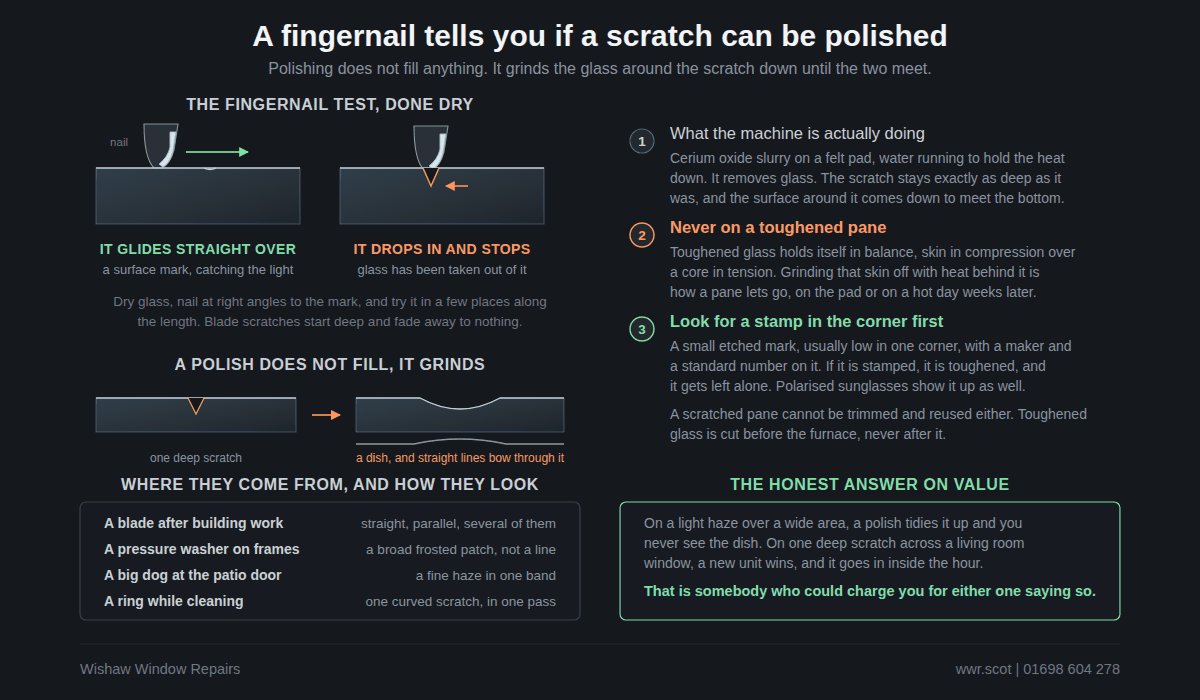
Run a fingernail across the scratch at right angles, lightly, with the glass dry. If your nail glides over it and you can barely tell it’s there by touch, it’s a surface mark. That’s a scratch in the top few microns of the glass, and it’s mostly catching the light rather than cutting into anything.
If your nail catches in it, drops in and stops, that’s a deep scratch. It has removed material. Nothing is going to fill that back in, and the only way to make it disappear is to take the surrounding glass down to the bottom of the groove.
Do the test in a few places along the length. Scratches from a blade often start deep where the pressure went on and fade out to nothing.
Check which face it’s on as well. If you can feel nothing on either side, look again, because you may be seeing a mark inside the sealed cavity, which is a different problem altogether.
What polishing actually does to the glass
Glass polishing is done with cerium oxide, a fine abrasive slurry worked over the mark with a felt or wool pad on a slow machine, with water running to keep the heat down.
Here is the thing people don’t get told. It is not a filler and it is not a coating. It removes glass. The scratch stays exactly as deep as it always was, and you grind the surface around it down until the two meet. To lose a scratch you have to remove a shallow dish of glass around it, wider than it is deep, blended out over several inches.
Glass is optically flat. That flatness is the whole reason you can see through it without the world going odd. Put a shallow dish in it and light passing through that area bends slightly differently to the light either side, and you get a lens. A very weak one, but you’ll see it. Look through the polished patch at a straight line outside, a fence, a window frame across the road, a lamp post, and the line will bow gently as it crosses. Move your head and it swims.
On a light haze of fine marks, spread over a wide area, polishing can genuinely tidy things up and you’ll never notice the distortion. On one deep scratch across the middle of a living room window, you trade a scratch you can see for a warp you can see, and half the people who pay for it end up less happy than before.
Why we won’t polish a toughened pane
Most glass in a modern window is toughened. Anything in a door, anything in a side panel, anything low down, and in practice a lot of ordinary windows besides, because it’s what suppliers now make as standard.
Toughened glass gets its strength from being heated and then cooled fast, which puts the outer skin into compression and the core into tension. That compressed skin is what stops cracks starting. The pane is a balanced system held in tension against itself.
Grinding into that skin is exactly what you don’t want to do to it. You’re removing the layer holding everything in check, and putting heat into a small spot while you do it. Toughened glass that lets go doesn’t crack, it fragments, all at once. That might happen on the pad or on a hot afternoon three weeks later.
There’s a simple check. Look at the corners of the pane through polarised sunglasses on a bright day, or hunt for a small etched stamp in one corner, usually bottom, giving the manufacturer and a standard number. If it’s stamped, it’s toughened, and you leave it alone.
How they get there in the first place
The commonest one by a mile is the tail end of a building job. Render, plaster splashes or paint speckle get onto the glass, someone attacks it with a scraper blade, and the grit that came with the render goes under the blade and gets dragged the length of the pane. New builds and extensions, both. The marks are dead straight and parallel and there are usually several.
After that:
A pressure washer used on the frames, throwing sand and grit at the glass, which frosts a broad area rather than cutting a line.
Dogs. Big dogs at patio doors, every day for years, claws at chest height. Usually a fine haze across a band rather than one scratch.
Rings and watches, from cleaning. A stone in a ring going round with a cloth will draw a curved scratch across a pane in one pass. Scourers and any cloth with grit trapped in it do the same.
The honest answer on value
You’ve got two routes. Pay for a specialist to spend an hour or two on a machine with an outcome that depends on how deep it went and might leave optical distortion behind. Or replace the sealed unit.
For most single scratches, the replacement wins. And that’s someone who could take money for either one telling you so.
Bear in mind a scratched pane can’t be salvaged and re-cut. Toughened glass is cut to size before it goes through the furnace, and afterwards it cannot be cut again. Score it and it goes to pieces on the spot. So there’s no trimming the scratched section off and using the rest. It’s a new made to measure unit, built to your sizes and your glass spec, swapped into the frame you already have in well under an hour.
Worth a photo first
Send us a picture with the light raking across the glass so the scratch shows, tell us roughly how long it is and whether your fingernail catches, and say if there’s a stamp in the corner of the pane. That’s enough for us to say whether a polish would sort it or whether it needs a new unit.
WhatsApp is quickest for photos, or ring 01698 604 278 and talk it through. We cover Wishaw, Motherwell and across Lanarkshire, and there’s no call out charge for coming to look.
Scratched glass aside, anything wrong with the frame, the hinges or the handle comes under our window repair service.
Related advice
See our glass unit replacement page for what we do and where. Our contact details are here.
Browse the rest of our window and door advice for around fifty guides on common window and door problems.
Written by the team at Wishaw Window Repairs. Over thirty years repairing uPVC windows and doors across Lanarkshire.