
Here’s a bit of a surprise for anybody who’s woken up to find their windows fogged over on the outside and assumed something has gone wrong.
Nothing has gone wrong. If anything, it means your windows are doing their job unusually well.
It’s the one glazing complaint where the honest answer is that there’s nothing to fix, so this is a short article. But it’s worth explaining properly, because we get calls about it every spring and autumn from people convinced they’ve got a fault.
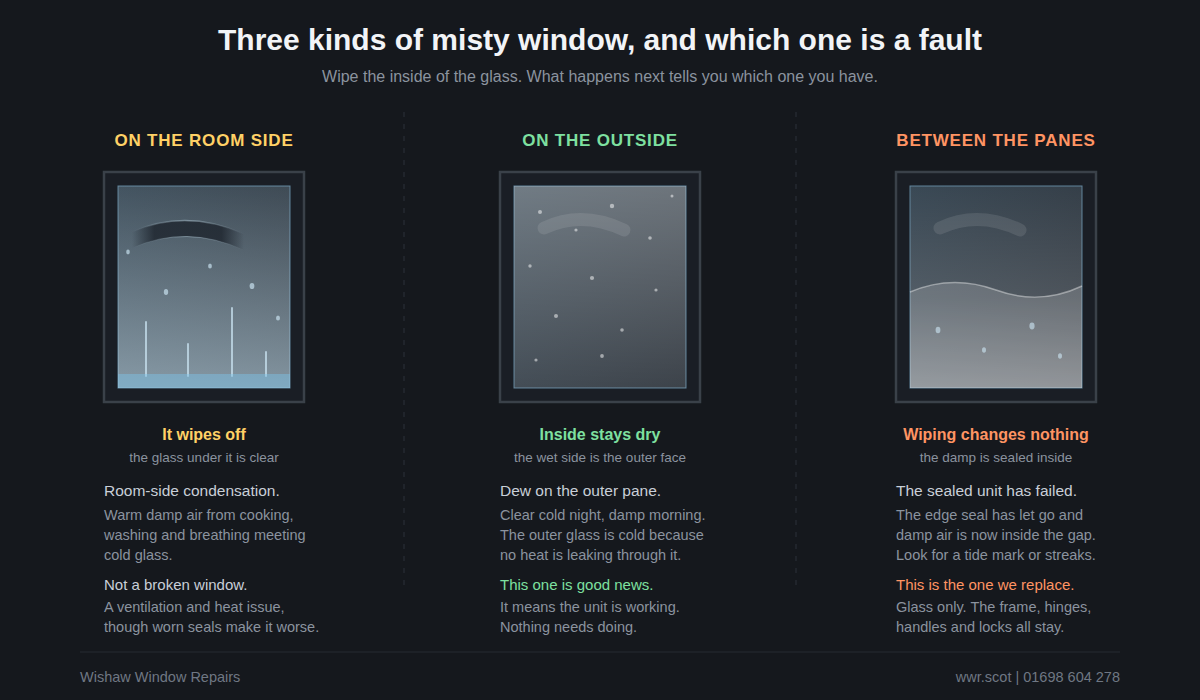
What you’re looking at
External condensation is dew. The same dew that lands on grass, cars and garden furniture overnight settles on the outside of your glass, and it forms for exactly the same reason.
On a clear, still night, surfaces facing the open sky lose heat by radiating it upwards. They can end up colder than the air around them. When moist air touches a surface that’s below its dew point, the moisture condenses out as water. Your car roof does it, your shed roof does it, and so does the outer pane of your window.
The conditions that bring it on are recognisable once you know them: a clear night with no cloud cover to hold heat in, still air, and high humidity. It shows up most in spring and autumn when nights are cold and days are mild, and it’s usually gone by mid-morning once the sun gets on the glass.
Why good windows get it more
This is the part that catches people out.
A modern double or triple glazed unit is designed to keep the heat inside your house. It has a low emissivity coating and an insulating gas filling that stop warmth escaping through the glass. That’s exactly what you want. The side effect is that no warmth reaches the outer pane either, so on a cold night the outer pane gets properly cold, cold enough for dew to form on it.
An old single glazed window, or a blown double glazed unit that’s lost its gas, leaks heat outwards constantly. That leaking heat keeps the outer surface warm enough that dew doesn’t form. So the window that stays clear on a dewy morning is the one wasting your money.
If you’ve had new windows fitted and noticed this starting, that’s why. It isn’t a defect, and it isn’t a sign the installer did something wrong. It’s the thermal performance you paid for, made visible.
You’ll often see it on some windows and not others in the same house. The ones that get it are usually facing open sky with nothing above them, no overhang, no tree, no porch roof, because they’re radiating heat straight up. A window tucked under a deep eave often stays clear all night.
The important distinction
Before you file this away as nothing to worry about, be sure the water is actually on the outside.
Go out and wipe the glass with your hand. If it clears, it’s external condensation and there’s nothing to do. If it doesn’t clear from outside, check inside. If it wipes away from the inside, that’s room-side condensation, which is about the moisture and ventilation in your house, and we’ve written about that separately.
And if the fog won’t wipe off from either side, that’s a different thing entirely: the seal on the double glazed unit has failed and the moisture is trapped between the panes. That one is a real fault, and it’s a repair rather than a replacement window. It also tends to be there all day rather than clearing by lunchtime, which is often the giveaway.
So: comes and goes with the weather and wipes off the outside, nothing to fix. Sits there permanently and won’t wipe off at all, give us a shout.
Can you reduce it?
A bit, though most people stop caring once they know what it is.
Trimming back planting and hedging close to the window helps, because dense greenery raises the humidity right against the glass. So does keeping the glass clean, since dirt and residue give moisture more to cling to. Anything that shelters the window from open sky, an overhang or a porch, reduces it, but nobody’s going to build a porch over it for this.
What won’t help is anything to do with the window itself, which is worth saying plainly. If someone tries to sell you a replacement window or a treatment to cure external condensation, they’re selling you a solution to something that isn’t a problem. There is no film, spray or upgrade that stops physics happening on the outside of your glass.
The short version
Water on the outside of your windows on a cold, clear morning means your glazing is insulating well and your heat is staying indoors. It’ll clear on its own. Leave it be.
If you’re not sure which sort of misting you’ve got, send us a photo on WhatsApp and we’ll tell you straight, including when the answer is that there’s nothing wrong. We’re a family-run repair firm covering Wishaw and Lanarkshire, no call-out charge, and you can reach us on 01698 604 278.
Outside condensation needs nothing done to it, but if you want the rest of the window checked over while we are passing, that is a window service.
Related advice
Ring 01698 604 278 or contact us here.
You will find around fifty more guides like this one in our advice section.
Written by the team at Wishaw Window Repairs. Over thirty years repairing uPVC windows and doors across Lanarkshire.